Results by title
22279 books match the query 'Social Science' and 4007 start with t
Two Twelfth-Century Texts on Chinese Painting
Robert J. Maeda, Translator
University of Michigan Press, 1970
Two Vatos Talk Pop Cultura
Latinx TV, Film, and Futures UnscriptedFrederick Luis Aldama and Peter Murrieta
University of Arizona Press, 2026
Two Vatos Talk Pop Cultura brings a leading Latinx media studies scholar, Frederick Luis Aldama, together with an award-winning television writer and producer, Peter Murrieta, to examine how Latinx representation has evolved—and stagnated—across seven decades of American TV, film, and pop culture.

Two Vermonts
Geography and Identity, 1865-1910Paul Searls
University of New Hampshire Press, 2006
Two Vermonts establishes a little-known fact about Vermont: that the state's fascination with tourism as a savior for a suffering economy is more than a century old, and that this interest in tourism has always been dogged by controversy. Through this lens, the book is poised to take its place as the standard work on Vermont in the Gilded Age and the Progressive Era. Searls examines the origins of Vermont's contemporary identity and some reasons why that identity ("Who is a Vermonter?") is to this day so hotly contested.
Searls divides nineteenth-century Vermonters into conceptually “uphill,” or rural/parochial, and “downhill,” or urban/cosmopolitan, elements. These two groups, he says, negotiated modernity in distinct and contrary ways. The dissonance between their opposing tactical approaches to progress and change belied the pastoral ideal that contemporary urban Americans had come to associate with the romantic notion of “Vermont.” Downhill Vermonters, espousing a vision of a mutually reinforcing relationship between tradition and progress, unilaterally endeavored to foster the pastoral ideal as a means of stimulating economic development. The hostile uphill resistance to this strategy engendered intense social conflict over issues including education, religion, and prohibition in the late nineteenth and early twentieth centuries. The story of Vermont's vigorous nineteenth-century quest for a unified identity bears witness to the stirring and convoluted forging of today's “Vermont.”
Searls's engaging exploration of this period of Vermont's history advances our understanding of the political, economic, and cultural transformation of all of rural America as industrial capitalism and modernity revolutionized the United States between 1865 and 1910. By the late Progressive Era, Vermont's reputation was rooted in the national yearning to keep society civil, personal, and meaningful in a world growing more informal, bureaucratic, and difficult to navigate. The fundamental ideological differences among Vermont communities are indicative of how elusive and frustrating efforts to balance progress and tradition were in the context of effectively negotiating capitalist transformation in contemporary America.

Two-Spirit People
Native American Gender Identity, Sexuality, and SpiritualityEdited by Sue-Ellen Jacobs; Wesley Thomas; and Sabine Lang
University of Illinois Press, 1997
1997 Winner of the Ruth Benedict Prize for an edited book given by the Society of Lesbian and Gay Anthropologists.
Two-Year College Writing Studies
Rationale and Praxis for Just TeachingDarin Jensen
Utah State University Press, 2023
Contributors draw on theories of identity, rhetorical third space, and linguistics to articulate a praxis of just teaching. They describe existing institutional challenges and opportunities that foster equity and offer cautionary tales of educational systems dismantled for short-term economic and political gains. Two-year college writing studies—when properly resourced—holds the potential to foster (or undermine) democratic ideals of civic literacy and uplift. Chapters in this volume offer case study examples of changes in departmental practices for reflection, interaction, and assessment that empower faculty to break free and engage directly with institutional, regional, state, and national constraints.
By making these resilient practices visible, Two-Year College Writing Studies amplifies the voices and validates the experiences of instructors engaging in this work. It will serve generalists, specialists, and academics interested in the subdiscipline of student success pedagogies and the political histories of two-year colleges and be useful for instructors new to the field, as professional development for veteran instructors, and as an introduction for graduate students entering two-year college writing studies programs.
Typology and Structure of Roman Historical Reliefs
Mario Torelli
University of Michigan Press, 1992
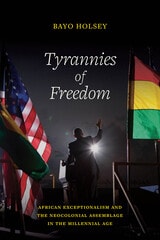
Tyrannies of Freedom
African Exceptionalism and the Neocolonial Assemblage in the Millennial AgeBayo Holsey
University of Chicago Press, 0
Examines the enduring myth of Ghanaian exceptionalism and neoliberal freedom.
What is the legacy of the African Revolution today? Black Studies scholar and anthropologist Bayo Holsey addresses this question by examining the twenty-first-century relationship between the United States and Ghana, a nation that was once associated with a powerful vision of Black freedom. In Tyrannies of Freedom, she demonstrates that the period that saw the expansion of the US counterterror state also witnessed attempts to discredit this vision of freedom and replace it with another—one that centers the agency of US politicians, media pundits, and development experts.
Analyzing international development discourses, the anti-trafficking regime’s representational economy, and the expansion of Ghana’s branding as a homeland of the African diaspora, Holsey interrogates the operation of a millennial neocolonial assemblage that asserts, in various ways, that the United States is the guarantor of Ghanaian freedom while simultaneously implementing policies of surveillance, endangerment, and exploitation. At the same time, Holsey shows how Ghanaians and other Black subjects have contested these projects. Tracking the transformation of the Ghanaian nation from a beacon of Black freedom and Pan-African possibility to a battleground over the meanings of African sovereignty in a post-9/11 world, this important book addresses pressing questions concerning the operation of US power in Africa and the production and legitimation of a racialized global hierarchy.