Results by title
1566 books match the query 'Christianity' and 410 start with t
Treatises on Noah and David
Brian P. St. Ambrose
Catholic University of America Press, 2020
These sermons by Ambrose of Milan (340–397 AD) provide a window into the preaching and scriptural exegesis of the legendary bishop, whose exposition of the Old Testament was instrumental in the conversion of Augustine of Hippo and in the development of Latin theology. In his treatise On Noah and his two Defenses for David, Ambrose borrows from influential Greek theologians, including Philo of Alexandria, Origen, and Didymus the Blind, while developing his own commentary on the exemplary patriarchs. Ambrose’s exegesis typifies both his attention to the letter of Scripture as well as his spiritual and allegorical reading of the holy figures or “saints” who lived before Christ.
The first treatise presents Noah as a model just man, as Ambrose pairs the literal and the higher or spiritual meaning of the Genesis flood narrative to address topics ranging from the Genesis narrative to Stoic ethics to the Incarnation. In his defense of David to the emperor Theodosius, Ambrose ties David’s sin and repentance to his own close reading of Psalm 51(50), David’s plea for himself in his famous “Miserere.” While the authenticity of the third treatise included in the volume, the Second Apology of David, has long been challenged, recent scholarship suggests that it transmits Ambrose’s own preaching, which applies the lessons of David’s life to the situation of gentile unbelievers, Jews, and the church; even if it is the work of a later imitator, the Second Apology is a compelling and systematic treatment of the David’s sin and repentance as relevant to Christian morality and doctrine.
The three treatises, previously unavailable in English translation, broaden our understanding of exegesis in the Latin West and our interpretation of Ambrose as preacher and exegete.
[more]
Trinitarian Ecclesiology
Charles Journet, the Divine Missions, and the Mystery of the ChurchJohn F. O'Neill
Catholic University of America Press, 2023
Venerable Fulton Sheen once famously said that “There are not one hundred people in the United States who hate the Catholic Church, but there are millions who hate what they wrongly perceive the Catholic Church to be – which is, of course, quite a different thing.” What is the true understanding of the mystery of the Church? In Lumen Gentium, the Church famously identifies herself as the sacrament of salvation, and various attempts have been made at developing an ecclesiology rooted in this idea. Another approach, nevertheless, prominent in the opening chapter of Lumen Gentium, is the relation of the Church to the Trinity in light of the divine missions, especially those of the Incarnation and Pentecost.
Trinitarian Ecclesiology is an example of this approach to the mystery of the Church that places the divine missions at the head and the heart of the work. The order of Journet's work is based on the four causes of the Church. Journet situates the treatise on the hierarchy in its proper place as belonging to the efficient cause of the Church in order to treat the more central mystery of the Church in her formal and material causes, namely the sanctifying gift of fully Christic charity and its visible manifestation.
While Journet’s magisterial work may already be identified as a Trinitarian Ecclesiology, recent research into the Trinitarian theology of St. Thomas Aquinas has deepened our understanding of his teaching, particularly in the way that creatures can relate to the divine persons in the divine missions. With a clearer understanding of the relation of creatures to the divine persons rooted in grace and its effects, a deeper vision of the mystery of the Church emerges, one that sees the Church as the visible mission of the Holy Spirit, inseparably joined with the visible mission of the Son in the Incarnation. The Great Mystery of Christ and the Church is the unity of the visible missions of the Son and the Spirit who have been sent into the world for our salvation.
[more]
Trinitarian Explorations in Systematic Theology
Unpacking Lonergan's Four-Point HypothesisNeil Ormerod
Catholic University of America Press, 2026
In his Latin theological textbook, Bernard Lonergan proposed a way of correlating the four trinitarian relations (paternity, filiation, active spiration and passive spiration) with four distinct participations in the divine nature vis. the Incarnation, the beatific vision, sanctifying grace and the habit of charity. This book uncovers the genetic origins of this hypothesis in Augustine and Aquinas, its significance in terms of the grace-nature debate, and the insights it provides to key Christian doctrines such as Christology, ecclesiology, the nature of holiness, and the beatific vision. The author engages with contemporary theological literature to demonstrate the explanatory power of Lonergan’s construct in relation to competing proposals.
Vatican I taught that the role of systematic theology is to understand divine mysteries through analogy and through the nexus between these mysteries. This work argues that Lonergan’s hypothesis perfectly fulfils the second of these tasks and thus provides a needed unification of the diverse topics that confront systematic theologians.
Each individual chapter has appeared in leading theological journals: Theological Studies, Irish Theological Quarterly and Louvain Studies. The chapters are ordered here not in terms of publication date, but in such a way as to guide the reader through a more synthetic grasp of the issues involved.
[more]
Truth and the Heretic
Crises of Knowledge in Medieval French LiteratureKaren Sullivan
University of Chicago Press, 2005
In the Middle Ages, the heretic, more than any other social or religious deviant, was experienced as an imaginary construct. Everyone believed heretics existed, but no one believed himself or herself to be a heretic, even if condemned as such by representatives of the Catholic Church. Those accused of heresy, meanwhile, maintained that they were the good Christians and their accusers were the false ones.
Exploring the figure of the heretic in Catholic writings of the twelfth and thirteenth centuries as well as the heretic's characterological counterpart in troubadour lyrics, Arthurian romance, and comic tales, Truth and the Heretic seeks to understand why French literature of the period celebrated the very characters who were so persecuted in society at large. Karen Sullivan proposes that such literature allowed medieval culture a means by which to express truths about heretics and the epistemological anxieties they aroused.
The first book-length study of the figure of the heretic in medieval French literature, Truth and the Heretic explores the relation between orthodoxy and deviance, authority and innovation, and will fascinate historians of ideas and literature as well as scholars of religion, critical theory, and philosophy.
[more]
Truth on Trial
The Rise and Fall of the Integrated Humanities Program at the University of KansasRobert K. Carlson
Catholic University of America Press, 2026
In this reprinting of Truth on Trial, Robert Carlson outlines the sad state of higher education in America, where “learning” is increasingly disconnected from the pursuit of truth, goodness, and beauty that has always been its most important heritage, replaced by an environment where any view that is not ‘politically correct’ is persecuted and disdained. Drawing upon his own experiences in the transformational Integrated Humanities Program (IHP) at the University of Kansas (KU), Carlson details the crisis that faces education today, and uses the lessons learned through that program’s meteoric rise (and eventual demise) to propose a solution to that same crisis.
Launching in the early 1970’s, the IHP was the “Great Books” brainchild of a trio of KU professors—Dennis Quinn, Franklyn Nelick, and John Senior—who understood that wonder is not only the beginning but also the sustaining principle of the best education, and who sought to offset the radical disintegration permeating Western culture in general and higher education in particular. Convinced that the fragmentation of such major cultural institutions as the family, the church, and the world of education was profoundly affecting students, these three teachers invited freshmen and sophomores at the public university to join their fledgling program, where they would study, hear, and discuss the classics of ancient and medieval literature, listen to their professors converse on “the greatest that has been thought and said,” memorize poems, stargaze, take courses in Latin and rhetoric, and much more.
The program’s growth was immediate and rapid—student enrollment increased from 20 in 1970 to 140 in 1971, and 186 in 1972—but its counter-cultural stance put it on fragile ground at KU, and within a year, it was under intense scrutiny, culminating in a public, quasi-judicial proceeding in which a dean-appointed committee sought to determine whether the IHP should continue to exist. Quinn, Nelick, and Senior, professors with a combined total of 90+ years in teaching, were now on trial at the university, not because they had taught poorly, but because they had taught too well. On January 20, 1979, the Advisory Committee charged with investigating the Program rendered its verdict, placing it under the administration of a new Humanities Committee, effectively annihilating the IHP.
While its initial trial felt like a defeat, God had other plans in store. Thankfully (and to paraphrase Twain’s famous words), the effects of the IHP’s death were greatly exaggerated. In the years since its untimely demise on the KU campus, its impact on the world of Catholic education has only grown stronger—the fruitfulness of its alumni and friends serving as the ultimate proof of its vision’s great worth. Since the program’s closing in 1979, it has inspired the founding of both Clear Creek Abbey and Wyoming Catholic College, as well as St. Gregory’s Academy in Pennsylvania (which eventually led to Gregory the Great Academy), and St. Martin’s Academy in Kansas. Perhaps most tellingly of all, its clear call to make wonder, beauty, and experience vital parts of any educational program has impacted countless homeschooling families, private and public school teachers, and educational programs in the subsequent years.
[more]
Trying Biology
The Scopes Trial, Textbooks, and the Antievolution Movement in American SchoolsAdam R. Shapiro
University of Chicago Press, 2013
In Trying Biology, Adam R. Shapiro convincingly dispels many conventional assumptions about the 1925 Scopes “monkey” trial. Most view it as an event driven primarily by a conflict between science and religion. Countering this, Shapiro shows the importance of timing: the Scopes trial occurred at a crucial moment in the history of biology textbook publishing, education reform in Tennessee, and progressive school reform across the country. He places the trial in this broad context—alongside American Protestant antievolution sentiment—and in doing so sheds new light on the trial and the historical relationship of science and religion in America.
For the first time we see how religious objections to evolution became a prevailing concern to the American textbook industry even before the Scopes trial began. Shapiro explores both the development of biology textbooks leading up to the trial and the ways in which the textbook industry created new books and presented them as “responses” to the trial. Today, the controversy continues over textbook warning labels, making Shapiro’s study—particularly as it plays out in one of America’s most famous trials—an original contribution to a timely discussion.
[more]
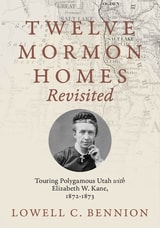
Twelve Mormon Homes Revisited
Touring Polygamous Utah with Elizabeth Kane, 1872-1873Lowell C. Bennion
University of Utah Press, 2024
In Twelve Mormon Homes: Visited in Succession on a Journey through Utah to Arizona, first published in 1874, Elizabeth Kane recorded impressions of what she heard and saw among the Mormon people in the twelve communities that hosted her and her family. Neither an apologist nor a convert, Kane maintained her anti-polygamy stance, even while gaining admiration for the women who had entered and endured what she considered an objectionable practice. In this new volume, Lowell C. Bennion immerses readers in the social and architectural worlds encountered by Kane. He provides descriptions of the people and customs of the plural families that hosted her and reconstructions of what the houses looked like at the time of the visit, particularly valuable to contemporary readers because all but two—the Hinckley house at Cove Creek Fort and the Dame house in Parowan—have long since been demolished. By retracing Elizabeth Kane's steps, readers will gain a new perspective on attitudes toward Mormon life in the nineteenth century.
[more]
Two Lives of Saint Colette
With a Selection of Letters by, to, and about ColettePierre de Vaux and Sister Perrine de Baume
Iter Press, 2022
Two accounts of the life of Saint Colette of Corbie.
Saint Colette of Corbie (1381–1447) was a French reformer of the Franciscan Order and the founder of seventeen convents. Though of humble origin, she attracted the support of powerful patrons and important Church officials. The two biographies translated here were authored by Pierre de Vaux, her confessor and mentor, and Perrine de Baume, a nun who for decades was Colette’s companion and confidant. Both accounts offer fascinating portraits of the saint as a pious ascetic assailed by demons and performing miracles, as well as in her role as skillful administrator and caring mother of her nuns. This is the first English translation of two biographies in Middle French of the most important female figures of the Middle Ages.
Saint Colette of Corbie (1381–1447) was a French reformer of the Franciscan Order and the founder of seventeen convents. Though of humble origin, she attracted the support of powerful patrons and important Church officials. The two biographies translated here were authored by Pierre de Vaux, her confessor and mentor, and Perrine de Baume, a nun who for decades was Colette’s companion and confidant. Both accounts offer fascinating portraits of the saint as a pious ascetic assailed by demons and performing miracles, as well as in her role as skillful administrator and caring mother of her nuns. This is the first English translation of two biographies in Middle French of the most important female figures of the Middle Ages.
[more]
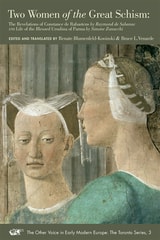
Two Women of the Great Schism
The Revelations of Constance de Rabastens by Raymond de Sabanac and Life of the Blessed Ursulina of Parma by Simone ZanacchiRaymond de Sabanac and Simone Zanacchi
Iter Press, 2010
The Great Schism (1378–1417) divided Western Christendom into two groups: those who recognized a pope in Rome and those who recognized one in Avignon. It was a crisis of authority that brought with it spiritual anxiety and political uproar. This book presents the responses of two fascinating women whose experiences demonstrate the impact of the Schism on ordinary Christians. Constance de Rabastens (active 1384–1386), who lived in a village in rural Languedoc, had dramatic visions indicting the Avignon pope Clement VII, despite his being recognized in her region. Ursulina of Parma (1375–1408), a diminutive young woman from an urban milieu in Italy, believed that she was commanded by Christ to engage in shuttle diplomacy between the Roman and Avignon papacies in order to end the Schism. Two Women of the Great Schism translates an account of Constance’s visionary experiences as recorded by her confessor Raymond de Sabanac and a posthumous biography of Ursulina by Simone Zanacchi, a pious abbot who wrote some sixty years after his subject’s death. These texts bring to life the extraordinary spiritual and political engagement of two late medieval women who refused to be passive bystanders as rival papal factions tore Christendom apart.
[more]
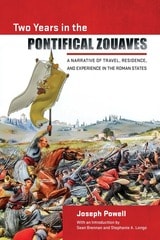
Two Years in the Pontifical Zouaves
A Narrative of Travel, Residence, and Experience in the Roman StatesJoseph Powell
Catholic University of America Press, 2026
Following the formation of the kingdom of Italy in 1860, the new Italian government, led by its King, Victor Emmanuel II, turned its attention to the city it intended to make its capital, the Eternal City, Caput Mundi, Rome. One major obstacle stood in their path, the Papal States, under the leadership of Pius IX and under the protection of French soldiers sent by Emperor Napoleon III. For the Italian nationalist leader Giuseppe Garibaldi, a ferocious anticlerical who had an uneasy alliance with the monarchial Italian government, the Papacy would no longer be allowed to hold back Italy's progress into the modern world. As French commitments to preserve the independence of the Vatican waned, it increasingly fell to one of the most remarkable military units in the history of modern Europe to protect the center of Western Christendom. This unit was the Papal Zouaves, soldiers and officers from all over the world drawn by their Catholic faith to fight on behalf of the Pope against an Italian government which was ruthless in enforcing its authority. They came from as near as Switzerland and Belgium and as far away as Canada and China. This is the memoir of one of the, and Englishmen named Joseph Powell. His story is a chronicle of one of the most tragic clashes of church and state, and how ancient institutions fought to protect their existence against the ruthless waves of modernity.
[more]