Results by title
8113 books match the query 'Literary Criticism' and 1818 start with t
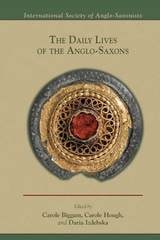
The Daily Lives of the Anglo-Saxons
Carole Biggam
Arizona Center for Medieval and Renaissance Studies, 2017
Insights into the lives of any group of historical people are provided by three main types of evidence: their language, their literature and their material culture. The contributors to this volume draw on all three types of evidence in order to present new research into the lives of the Anglo-Saxons. The particular focus is on daily life – the ordinary rather than the extraordinary, the normal rather than the exceptional. Rather than attempting an overview, the essays address individual scenarios in greater depth, but with an emphasis on shared experience.
The following scholars have contributed essays to this collection:
Martha Bayless
University of Oregon
Carole P. Biggam
University of Glasgow
Paul Cavill
University of Nottingham
Amy W. Clark
University of California, Berkeley
James Graham-Campbell
University College London
Antonina Harbus
Macquarie University, Sydney
Carole Hough
University of Glasgow
Daria Izdebska
Liverpool Hope University
Karen Louise Jolly
University of Hawai‘i at Mānoa
Alexandra Lester-Makin
University of Manchester
Elisabeth Okasha
University College, Cork
Phyllis Portnoy
University of Manitoba
Jane Roberts
University of London
The Dance of the Intellect
Studies in the Poetry of the Pound TraditionMarjorie Perloff
Northwestern University Press, 1996
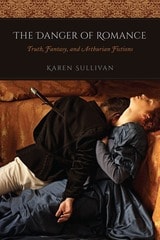
The Danger of Romance
Truth, Fantasy, and Arthurian FictionsKaren Sullivan
University of Chicago Press, 2018
Yet is it possible that romance is expressing a truth—and a truth unrecognized by realist genres? The Arthurian literature of the Middle Ages, Karen Sullivan argues, consistently ventriloquizes in its pages the criticisms that were being made of romance at the time, and implicitly defends itself against those criticisms. The Danger of Romance shows that the conviction that ordinary reality is the only reality is itself an assumption, and one that can blind those who hold it to the extraordinary phenomena that exist around them. It demonstrates that that which is rare, ephemeral, and inexplicable is no less real than that which is commonplace, long-lasting, and easily accounted for. If romance continues to appeal to audiences today, whether in its Arthurian prototype or in its more recent incarnations, it is because it confirms the perception—or even the hope—of a beauty and truth in the world that realist genres deny.
The Dangerous Lover
Gothic Villains, Byronism, and the Nineteenth-Century Seduction NarrativeDeborah Lutz
The Ohio State University Press, 2006
The dangerous lover has haunted our culture for over two hundred years; English, American, and European literature is permeated with his erotic presence. The Dangerous Lover takes seriously the ubiquity of the brooding romantic hero—his dark past, his remorseful and rebellious exile from comfortable everyday living. Deborah Lutz traces the recent history of this figure, through the melancholy iconoclasm of the Romantics, the lost soul redeemed by love of the Brontës, and the tormented individualism of twentieth-century love narratives. Arguing for this character’s central influence not only in literature but also in the history of ideas, this book places the dangerous lover firmly within the philosophy of Martin Heidegger, the Modernism of Georg Lukács, and Roland Barthes’s theories on love and longing. Working with canonical authors such as Ann Radcliffe, Charles Maturin, Lord Byron, Charles Dickens, George Eliot, and Oscar Wilde, and also with non-canonical texts such as contemporary romance, The Dangerous Lover combines a lyrical, essayistic style with a depth of inquiry that raises questions about the mysteries of desire, death, and eroticism.
The Dangerous Lover is the first book-length study of this pervasive literary hero; it also challenges the tendency of sophisticated philosophical readings of popular narratives and culture to focus on male-coded genres. In its conjunction of high and low literary forms, this volume explores new historical and cultural framings for female-coded popular narratives.
The Dark Thread
From Tragical Histories to Gothic TalesJohn D. Lyons
University of Delaware Press, 2011
Published by University of Delaware Press. Distributed worldwide by Rutgers University Press.
The Darker Side of Western Modernity
Global Futures, Decolonial OptionsWalter D. Mignolo
Duke University Press, 2011
The Darkness of the Present
Poetics, Anachronism, and the AnomalySteve McCaffery
University of Alabama Press, 2012
The Daughter as Reader
Encounters between Literature and LifePaula Marantz Cohen
University of Michigan Press, 1996
The Daughter's Dilemma
Family Process and the Nineteenth-Century Domestic NovelPaula Marantz Cohen
University of Michigan Press, 1993
The Daybreak Boys
Essays on the Literature of the Beat GenerationGregory Stephenson
Southern Illinois University Press, 1990
In these critical essays Gregory Stephenson takes the reader on a journey through the literature of the Beat Generation: a journey encompassing that common ethos of Beat literature—the passage from darkness to light, from fragmented being toward wholeness, from Beat to Beatific. He travels through Jack Kerouac’s Duluoz Legend,following Kerouac’s quests for identity, community, and spiritual knowledge. He examines Allen Ginsberg’s use of transcendence in “Howl,” discovers the Gnostic vision in William S. Burroughs’s fiction, and studies the mythic, visionary power of Lawrence Ferlinghetti’s poetry. Stephenson also provides detailed examinations of the writing of lesser-known Beat authors: John Clellon Holmes, Gregory Corso, Richard Fariña, and Michael McClure. He explores the myth and the mystery of the literary legend of Neal Cassady. The book concludes with a look at the common traits of the Beat writers—their use of primitivism, shamanism, myth and magic, spontaneity, and improvisation, all of which led them to a new idiom of consciousness and to the expansion of the parameters of American literature.
The Dead Ladies Project
Exiles, Expats, and Ex-CountriesJessa Crispin
University of Chicago Press, 2015
The Dead Ladies Project is an account of that journey—but it’s also much, much more. Fascinated by exile, Crispin travels an itinerary of key locations in its literary map, of places that have drawn writers who needed to break free from their origins and start afresh. As she reflects on William James struggling through despair in Berlin, Nora Barnacle dependant on and dependable for James Joyce in Trieste, Maud Gonne fomenting revolution and fostering myth in Dublin, or Igor Stravinsky starting over from nothing in Switzerland, Crispin interweaves biography, incisive literary analysis, and personal experience into a rich meditation on the complicated interactions of place, personality, and society that can make escape and reinvention such an attractive, even intoxicating proposition.
Personal and profane, funny and fervent, The Dead Ladies Project ranges from the nineteenth century to the present, from historical figures to brand-new hangovers, in search, ultimately, of an answer to a bedrock question: How does a person decide how to live their life?
The Death Penalty, Volume I
Jacques Derrida
University of Chicago Press, 2013
With his signature genius and patient yet dazzling readings of an impressive breadth of texts, Derrida examines everything from the Bible to Plato to Camus to Jean Genet, with special attention to Kant and post–World War II juridical texts, to draw the landscape of death penalty discourses. Keeping clearly in view the death rows and execution chambers of the United States, he shows how arguments surrounding cruel and unusual punishment depend on what he calls an “anesthesial logic,” which has also driven the development of death penalty technology from the French guillotine to lethal injection. Confronting a demand for philosophical rigor, he pursues provocative analyses of the shortcomings of abolitionist discourse. Above all, he argues that the death penalty and its attendant technologies are products of a desire to put an end to one of the most fundamental qualities of our finite existence: the radical uncertainty of when we will die.
Arriving at a critical juncture in history—especially in the United States, one of the last Christian-inspired democracies to resist abolition—The Death Penalty is both a timely response to an important ethical debate and a timeless addition to Derrida’s esteemed body of work.
The Death Penalty, Volume II
Jacques Derrida
University of Chicago Press, 2017
Of central importance in this second volume is Kant’s explicit justification of the death penalty in the Metaphysics of Morals. Thoroughly deconstructing Kant’s position—which holds the death penalty as exemplary of the eye-for-an-eye Talionic law—Derrida exposes numerous damning contradictions and exceptions. Keeping the current death penalty in the United States in view, he further explores the “anesthesial logic” he analyzed in volume one, addressing the themes of cruelty and pain through texts by Robespierre and Freud, reading Heidegger, and—in a fascinating, improvised final session—the nineteenth-century Spanish Catholic thinker Donoso Cortés. Ultimately, Derrida shows that the rationality of the death penalty as represented by Kant involves an imposition of knowledge and calculability on a fundamental condition of non-knowledge—that we don’t otherwise know what or when our deaths will be. In this way, the death penalty acts out a phantasm of mastery over one’s own death.
Derrida’s thoughts arrive at a particular moment in history: when the death penalty in the United States is the closest it has ever been to abolition, and yet when the arguments on all sides are as confused as ever. His powerful analysis will prove to be a paramount contribution to this debate as well as a lasting entry in his celebrated oeuvre.
The Death and Life of Drama
Reflections on Writing and Human NatureBy Lance Lee
University of Texas Press, 2005
What makes a film "work," so that audiences come away from the viewing experience refreshed and even transformed in the way they understand themselves and the world around them? In The Death and Life of Drama, veteran screenwriter and screenwriting teacher Lance Lee tackles this question in a series of personal essays that thoroughly analyze drama's role in our society, as well as the elements that structure all drama, from the plays of ancient Athens to today's most popular movies.
Using examples from well-known classical era and recent films, Lee investigates how writers handle dramatic elements such as time, emotion, morality, and character growth to demonstrate why some films work while others do not. He seeks to define precisely what "action" is and how the writer and the viewer understand dramatic reality. He looks at various kinds of time in drama, explores dramatic context from Athens to the present, and examines the concept of comedy. Lee also proposes a novel "five act" structure for drama that takes account of the characters' past and future outside the "beginning, middle, and end" of the story. Deftly balancing philosophical issues and practical concerns, The Death and Life of Drama offers a rich understanding of the principles of successful dramatic writing for screenwriters and indeed everyone who enjoys movies and wants to know why some films have such enduring appeal for so many people.
The Death of Things
Ephemera and the American NovelSarah Wasserman
University of Minnesota Press, 2020
A comprehensive study of ephemera in twentieth-century literature—and its relevance to the twenty-first century
“Nothing ever really disappears from the internet” has become a common warning of the digital age. But the twentieth century was filled with ephemera—items that were designed to disappear forever—and these objects played crucial roles in some of that century’s greatest works of literature. In The Death of Things, author Sarah Wasserman delivers the first comprehensive study addressing the role ephemera played in twentieth-century fiction and its relevance to contemporary digital culture.
Representing the experience of perpetual change and loss, ephemera was central to great works by major novelists like Don DeLillo, Ralph Ellison, and Marilynne Robinson. Following the lives and deaths of objects, Wasserman imagines new uses of urban space, new forms of visibility for marginalized groups, and new conceptions of the marginal itself. She also inquires into present-day conundrums: our fascination with the durable, our concerns with the digital, and our curiosity about what new fictional narratives have to say about deletion and preservation.
The Death of Things offers readers fascinating, original angles on how objects shape our world. Creating an alternate literary history of the twentieth century, Wasserman delivers an insightful and idiosyncratic journey through objects that were once vital but are now forgotten.
The Death-Bound-Subject
Richard Wright's Archaeology of DeathAbdul R. JanMohamed
Duke University Press, 2005
Drawing on psychoanalytic, Marxist, and phenomenological analyses, and on Orlando Patterson’s notion of social death, JanMohamed develops comprehensive, insightful, and original close readings of Wright’s major publications: his short-story collection Uncle Tom’s Children; his novels Native Son, The Outsider, Savage Holiday, and The Long Dream; and his autobiography Black Boy/American Hunger. The Death-Bound-Subject is a stunning reevaluation of the work of a major twentieth-century American writer, but it is also much more. In demonstrating how deeply the threat of death is involved in the formation of black subjectivity, JanMohamed develops a methodology for understanding the presence of the death-bound-subject in African American literature and culture from the earliest slave narratives forward.
The Deathly Pleasures of Form
Opera, Mimesis, AgencySarah Collins
University of Chicago Press, 0
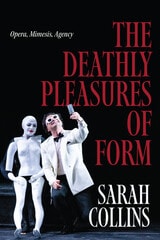
Opera offers a rich space in which to think about problems of mimesis—how artworks imitate ideal forms, how humans imitate the things around us, and how words attempt to represent reality.
In this book, musicologist and cultural historian Sarah Collins shows how the strange, exhilarating, and uniquely self-conscious art form of opera opens itself to such contemporary, theoretical questions. The Deathly Pleasures of Form is especially concerned with the links between linguistic and bodily signification in opera through the genre’s use of figures of partial agency—disembodied voices, enchanted objects, puppets, mechanical devices. The book is structured around four emblematic figures (Faust, Don Juan, Papageno, and Hoffmann) who are paired with four objects of variable animacy (puppet, stone, silhouette, and mirror, respectively). Across these chapters, Collins develops an expanded notion of mimesis that illuminates opera’s material and mechanical investments, its filmic and other adaptations, its explicit negotiation between vocal utterance and bodily gesture, and the epistemological significance of opera’s excesses. Ultimately, Collins claims that opera performs a type of compromised agency that can offer new critical insight into the self-limiting nature of both freedom and representation.
The Deaths of the Author
Reading and Writing in TimeJane Gallop
Duke University Press, 2011
The Decision Between Us
Art and Ethics in the Time of ScenesJohn Paul Ricco
University of Chicago Press, 2014
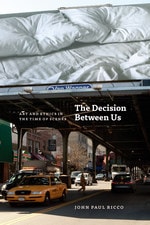
Laying out this theory of “unbecoming community” in modern and contemporary art, literature, and philosophy, and calling our attention to such things as blank sheets of paper, images of unmade beds, and the spaces around bodies, The Decision Between Us opens in 1953, when Robert Rauschenberg famously erased a drawing by Willem de Kooning, and Roland Barthes published Writing Degree Zero, then moves to 1980 and the “neutral mourning” of Barthes’ Camera Lucida, and ends in the early 1990s with installations by Felix Gonzalez-Torres. Offering surprising new considerations of these and other seminal works of art and theory by Jean Genet, Marguerite Duras, and Catherine Breillat, The Decision Between Us is a highly original and unusually imaginative exploration of the spaces between us, arousing and evoking an infinite and profound sense of sharing in scenes of passionate, erotic pleasure as well as deep loss and mourning.
The Decline of the Novel
Joseph Bottum
St. Augustine's Press, 2019
The novel has lost its purpose, Joseph Bottum argues in this fascinating new look at the history of fiction. We have not transcended our need for what novels provide, but we have grown to distrust the culture that allowed novels to flourish. “For almost three hundred years,” Bottum writes, “the novel was a major art form, perhaps the major art form, of the modern world—the device by which, more than any other, we tried to explain ourselves to ourselves.” But now we no longer “read novels the way we used to.”
In a historical tour de force—the kind of sweeping analysis almost lost to contemporary literary criticism—Bottum traces the emergence of the novel from the modern religious crisis of the individual soul and the atomized self. In chapters on such figures as Sir Walter Scott, Charles Dickens, and Thomas Mann, he examines the enormous ambitions once possessed by novels and finds in these older works a rebuke of our current failure of nerve.
“We walk with our heads down,” Bottum writes. “Without a sense of the old goals and reasons––a sense of the good achieved, understood as progress––all that remains are the crimes the culture committed in the past to get where it is now. uncompensated by achievement, unexplained by purpose, these unameliorated sins must now seem overwhelming: the very definition of a failed culture.” In readings of everything from genre fiction to children’s books, Bottum finds a lack of faith in the ability of art to respond to the deep problems of existence. “the decline of the novel’s prestige reflects and confirms a genuine cultural crisis,” he writes.
Linking the novel to its religious origins, Bottum describes the urgent search for meaning in the new conditions of the modern age: “If the natural world is imagined by modernity as empty of purpose, then the hunt for nature’s importance is supernatural, by definition.” the novel became a fundamental device by which culture pursued the supernatural—facilitated by modernity’s confidence in science and cultural progress. Losing that confidence, Bottum says, we lost the purpose of the art: “the novel didn’t fail us. We failed the novel.”
Told in fast-paced, wide-ranging prose, Bottum’s The Decline of the Novel is a succinct critique of classical and contemporary fiction, providing guidelines for navigating the vast genre. this book is a must-read for those who hunger for grand accounts of literature, students of literary form, critics of contemporary art, and general readers who wish to learn, finally, what we all used to know: the deep moral purpose of reading novels.
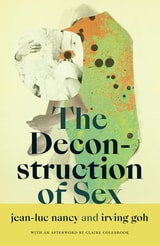
The Deconstruction of Sex
Jean-Luc Nancy and Irving Goh
Duke University Press, 2021

The Defective Detective in the Pulps
Edited by Gary Hoppenstand and Ray B. Browne
University of Wisconsin Press, 1983
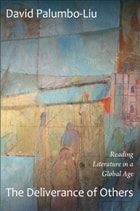
The Deliverance of Others
Reading Literature in a Global AgeDavid Palumbo-Liu
Duke University Press, 2012
The influential literary critic David Palumbo-Liu suggests that we can arrive at a sense of responsibility toward others by reconsidering the discourses of sameness that deliver those unlike ourselves to us. Through virtuoso readings of novels by J. M. Coetzee, Nadine Gordimer, Kazuo Ishiguro, and Ruth Ozeki, he shows how notions that would seem to offer some basis for commensurability between ourselves and others—ideas of rationality, the family, the body, and affect—become less stable as they try to accommodate more radical types of otherness. For Palumbo-Liu, the reading of literature is an ethical act, a way of thinking through our relations to others.
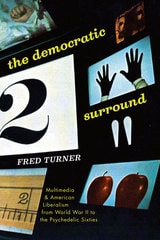
The Democratic Surround
Multimedia and American Liberalism from World War II to the Psychedelic SixtiesFred Turner
University of Chicago Press, 2013
In this prequel to his celebrated book From Counterculture to Cyberculture, Turner rewrites the history of postwar America, showing how in the 1940s and ’50s American liberalism offered a far more radical social vision than we now remember. Turner tracks the influential mid-century entwining of Bauhaus aesthetics with American social science and psychology. From the Museum of Modern Art in New York to the New Bauhaus in Chicago and Black Mountain College in North Carolina, Turner shows how some of the most well-known artists and intellectuals of the forties developed new models of media, new theories of interpersonal and international collaboration, and new visions of an open, tolerant, and democratic self in direct contrast to the repression and conformity associated with the fascist and communist movements. He then shows how their work shaped some of the most significant media events of the Cold War, including Edward Steichen’s Family of Man exhibition, the multimedia performances of John Cage, and, ultimately, the psychedelic Be-Ins of the sixties. Turner demonstrates that by the end of the 1950s this vision of the democratic self and the media built to promote it would actually become part of the mainstream, even shaping American propaganda efforts in Europe.
Overturning common misconceptions of these transformational years, The Democratic Surround shows just how much the artistic and social radicalism of the sixties owed to the liberal ideals of Cold War America, a democratic vision that still underlies our hopes for digital media today.
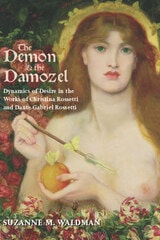
The Demon and the Damozel
Dynamics of Desire in the Works of Christina Rossetti and Dante Gabriel RossettiSuzanne M. Waldman
Ohio University Press, 2008

The Desert Is Alive
Aesthetic Cartographies and the SaharaJill Jarvis
University of Chicago Press, 0
How contemporary writers and filmmakers from across the African Sahara confront the colonial ideology of desert emptiness.
Jill Jarvis’s The Desert Is Alive challenges the image of the Sahara desert as a historical and cultural blank zone through a new “aesthetic cartography” that combines literary and film study with interdisciplinary thinking about space, borders, and infrastructures. In fields that still bear the imprint of a French colonial mindset, the Sahara has long been overlooked as a site of intellectual and cultural vitality. The Desert Is Alive breaks with a longstanding conceptual divide between “North” and “Subsaharan” Africa by resolutely centering the African Sahara and recognizing that the desert is not just full, but “peopled” in unexpected ways.
Jarvis accounts for colonial transformations of Saharan land during the twentieth century, attesting to the tactical and symbolic allure that this desert’s purported “emptiness” has held for French empire-building. Jarvis also considers how such tactics have been repurposed by postcolonial states. She takes up the last manuscript composed by Swiss writer Isabelle Eberhardt, who died in a flood at Aïn Sefra, Algeria in 1904, and examines the first novel published by French writer and aviator Antoine de Saint-Exupéry, composed while he worked as a pilot at Tarfaya, Morocco, in order to build the first trans-Saharan flight line during the 1920s. Jarvis then explores depictions of Timbuktu (Mali) and Nouadhibou (Mauretania) in films by Mauritanian-French director Abderrahmane Sissako. Jarvis concludes with chapters that unfold the unfinished history of French nuclear violence in the Sahara. First, she discusses multimedia and documentary works that reckon with the enduring impact of the seventeen nuclear bombs that France detonated in the Algerian desert in the 1960s. Finally, Jarvis turns to works by Tuareg poet and artist Hawad that confront the ongoing legacy of uranium mining on Indigenous land in northern Niger. The result is a rich contribution to Francophone cultural studies, African studies, postcolonial studies, and ecocriticism.
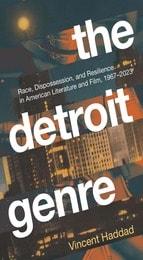
The Detroit Genre
Race, Dispossession, and Resilience in American Literature and Film, 1967-2023Vincent Haddad
Lever Press, 2024
The book first establishes the concept of the “Detroit genre” that emerged in late 1960s and traces the tropes of this white-centric narrative genre in popular culture, touching on key texts including Blue Collar, Robocop, The Crow, It Follows, and Barbarian. The second part shows how Black writers, including Alice Randall, adrienne maree brown, Stephen Mack Jones, and Angela Flournoy, reclaimed and revised the Detroit genre by un-fixing Detroit narratives of dispossession, criminality, and industrial and social failure through formal experimentations on genre itself.
Where Detroit has typically been painted in the news as one of three things—the center of the automotive industry; crime-ridden and in ruins; or as a “blank canvas” with limitless potential of entrepreneurship—Vincent Haddad shows that the Detroit genre in literature and film can be far more powerful than news media in narrating Black dispossession as a pragmatic, even liberal consensus. The texts studied here condition forgetfulness about Detroit’s history or expose it to a full reckoning, direct attention toward or away from the city’s agents of injustice, fetishize resilience or model resistance, and foreclose or imagine a future of Black liberation. Appealing to scholars of popular literature, media, race, and American studies, The Detroit Genre is an accessible and engaging study of the city’s influence on a wide array of genres in pop culture.
The Dialectics of Our America
Genealogy, Cultural Critique, and Literary HistoryJosé David Saldívar
Duke University Press, 1991
Saldívar pursues this goal through an array of oppositional critical and creative practices. He analyzes a range of North American writers of color (Rolando Hinojosa, Gloria Anzaldúa, Arturo Islas, Ntozake Shange, and others) and Latin American authors (José Martí, Roberto Fernández Retamar, Gabriel García Márquez, and others), whose work forms a radical critique of the dominant culture, its politics, and its restrictive modes of expression. By doing so, Saldívar opens the traditional American canon to a dialog with other voices, not just the voices of national minorities, but those of regional cultures different from the prevalent anglocentric model.
The Dialectics of Our America, in its project to expand the “canon” and define a pan-American literary tradition, will make a critical difference in ongoing attempts to reconceptualize American literary history.
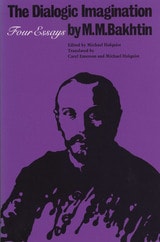
The Dialogic Imagination
Four EssaysBy M. M. Bakhtin
University of Texas Press, 1982
These essays reveal Mikhail Bakhtin (1895-1975)—known in the West largely through his studies of Rabelais and Dostoevsky—as a philosopher of language, a cultural historian, and a major theoretician of the novel. The Dialogic Imagination presents, in superb English translation, four selections from Voprosy literatury i estetiki (Problems of literature and esthetics), published in Moscow in 1975. The volume also contains a lengthy introduction to Bakhtin and his thought and a glossary of terminology.
Bakhtin uses the category "novel" in a highly idiosyncratic way, claiming for it vastly larger territory than has been traditionally accepted. For him, the novel is not so much a genre as it is a force, "novelness," which he discusses in "From the Prehistory of Novelistic Discourse." Two essays, "Epic and Novel" and "Forms of Time and of the Chronotope in the Novel," deal with literary history in Bakhtin's own unorthodox way. In the final essay, he discusses literature and language in general, which he sees as stratified, constantly changing systems of subgenres, dialects, and fragmented "languages" in battle with one another.
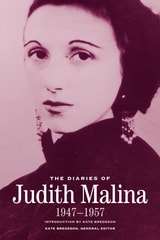
The Diaries of Judith Malina
1947-1957Judith Malina, Kate Bredeson
Northwestern University Press, 2026
Judith Malina’s newly restored diaries from a critical early decade in her personal, artistic, and political development
Judith Malina’s diaries from 1947 to 1957 are brought back into print in this volume, which charts her cofounding of The Living Theatre with husband and lifelong artistic partner Julian Beck. In these diaries, she narrates her developing political commitments and her expansive collaborations and personal relationships, as well as a moving account of her time in prison with activist Dorothy Day. This new edition features Kate Bredeson’s comprehensive introduction, which offers a detailed examination of Malina’s life and work in this period, along with additional historical context of these years and never-before-published photographs from Malina’s personal archives.
The Diaries of Judith Malina is a four-volume set that publishes for the first time together the edited diaries of radical theater director, actor, and activist Judith Malina from 1947 to 1971, the most influential period of her remarkable and storied career. A committed anarchist and pacifist, Malina made theater as a way to stoke revolutionary action. Her diaries showcase her political and social observations, cultural commentary, self-reflection, and wit. This expertly prepared set invites us to recognize Malina for her accomplishments not only as an artist and an activist but as one of the great literary diarists.
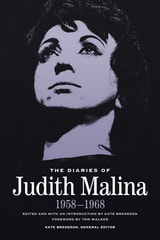
The Diaries of Judith Malina
1958-1968Judith Malina, Kate Bredeson, Tom Walker
Northwestern University Press, 2026
A previously unpublished volume of diaries recording Judith Malina’s extraordinary life and career in a moment of cultural revolution
Judith Malina’s diaries from the pivotal years of 1958 to 1968 are presented here in print for the first time. Meticulously edited and with an essential introduction by Kate Bredeson that offers a detailed discussion of Malina’s life and works during this period, the volume includes additional historical context and never-before-published photographs from Malina’s personal archives, as well as an illuminating foreword by Living Theatre archivist and longtime company member Tom Walker. This decade covers some of the most important years of Malina’s life and in the history of The Living Theatre, from career-defining productions of The Connection and The Brig to the company’s self-imposed European exile, when they created their signature works, including Paradise Now, Antigone, and Frankenstein.
The Diaries of Judith Malina is a four-volume set that publishes for the first time together the edited diaries of radical theater director, actor, and activist Judith Malina from 1947 to 1971, the most influential period of her remarkable and storied career. A committed anarchist and pacifist, Malina made theater as a way to engage in revolutionary action. Her diaries showcase her political and social observations, cultural commentary, self-reflection, and wit. This expertly prepared set invites us to recognize Malina for her accomplishments not only as an artist and an activist but as one of the great literary diarists.
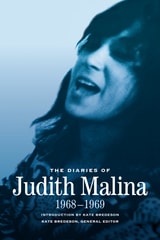
The Diaries of Judith Malina
1968-1969Judith Malina, Kate Bredeson
Northwestern University Press, 2026
A newly restored edition of Judith Malina’s legendary diaries narrating a key moment of social, political, and cultural upheaval
Originally published by Judith Malina as The Enormous Despair, this slim, gripping collection of diaries from a pivotal period between 1968 and 1969 follows The Living Theatre’s return to the United States after their years of self-exile in Europe, their increasing notoriety and frequent arrests, and their cross-country touring. In these pages, Malina wrestles with the company’s artistic and political efforts during a moment of societal crisis and grapples with their future. Kate Bredeson’s introduction contextualizes Malina’s life and work in this period, while additional historical context and never-before-published photographs add new detail and depth to a stirring account of American social and political history.
The Diaries of Judith Malina is a four-volume set that publishes for the first time together the edited diaries of radical theater director, actor, and activist Judith Malina from 1947 to 1971, the most influential period of her remarkable and storied career. A committed anarchist and pacifist, Malina made theater as a way to engage in revolutionary action. Her diaries showcase her political and social observations, her cultural commentary, her self-reflection, and her wit. This expertly prepared set invites us to recognize Malina for her accomplishments not only as an artist and an activist but as one of the great literary diarists.
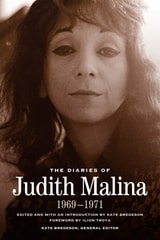
The Diaries of Judith Malina
1969-1971Judith Malina, Kate Bredeson, Ilion Troya
Northwestern University Press, 2026
Judith Malina’s never-before-published diaries describing a period of profound personal and professional transformation
The years 1969 to 1971 saw The Living Theatre’s greatest rupture, reckoning with its desire to leave its defining productions from the 1960s behind and move forward with new artistic works and practices. In these previously unpublished diaries, Judith Malina recounts these pivotal years, describing her transformative time in Brazil, including her experiences of daily life in jail while awaiting trial with her company members. This meticulously edited volume includes Kate Bredeson’s introduction, examining Malina’s life and work in this period, as well as additional historical context and never-before-published photographs. Living Theatre member Ilion Troya offers a foreword that provides new context for understanding the volume’s historical significance.
The Diaries of Judith Malina is a four-volume set that publishes for the first time together the edited diaries of radical theater director, actor, and activist Judith Malina from 1947 to 1971, the most influential period of her remarkable and storied career. A committed anarchist and pacifist, Malina made theater as a way to engage in revolutionary action. Her diaries showcase her political and social observations, cultural commentary, self-reflection, and wit. This expertly prepared set invites us to recognize Malina for her accomplishments not only as an artist and an activist but as one of the great literary diarists.
The Diaries of Nikolay Punin
1904-1953By Nikolay Punin
University of Texas Press, 1999
Nikolay Punin (1888-1953) was the most articulate Russian/Soviet art critic of the 1920s. He strongly advocated Constructivism, an avant-garde impulse that favored mechanomorphic abstraction and proclaimed a movement to bring art into the center of popular life. In the United States, he is perhaps best remembered for his love affair with Anna Akhmatova, one of the great poets of the twentieth century.
This volume presents the first English translation of ten diary notebooks that Punin wrote between 1915 and 1936, as well as selections from his earlier (1904-1910) and later (1941-1946) diaries and some thirty notes and letters relating to his affair with Anna Akhmatova. These materials offer a rare glimpse into the life of art and artists in Russia. They also present vivid scenes from the 1905 Revolution, World War I, the 1917 Revolutions, World War II, and Stalinist oppression through the reflections of a talented man, who, unlike many of his generation, lived to tell the tale.
The Dictator Novel
Writers and Politics in the Global SouthMagalí Armillas-Tiseyra
Northwestern University Press, 2019
The Dictator Novel positions novels about dictators as a vital genre in the literatures of the Global South. Primarily identified with Latin America, the dictator novel also has underacknowledged importance in the postcolonial literatures of francophone and anglophone Africa. Although scholars have noted similarities, this book is the first extensive comparative analysis of these traditions; it includes discussions of authors including Gabriel García Márquez, Ngũgĩ wa Thiong’o, Alejo Carpentier, Augusto Roa Bastos, Domingo Faustino Sarmiento, José Mármol, Esteban Echeverría, Ousmane Sembène , Chinua Achebe, Aminata Sow Fall, Henri Lopès, Sony Labou Tansi, and Ahmadou Kourouma. This juxtaposition illuminates the internal dynamics of the dictator novel as a literary genre. In so doing, Armillas-Tiseyra puts forward a comparative model relevant to scholars working across the Global South.
The Difference Aesthetics Makes
On the Humanities “After Man”Kandice Chuh
Duke University Press, 2019
The Difficulty of Being a Dog
Roger Grenier
University of Chicago Press, 2000
The Digitally Disposed
Racial Capitalism and the Informatics of ValueSeb Franklin
University of Minnesota Press, 2021
Locates the deep history of digitality in the development of racial capitalism
Seb Franklin sets out a media theory of racial capitalism to examine digitality’s racial-capitalist foundations. The Digitally Disposed shows how the promises of boundless connection, flexibility, and prosperity that are often associated with digital technologies are grounded in racialized histories of dispossession and exploitation. Reading archival and published material from the cybernetic sciences alongside nineteenth-century accounts of intellectual labor, twentieth-century sociometric experiments, and a range of literary and visual works, The Digitally Disposed locates the deep history of digitality in the development of racial capitalism.
Franklin makes the groundbreaking argument that capital’s apparently spontaneous synthesis of so-called free individuals into productive circuits represents an “informatics of value.” On the one hand, understanding value as an informatic relation helps to explain why capital was able to graft so seamlessly with digitality at a moment in which it required more granular and distributed control over labor—the moment that is often glossed as the age of logistics. On the other hand, because the informatics of value sort populations into positions of higher and lower capacity, value, and status, understanding their relationship to digitality requires that we see the digital as racialized and gendered in pervasive ways.
Ultimately, The Digitally Disposed questions the universalizing assumptions that are maintained, remade, and intensified by today’s dominant digital technologies. Vital and far-reaching, The Digitally Disposed reshapes such fundamental concepts as cybernetics, informatics, and digitality.
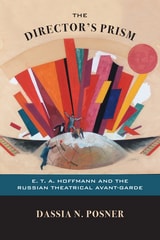
The Director's Prism
E. T. A. Hoffmann and the Russian Theatrical Avant-GardeDassia N. Posner
Northwestern University Press, 2016
Shortlist, 2019 Prague Quadrennial Best Scenography and Design Publication Award
The Director's Prism investigates how and why three of Russia's most innovative directors— Vsevolod Meyerhold, Alexander Tairov, and Sergei Eisenstein—used the fantastical tales of German Romantic writer E. T. A. Hoffmann to reinvent the rules of theatrical practice. Because the rise of the director and the Russian cult of Hoffmann closely coincided, Posner argues, many characteristics we associate with avant-garde theater—subjective perspective, breaking through the fourth wall, activating the spectator as a co-creator—become uniquely legible in the context of this engagement. Posner examines the artistic poetics of Meyerhold's grotesque, Tairov's mime-drama, and Eisenstein's theatrical attraction through production analyses, based on extensive archival research, that challenge the notion of theater as a mirror to life, instead viewing the director as a prism through whom life is refracted. A resource for scholars and practitioners alike, this groundbreaking study provides a fresh, provocative perspective on experimental theater, intercultural borrowings, and the nature of the creative process.

The Disappearance of God
FIVE NINETEENTH-CENTURY WRITERSJ. Hillis Miller
University of Illinois Press, 1963
interpreters of nineteenth-century England, The Disappearance of God confronts the consciousness of an absent (though perhaps still existent) God in the writings of Thomas De Quincey, Robert Browning, Emily Brontë, Matthew Arnold, and Gerard Manley Hopkins. J. Hillis Miller surveys the intellectual and material developments that conspired to cut man off from God--among other factors the city, developments within Christianity, subjectivism, and the emergence of the modern historical sense--and shows how each writer's body of work reflects a sustained response to the experience of God's disappearance.
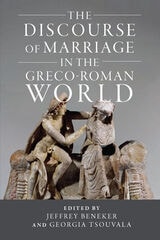
The Discourse of Marriage in the Greco-Roman World
Edited by Jeffrey Beneker and Georgia Tsouvala
University of Wisconsin Press, 2022
Through aesthetically informed and sensitive modes of analysis, these contributors examine a wealth of representations—including violence in weddings and spousal devotion after death. The Discourse of Marriage in the Greco-Roman World demonstrates the varying conceptions of an institution that was central to ancient social and political life—and remains prominent in the modern world. This volume will contribute to scholars' understanding of the era and fascinate anyone interested in historic depictions of marriage and the role and status of women in the late Hellenistic and early Imperial periods.
The Dismemberment of Orpheus
Toward a Postmodern LiteratureIhab Hassan
University of Wisconsin Press, 1982
In this book, the first edition of which was published in 1971 by Oxford University Press, Ihab Hassan takes Orphic dismemberment and regeneration as his metaphor for a radical crisis in art and language, culture and consciousness, which prefigures postmodern literature. The modern Orpheus, he writes, “sings on a lyre without strings.” Thus, his sensitive critique traces a hypothetical line from Sade through four modern authors—Hemingway, Kafka, Genet, and Beckett—to a literature still to come. But the line also breaks into two Interludes, one concerning ’Pataphysics, Dada, and Surrealism, and the other concerning Existentialism and Aliterature.
Combining literary history, brief biography, and critical analysis, Hassan surrounds these authors with a complement of avant-garde writers whose works also foreshadow the postmodern temper. These include Jarry, Apollinaire, Tzara, Breton, Sartre, Camus, Nathalie Sarraute, Robbe-Grillet, and in America, Cage, Salinger, Ginsberg, Barth, and Burroughs. Hassan takes account also of related contemporary developments in art, music, and philosophy, and of many works of literary theory and criticism.
For this new edition, Hassan has added a new preface and postface on the developing character of postmodernism, a concept which has gained currency since the first edition of this work, and which he himself has done much to theorize.
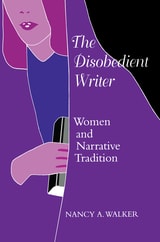
The Disobedient Writer
Women and Narrative TraditionBy Nancy A. Walker
University of Texas Press, 1995
For centuries, women who aspired to write had to enter a largely male literary tradition that offered few, if any, literary forms in which to express their perspectives on lived experience. Since the nineteenth century, however, women writers and readers have been producing "disobedient" counter-narratives that, while clearly making reference to the original texts, overturn their basic assumptions.
This book looks at both canonical and non-canonical works, over a variety of fiction and nonfiction genres, that offer counter-readings of familiar Western narratives. Nancy Walker begins by probing women's revisions of two narrative traditions pervasive in Western culture: the biblical story of Adam and Eve, and the traditional fairy tales that have served as paradigms of women's behavior and expectations. She goes on to examine the works of a wide range of writers, from contemporaries Marilynne Robinson, Ursula Le Guin, Anne Sexton, Fay Weldon, Angela Carter, and Margaret Atwood to precursors Caroline Kirkland, Fanny Fern, Mary De Morgan, Mary Louisa Molesworth, Edith Nesbit, and Evelyn Sharp.
The Dissenting Voice
The New Essay of Spanish America, 1960-1985By Martin S. Stabb
University of Texas Press, 1995
Political, social, and aesthetic change marked Latin American society in the years between 1960 and 1985. In this book, Martin Stabb explores how these changes made their way into the essayistic writings of twenty-six Spanish American intellectuals.
Stabb posits that dissent—against ideology, against simplistic notions of technological progress, against urban values, and even against the direct linear expository style of the essay itself—characterizes the work of these contemporary essayists. He draws his examples from major canonical figures, including Paz, Vargas Llosa, Fuentes, and Cortázar, and from lesser-known writers who merit a wider readership, such as Monterroso, Zaid, Edwards, and Ibargüengoitia. This exploration overturns many conventional assumptions about Latin American intellectuals and also highlights some of the other achievements of authors famous primarily for novels or short stories.
The Divided States
Unraveling National Identities in the Twenty-First CenturyEdited by Laura J. Beard and Ricia Anne Chansky
University of Wisconsin Press, 2023
Working across auto/biography studies, American studies, and human geography—all of which deal with the current interest in competing narratives, “alternative facts,” and accountability—the essays engage in and contribute to critical conversations in classrooms, scholarship, and the public sphere. The authors draw from a variety of fields, including anthropology; class analysis; critical race theory; diasporic, refugee, and immigration studies; disability studies; gender studies; graphic and comix studies; Indigenous studies; linguistics; literary studies; sociology; and visual culture. And the genres under scrutiny include diary, epistolary communication, digital narratives, graphic narratives, literary narratives, medical narratives, memoir, oral history, and testimony.
This fresh and theoretically engaged volume will be relevant to anyone interested in the multiplicity of voices that make up the US national narrative.
The Divided World
Human Rights and Its ViolenceRandall Williams
University of Minnesota Press, 2010
The Division of Literature
Or the University in DeconstructionPeggy Kamuf
University of Chicago Press, 1996
Kamuf begins by analyzing the complex history of literary study within the modern university, critically reading developments from the French Revolution through the nineteenth century and beyond in Europe. She then turns to one of the most troubling works in the American literary canon—Melville's The Confidence-Man—to show how academic literary history has avoided confronting the implications of works in which meaning is never solely confined within a past. By engaging a future readership to which it applies for credit, Kamuf argues, literature cannot serve as a stable object of study. It locates, rather, a site of "the university in deconstruction."
Ranging from disciplinary histories of literature to our current culture wars, Kamuf offers a fascinating critique of academic literary study.
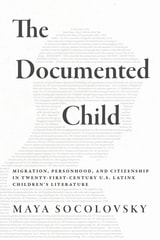
The Documented Child
Migration, Personhood, and Citizenship in Twenty-First-Century U.S. Latinx Children's LiteratureMaya Socolovsky
University of Arizona Press, 2025
Immigration is at once a personal, immediate, and urgent issue that plays a central role in the United States’ perception of itself. In The Documented Child, scholar Maya Socolovsky demonstrates how the portrayal of Latinx children has shifted over the first two decades of the twenty-first century in literary texts aimed at children and young adults and looks at how these shifts map onto broader changes in immigration policy and discourse.
Through a critical inquiry into picture books and middle-grade and young adult literature, Socolovsky argues that the literary documentations of—and for—U.S. Latinx children have shifted over the decades, from an emphasis on hybrid transnationalism to that of a more American-oriented self. Socolovsky delves into texts written from 1997 to 2020, a period marked by tremendous changes in U.S. immigration policies, amplified discourses around nationhood, and an increasingly militarized border. The author shows how children’s and young adult books have shifted their depictions of the border, personal and national identity, and sovereignty.
For students, scholars, and educators of Latinx studies and children’s literature, this work shows how the creators of children’s literature reflect new strategies for representing the undocumented Latinx child protagonist. While earlier books document the child as a transnational (sometimes global) subject, later books document her as both a transnational and U.S. national subject. The Documented Child explores this change as a necessary survival strategy, reflecting current awareness that cultural hybridity and transnational identity are not sufficient stand-ins for the stability and security of legal personhood.
The Doom of the Great City; Being the Narrative of a Survivor, Written A.D. 1942
William Delisle Hay
West Virginia University Press, 2025
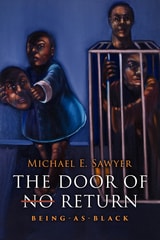
The Door of No Return
Being-As-BlackMichael E. Sawyer
Temple University Press, 2026
Using critical theory and philosophy, Sawyer decouples Black identity and Black philosophy from White and Western frames by building on Toni Morrison’s ideas of Black Thought and encouraging an understanding of Black Self-Consciousness and Black Self-Identity on Black terms. The Door of No Return uses music, literature, visual art, and a variety of physical disciplines to imagine a world that differs from one that confounds the positive formation of Black Self-Consciousness under the coercive regime of white supremacy and Anti-Black racism.