Results by title
4038 books match the query 'Social aspects' and 711 start with t
The Philosopher of Palo Alto
Mark Weiser, Xerox PARC, and the Original Internet of ThingsJohn Tinnell
University of Chicago Press, 2023
When developers and critics trace the roots of today’s Internet of Things—our smart gadgets and smart cities—they may single out the same creative source: Mark Weiser (1952–99), the first chief technology officer at Xerox PARC and the so-called “father of ubiquitous computing.” But Weiser, who died young at age 46 in 1999, would be heartbroken if he had lived to see the ways we use technology today. As John Tinnell shows in this thought-provoking narrative, Weiser was an outlier in Silicon Valley. A computer scientist whose first love was philosophy, he relished debates about the machine’s ultimate purpose. Good technology, Weiser argued, should not mine our experiences for saleable data or demand our attention; rather, it should quietly boost our intuition as we move through the world.
Informed by deep archival research and interviews with Weiser’s family and colleagues, The Philosopher of Palo Alto chronicles Weiser’s struggle to initiate a new era of computing. Working in the shadows of the dot-com boom, Weiser and his collaborators made Xerox PARC headquarters the site of a grand experiment. Throughout the building, they embedded software into all sorts of objects—coffeepots, pens, energy systems, ID badges—imbuing them with interactive features. Their push to integrate the digital and the physical soon caught on. Microsoft’s Bill Gates flagged Weiser’s Scientific American article “The Computer for the 21st Century” as a must-read. Yet, as more tech leaders warmed to his vision, Weiser grew alarmed about where they wished to take it.
In this fascinating story of an innovator and a big idea, Tinnell crafts a poignant and critical history of today’s Internet of Things. At the heart of the narrative is Weiser’s desire for deeper connection, which animated his life and inspired his notion of what technology at its best could be.

The Photographic Fix
Memory, Ideology, and the First World War in the Weimar RepublicJustin Court
University of Michigan Press, 2026
The Playing Fields of Eton
Equality and Excellence in Modern MeritocracyMika LaVaque-Manty
University of Michigan Press, 2009
"Beautifully written and brilliantly argued, The Playing Fields of Eton takes us on a three-century tour of modern mental and physical life. We visit gymnasiums and dueling fields, murderball courts and Olympic venues, and while immersed in thought-provoking stories of people wrestling with the twin pursuit of equality and excellence, we find ourselves learning what it might mean to be modern. With equal measures of erudition and gentle humor, Mika LaVaque-Manty convincingly refutes the view that egalitarian progress forecloses possibilities for human excellence."
---Elisabeth Ellis, Texas A&M University
"A very insightful and clearly written philosophical inquiry into the nature of sport."
---Marion Smiley, Brandeis University
"A marvelously original analysis of the tensions---and interdependence---between equality and excellence in modern political life. From eighteenth-century dueling to contemporary doping in sports, LaVaque-Manty illuminates the bodily life of democracy at play, and challenges us to think in new ways about the connections between achievement and autonomy. The Playing Fields of Eton is an important book that pushes liberal and democratic theory in fruitful new directions."
---Sharon Krause, Brown University
Can equality and excellence coexist? If we assert that no person stands above the rest, can we encourage and acknowledge athletic, artistic, and intellectual achievements? Perhaps equality should merely mean equality of opportunity. But then how can society reconcile inherent differences between men and women, the strong and the weak, the able-bodied and the disabled?
In The Playing Fields of Eton, Mika LaVaque-Manty addresses questions that have troubled philosophers, reformers, and thoughtful citizens for more than two centuries. Drawing upon examples from the eighteenth-century debate over dueling as a gentleman's prerogative to recent controversies over athletes' use of performance-enhancing drugs, LaVaque-Manty shows that societies have repeatedly redefined equality and excellence. One constant remains, however: sports provide an arena for working out tensions between these two ideals.
Just as in sports where athletes are sorted by age, sex, and professional status, in modern democratic society excellence has meaning only in the context of comparisons among individuals who are, theoretically, equals. LaVaque-Manty's argument will engage philosophers, and his inviting prose and use of familiar illustrations will welcome nonphilosophers to join the conversation.
Mika LaVaque-Manty is Associate Professor of Political Science at the University of Michigan.

The Poem Electric
Technology and the American LyricSeth Perlow
University of Minnesota Press, 2018
An enlightening examination of the relationship between poetry and the information technologies increasingly used to read and write it
Many poets and their readers believe poetry helps us escape straightforward, logical ways of thinking. But what happens when poems confront the extraordinarily rational information technologies that are everywhere in the academy, not to mention everyday life?
Examining a broad array of electronics—including the radio, telephone, tape recorder, Cold War–era computers, and modern-day web browsers—Seth Perlow considers how these technologies transform poems that we don’t normally consider “digital.” From fetishistic attachments to digital images of Emily Dickinson’s manuscripts to Jackson Mac Low’s appropriation of a huge book of random numbers originally used to design thermonuclear weapons, these investigations take Perlow through a revealingly eclectic array of work, offering both exciting new voices and reevaluations of poets we thought we knew.
With close readings of Gertrude Stein, Frank O’Hara, Amiri Baraka, and many others, The Poem Electric constructs a distinctive lineage of experimental writers, from the 1860s to today. Ultimately, Perlow mounts an important investigation into how electronic media allows us to distinguish poetic thought from rationalism. Posing a necessary challenge to the privilege of information in the digital humanities, The Poem Electric develops new ways of reading poetry, alongside and against the electronic equipment that is now ubiquitous in our world.

The Poetics of DNA
Judith Roof
University of Minnesota Press, 2007
How has DNA come to be seen as a cosmic truth, representative of all life, potential for all cures, repository for all identity, and end to all stories? In The Poetics of DNA, Judith Roof examines the rise of this powerful symbol and the implications of its ascendancy for the ways we think—about ourselves, about one another, and about the universe.
Descriptions of DNA, Roof argues, have distorted ideas and transformed nucleic acid into the answer to all questions of life. This hyperbolized notion of DNA, inevitably confused or conflated with the “gene,” has become a vector through which older ways of thinking can merge with the new, advancing long-discredited and insidious ideas about such things as eugenics and racial selection and influencing contemporary debates, particularly the popular press obsession with the “gay gene.” Through metaphors of DNA, she contends, racist and homophobic ideology is masked as progressive science.
Grappling with twentieth-century intellectual movements as well as contemporary societal anxieties, The Poetics of DNA reveals how descriptions of DNA and genes typify a larger set of epistemological battles that play out not only through the assumptions associated with DNA but also through less evident methods of magical thinking, reductionism, and pseudoscience.
For the first time, Roof exposes the ideology and cultural consequences of DNA and gene metaphors to uncover how, ultimately, they are paradigms used to recreate prejudices.
Judith Roof is professor of English and film studies at Michigan State University. She is the author of several books, including All about Thelma and Eve: Sidekicks and Third Wheels.
The Political Economy of Stigma
HIV, Memoir, Medicine, and Crip PositionalitiesAlly Day
The Ohio State University Press, 2021
In The Political Economy of Stigma, Ally Day offers a compelling critique of neoliberal medical practices in the US by coupling an analysis of HIV memoir with a critical examination of narrative medicine practice. Using insights from feminist disability studies and crip theory, Day argues that stories of illness and disability—such as HIV memoirs—operate within a political economy of stigma, which she defines as the formal and informal circulation of personal illness and disability narratives that benefits some while hindering others. On the one hand, this system decreases access to appropriate medical care for those with chronic conditions by producing narratives of personal illness that frame one’s relationship to structural inequality as a result of personal failure. On the other hand, the political economy of stigma rewards those who procure such narratives and circulate them for public consumption.
The political economy of stigma is theorized from three primary research sites: a reading group with women living with HIV, a reading group with AIDS service workers, and participant observation research and critical close reading of practices in narrative medicine. Ultimately, it is the women living with HIV who provide an alternative way to understand disability and illness narratives, a practice of differential reading that can challenge stigmatizing tropes and reconceptualize the creation, reception, and circulation of patient memoir.
The Political Force of Musical Beauty
Barry Shank
Duke University Press, 2014
The Political Mapping of Cyberspace
Jeremy W. Crampton
University of Chicago Press, 2003
Using concepts and methods derived from the work of Michel Foucault, Crampton outlines a new mapping of cyberspace to help define the role of space in virtual worlds and to provide constructive ways in which humans can exist in another spatial dimension. He delineates the critical role maps play in constructing the medium as an object of knowledge and demonstrates that by processes of mapping we come to understand cyberspace. Maps, he argues, shape political thinking about cyberspace, and he deploys in-depth case studies of crime mapping, security maintenance, and geo-surveillance to show how we map ourselves onto cyberspace, inexorably, and indelibly.
Offering a powerful reinterpretation of technology and contemporary life, this innovative book will be an essential touchstone for the study of cartography and cyberspace in the twenty-first century.
The Political Origins of Inequality
Why a More Equal World Is Better for Us AllSimon Reid-Henry
University of Chicago Press, 2015
The problem of inequality, Reid-Henry argues, is a problem that manifests between places as well as over time. This is one reason why it cannot be resolved by the usual arguments of left versus right, bound as they are to the national scale alone. Most of all, however, it is why the level of inequality that confronts us today is indicative of a more general crisis in political thought. Modern political discourse has no place for public reason or the common good. Equality is yesterday’s dream. Yet the fact that we now accept such a world—a world that values security over freedom, special treatment over universal opportunity, and efficiency over fairness—is ultimately because we have stopped even trying in recent decades to build the political architecture the world actually requires.
Our politics has fallen out of step with the world, then, and at the every moment it is needed more than ever. Yet it is within our power to address this. Doing so involves identifying and then meeting our political responsibilities to others, not just offering them the selective charity of the rich. It means looking beyond issues of economics and outside our national borders. But above all it demands of us that we reinvent the language of equality for a modern, global world: and then institute this. The world is not falling apart. Different worlds, we all can see, are colliding together. It is our capacity to act in concert that is falling apart. It is this that needs restoring most of all.
The Politics of Bitcoin
Software as Right-Wing ExtremismDavid Golumbia
University of Minnesota Press, 2016
Since its introduction in 2009, Bitcoin has been widely promoted as a digital currency that will revolutionize everything from online commerce to the nation-state. Yet supporters of Bitcoin and its blockchain technology subscribe to a form of cyberlibertarianism that depends to a surprising extent on far-right political thought. The Politics of Bitcoin exposes how much of the economic and political thought on which this cryptocurrency is based emerges from ideas that travel the gamut, from Milton Friedman, F.A. Hayek, and Ludwig von Mises to Federal Reserve conspiracy theorists.
Forerunners: Ideas First is a thought-in-process series of breakthrough digital publications. Written between fresh ideas and finished books, Forerunners draws on scholarly work initiated in notable blogs, social media, conference plenaries, journal articles, and the synergy of academic exchange. This is gray literature publishing: where intense thinking, change, and speculation take place in scholarship.
The Politics of Deafness
Owen Wrigley
Gallaudet University Press, 1997
The Politics of Deafness embarks upon a post-modern examination of the search for identity in deafness and its relationship to the prevalent hearing culture that has marginalized Deaf people. Author Owen Wrigley plainly states his intention to disrupt “normal” thought about the popularly considered condition of deafness as a physical deficiency. From his decade of experience working and living in the Deaf community in Thailand, he uses wide-ranging examples to go beyond disputing conventional theorists for their interpretation of deafness as the lack of a sensory function. By calling attention to the different lingual potential created by the instant visual expression of cyberspace, he explodes orthodox conceptualization of the nature of language as serially ordered and dependent upon sound.
In bold style, this provocative work poses the relationship of the bodies physical and mental of Deaf people as subject to a form of “colonialism” by the dominant Hearing culture. It proceeds to expose and attack presumptions and practices that derive from and descend upon deaf bodies. Related analysis also addresses tensions little noted in the current literature on deafness and on the popular move to reconstitute Deafness as a global culture.
Through displacement of logistical anchors, ironic stances, and disconcerting perspectives, The Politics of Deafness practices a form of de-naturalization to demand space within and between the normalizing frames of daily lives. By doing so, it offers an insightful and intriguing perspective on the meanings of Deafness, the politics of Deaf identity, and what it costs to be “unusual.”

The Politics of Fame
Burns, Eric
Rutgers University Press, 2019
In search of answers, cultural historian Eric Burns delves deep into the biographies of some of the most famous figures in American history, from Benjamin Franklin to Fanny Kemble, Elvis Presley to Gene Tierney, and Michael Jordan to Oprah Winfrey. Through these case studies, he considers the evolution of celebrity throughout the ages. More controversially, he questions the very status of fame in the twenty-first century, an era in which thousands of minor celebrities have seen their fifteen minutes in the spotlight.
The Politics of Fame is a provocative and entertaining look at the lives and afterlives of America’s most beloved celebrities as well as the mad devotion they inspired. It raises important questions about what celebrity worship reveals about the worshippers—and about the state of the nation itself
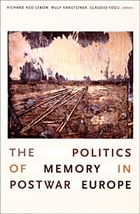
The Politics of Memory in Postwar Europe
Richard Ned Lebow, Wulf Kansteiner and Claudio Fogu, eds.
Duke University Press, 2006
An extensive introduction contains reflections on the significance of Europeans’ memories of World War II and a conclusion provides an analysis of the implications of the contributors’ findings for memory studies. These two pieces tease out some of the findings common to all seven countries: for instance, in each nation, the decade and a half between the late 1960s and the mid-1980s was the period of most profound change in the politics of memory. At the same time, the contributors demonstrate that Europeans understand World War II primarily through national frames of reference, which are surprisingly varied. Memories of the war have important ramifications for the democratization of Central and Eastern Europe and the consolidation of the European Union. This volume clarifies how those memories are formed and institutionalized.
Contributors. Claudio Fogu, Richard J. Golsan, Wulf Kansteiner, Richard Ned Lebow, Regula Ludi, Annamaria Orla-Bukowska, Heidemarie Uhl, Thomas C. Wolfe
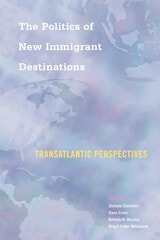
The Politics of New Immigrant Destinations
Transatlantic PerspectivesStefanie Chambers
Temple University Press, 2017
Migration to new destinations in Europe and the United States has expanded dramatically over the past few decades. Within these destinations, there is a corresponding greater variety of ethnic, cultural, and/or religious diversity. This timely volume, The Politics of New Immigrant Destinations, considers the challenges posed by this proliferation of diversity for governments, majority populations, and immigrants.
The contributors assess the effectiveness of the policy and political responses that have been spawned by increasing diversity in four types of new immigrant destinations: “intermediate” destination countries—Ireland and Italy; culturally distinct regions experiencing new migration such as Catalonia in Spain or the American South; new destinations within traditional destination countries like the state of Utah and rural towns in England; and “early migration cycle” countries including Latvia and Poland.
The Politics of New Immigrant Destinations examines how these new destinations for immigrants compare to traditional destinations, with respect to their policy responses and success at integrating immigrants, offering perspectives from both immigrants and natives.
Contributors include: Dace Akule, Amado Alarcón, Rhys Andrews, Francesca Campomori, Tiziana Caponio, Scott Decker, Erica Dobbs, Melissa M. Goldsmith, Aleksandra Grzymała-Kazłowska, Claudio A. Holzner, Magdalena Lesińska, Paul Lewis, Helen B. Marrow, Laura Morales, Katia Pilati, Marie Provine, Monica Varsanyi, and the editors.
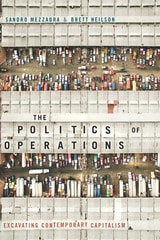
The Politics of Operations
Excavating Contemporary CapitalismSandro Mezzadra and Brett Neilson
Duke University Press, 2019
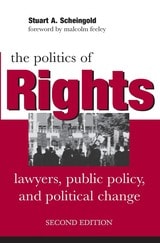
The Politics of Rights
Lawyers, Public Policy, and Political ChangeStuart A. Scheingold
University of Michigan Press, 2004
"Scheingold presents a clear, thoughtful discussion of the ways in which rights can both empower and constrain those seeking change in American society. While much of the writing on rights is abstract and obscure, The Politics of Rights stands out as an accessible and engaging discussion."
-Gerald N. Rosenberg, University of Chicago
"This book has already exerted an enormous influence on two generations of scholars. It has had an enormous influence on political scientists, sociologists, and anthropologists, as well as historians and legal scholars. With this new edition, this influence is likely to continue for still more generations. The Politics of Rights has, I believe, become an American classic."
-Malcolm Feeley, Boalt Hall School of Law, University of California, Berkeley, from the foreword
Stuart A. Scheingold is Professor Emeritus of Political Science at the University of Washington.

The Politics of School Reform, 1870 - 1940
Paul E. Peterson
University of Chicago Press, 1985
Drawing upon rarely examined archival data, Peterson demonstrates that widespread public backing for the common school existed in Atlanta, Chicago, and San Francisco. He finds little evidence of systematic discrimination against white immigrants, at least with respect to classroom crowding and teaching assignments. Instead, his research uncovers solid trade union and other working-class support for compulsory education, adequate school financing, and curricular modernization.
Urban reformers campaigned assiduously for fiscally sound, politically strong public schools. Often they had at least as much support from trade unionists as from business elites. In fact it was the business-backed machine politicians—from San Francisco's William Buckley to Chicago's Edward Kelly—who deprived the schools of funds. At a time when public schools are being subjected to searching criticism and when new educational ideas are gaining political support, The Politics of School Reform, 1870-1940 is a timely reminder of the strength and breadth of those groups that have always supported "free" public schools.
The Politics of Skin Tone
African American Experiences, Identity, and AttitudesNicole D. Yadon
University of Chicago Press, 2025
A nuanced examination of the salience of skin tone within African American politics.
Research shows that skin tone is associated with significant differences in life experiences. On average, African Americans with darker skin earn lower wages, suffer worse health outcomes, and endure more negative criminal justice experiences than lighter-skinned African Americans. Nicole D. Yadon conceptualizes skin tone as one facet of the multidimensional construct of race that powerfully influences racialized experiences which, in turn, can influence political identities and attitudes.
Drawing on evidence from one hundred in-depth interviews, multiple surveys, and a survey experiment, The Politics of Skin Tone investigates the political associations of skin tone. Yadon finds that skin tone correlates with political attitudes, particularly on issues where color-based disparities are especially pronounced such as criminal justice. Moreover, a sizable number of African Americans adopt a skin tone-based identity. In an era of shifting racial boundaries and growing color-based discrimination, The Politics of Skin Tone examines the implications for both scholars and policymakers.
The Politics of Value
Three Movements to Change How We Think about the EconomyJane L. Collins
University of Chicago Press, 2017
Each case shows how the concrete actions of a group of citizens can prompt us to reflect on what is needed for a just and sustainable economic system. In one case, activists raised questions about the responsibilities of business, in the second about the significance of local economies, and in the third about the contributions of the public sector. Through these movements, Jane L. Collins maps a set of cultural conversations about the types of investments and activities that contribute to the health of the economy. Compelling and persuasive, The Politics of Value offers a new framework for viewing economic value, one grounded in thoughtful assessment of the social division of labor and the relationship of the state and the market to civil society.
The Politics of Women's Education
Perspectives from Asia, Africa, and Latin AmericaJill Ker Conway and Susan C. Bourque, Editors
University of Michigan Press, 1995

The Politics of the Canoe
Bruce Erickson
University of Manitoba Press, 2021

The Portable Radio in American Life
Michael Brian Schiffer
University of Arizona Press, 1991
The Postal Age
The Emergence of Modern Communications in Nineteenth-Century AmericaDavid M. Henkin
University of Chicago Press, 2006
Americans commonly recognize television, e-mail, and instant messaging as agents of pervasive cultural change. But many of us may not realize that what we now call snail mail was once just as revolutionary. As David M. Henkin argues in The Postal Age, a burgeoning postal network initiated major cultural shifts during the nineteenth century, laying the foundation for the interconnectedness that now defines our ever-evolving world of telecommunications.
This fascinating history traces these shifts from their beginnings in the mid-1800s, when cheaper postage, mass literacy, and migration combined to make the long-established postal service a more integral and viable part of everyday life. With such dramatic events as the Civil War and the gold rush underscoring the importance and necessity of the post, a surprisingly broad range of Americans—male and female, black and white, native-born and immigrant—joined this postal network, regularly interacting with distant locales before the existence of telephones or even the widespread use of telegraphy. Drawing on original letters and diaries from the period, as well as public discussions of the expanding postal system, Henkin tells the story of how these Americans adjusted to a new world of long-distance correspondence, crowded post offices, junk mail, valentines, and dead letters.
The Postal Age paints a vibrant picture of a society where possibilities proliferated for the kinds of personal and impersonal communications that we often associate with more recent historical periods. In doing so, it significantly increases our understanding of both antebellum America and our own chapter in the history of communications.

The Postcolonial Science and Technology Studies Reader
Sandra Harding, ed.
Duke University Press, 2011
Contributors
Helen Appleton
Karen Bäckstrand
Lucille H. Brockway
Stephen B. Brush
Judith Carney
Committee on Women, Population, and the Environment
Arturo Escobar
Maria E. Fernandez
Ward H. Goodenough
Susantha Goonatilake
Sandra Harding
Steven J. Harris
Betsy Hartmann
Cori Hayden
Catherine L. M. Hill
John M. Hobson
Peter Mühlhäusler
Catherine A. Odora Hoppers
Consuelo Quiroz
Jenny Reardon
Ella Reitsma
Ziauddin Sardar
Daniel Sarewitz
Londa Schiebinger
Catherine V. Scott
Colin Scott
Mary Terrall
D. Michael Warren
The Postgenomic Condition
Ethics, Justice, and Knowledge after the GenomeJenny Reardon
University of Chicago Press, 2017
Drawing on more than a decade of research—in molecular biology labs, commercial startups, governmental agencies, and civic spaces—Reardon demonstrates how the extensive efforts to transform genomics from high tech informatics practiced by a few to meaningful knowledge beneficial to all exposed the limits of long-cherished liberal modes of knowing and governing life. Those in the American South challenged the value of being included in genomics when no hospital served their community. Ethicists and lawyers charged with overseeing Scottish DNA and data questioned how to develop a system of ownership for these resources when their capacity to create things of value—new personalized treatments—remained largely unrealized. Molecular biologists who pioneered genomics asked whether their practices of thinking could survive the deluge of data produced by the growing power of sequencing machines. While the media is filled with grand visions of precision medicine, The Postgenomic Condition shares these actual challenges of the scientists, entrepreneurs, policy makers, bioethicists, lawyers, and patient advocates who sought to leverage liberal democratic practices to render genomic data a new source of meaning and value for interpreting and caring for life. It brings into rich empirical focus the resulting hard on-the-ground questions about how to know and live on a depleted but data-rich, interconnected yet fractured planet, where technoscience garners significant resources, but deeper questions of knowledge and justice urgently demand attention.

The Posthuman Condition
Consciousness Beyond the BrainRobert Pepperell
Intellect Books, 2009
Synthetic creativity, organic computers, genetic modification, intelligent machines--such ideas are deeply challenging to many of our traditional assumptions about human uniqueness and superiority. But, ironically, it is our very capacity for technological invention that has secured us so dominant a position in the world which may lead ultimately to (as some have put it) 'The End of Man'. If we are really capable of creating entities that exceed our own skills and intellect then the consequences for humanity are almost inconceivable. Nevertheless, we must now face up to the possibility that attributes like intelligence and consciousness may be synthesised in non-human entities--perhaps within our lifetime. Would such entities have human-like emotions; would they have a sense of their own being?
The Posthuman Condition argues that such questions are difficult to tackle given the concepts of human existence that we have inherited from humanism, many of which can no longer be sustained. New theories about nature and the operation of the universe arising from sophisticated computer modelling are starting to demonstrate the profound interconnections between all things in reality where previously we had seen only separations. This has implications for traditional views of the human condition, consciousness, the way we look at art, and for some of the oldest problems in philosophy.
First published in the 1990s, this important text has been completely revised by the author with the addition of new sections and illustrations.
For further information see: www.post-human.net
The Power of the Steel-tipped Pen
Reconstructing Native Hawaiian Intellectual HistoryNoenoe K. Silva
Duke University Press, 2017

The Preacher's Tale
The Civil War Journal of Rev. Francis Springer, Chaplain, U.S. Army of the FrontierWilliam Furry
University of Arkansas Press, 2001
In the fall of 1861, fifty-one-year-old Rev. Francis Springer enlisted in the Union army. The following spring, Springer, a friend and one-time neighbor to Abraham Lincoln, rode away with the 10th Illinois Cavalry. A witness to the Battle of Prairie Grove (December 1862), Springer was later named post chaplain at Fort Smith, where, in additon to preaching and ministering to the troops, he was placed in charge of refugees—widows, orphans, and contrabands—the displaced victims of virulent guerrilla warfare in Northwest Arkansas. Springer also wrote articles and columns in the Fort Smith New Era under the pseudonym, “Thrifton.” Springer’s honest appraisals of life in the Army of the Frontier make for fascinating reading, and his unique perspective as moralist, educator, and journalist provide new insight into the Civil War and how it was fought in the West. The book includes several never-before published photographs and appendixes which feature accounts of six military executions that Springer participated in as a Union Army chaplain, the hitherto unpublished last letters home of two rebel soldiers condemned and executed at Fort Smith, as well as a eulogy for Abraham Lincoln.
The Preacher’s Tale includes several never before published photographs, and appendixes that contain accounts of six military executions that Springer participated in as a Union Army chaplain, the last letters home of two rebel soldiers condemned and executed at Fort Smith, as well as a eulogy written for Abraham Lincoln.

The Prescription-to-Prison Pipeline
The Medicalization and Criminalization of PainMichelle Smirnova
Duke University Press, 2023
The Price of Misfortune
Rights and Wrongs in Indebted AmericaDaniel Platt
University of Chicago Press, 2023
What can be taken from someone who has borrowed money and cannot repay? What do the victims of misfortune owe to their lenders, and what can they keep for themselves? The answers to those questions, immensely important for debtors, creditors, and society at large, have changed over time. The Price of Misfortune examines the cause of debtors’ rights in the modern United States and the struggles of reformers who fought to establish financial freedoms in law.
Daniel Platt shows how, in the wake of the Civil War, a range of advocates drew potent analogies between slavery, imprisonment for debt, and the experiences of wage garnishment and property foreclosure. He traces the ways those analogies were used to campaign for bold new protections for debtors, keeping them secure in their labor, property, and personhood. Yet, as Platt demonstrates, those reforms tended to assume as their ideal borrower someone who was white, propertied, and male. In subsequent decades, the emancipatory promise of debtors’ rights would be tested as women, wage earners, and African Americans seized on their language to challenge other structural inequalities: the dependency of marriage, the exploitation of industrial capitalism, and the oppression of Jim Crow. By reconstructing these forgotten developments—and recovering the experiences of indebted farmwives, sharecroppers, and wage workers—The Price of Misfortune narrates a new history of inequality, coercion, and law amid the early financialization of American capitalism.
The Price of Nice
How Good Intentions Maintain Educational InequityAngelina E. Castagno
University of Minnesota Press, 2019
How being “nice” in school and university settings works to reinforce racialized, gendered, and (dis)ability-related inequities in education and society
Being nice is difficult to critique. Niceness is almost always portrayed and felt as a positive quality. In schools, nice teachers are popular among students, parents, and administrators. And yet Niceness, as a distinct set of practices and discourses, is not actually good for individuals, institutions, or communities because of the way it maintains and reinforces educational inequity.
In The Price of Nice, an interdisciplinary group of scholars explores Niceness in educational spaces from elementary schools through higher education to highlight how this seemingly benign quality reinforces structural inequalities. Grounded in data, personal narrative, and theory, the chapters show that Niceness, as a raced, gendered, and classed set of behaviors, functions both as a shield to save educators from having to do the hard work of dismantling inequity and as a disciplining agent for those who attempt or even consider disrupting structures and ideologies of dominance.
Contributors: Sarah Abuwandi, Arizona State U; Colin Ben, U of Utah; Nicholas Bustamante, Arizona State U; Aidan/Amanda J. Charles, Northern Arizona U; Jeremiah Chin, Arizona State U; Sally Campbell Galman, U of Massachusetts; Frederick Gooding Jr., Texas Christian U; Deirdre Judge, Tufts U; Katie A. Lazdowski; Román Liera, U of Southern California; Sylvia Mac, U of La Verne; Lindsey Malcolm-Piqueux, California Institute of Technology; Giselle Martinez Negrette, U of Wisconsin–Madison; Amber Poleviyuma, Arizona State U; Alexus Richmond, Arizona State U; Frances J. Riemer, Northern Arizona U; Jessica Sierk, St. Lawrence U; Bailey B. Smolarek, U of Wisconsin–Madison; Jessica Solyom, Arizona State U; Megan Tom, Arizona State U; Sabina Vaught, U of Oklahoma; Cynthia Diana Villarreal, U of Southern California; Kristine T. Weatherston, Temple U; Joseph C. Wegwert, Northern Arizona U; Marguerite Anne Fillion Wilson, Binghamton U; Jia-Hui Stefanie Wong, Trinity College; Denise Gray Yull, Binghamton U.
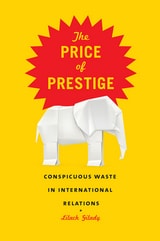
The Price of Prestige
Conspicuous Consumption in International RelationsLilach Gilady
University of Chicago Press, 2018
In The Price of Prestige, Gilady shows how many seemingly wasteful government expenditures that appear to contradict the laws of demand actually follow the pattern for what are known as Veblen goods, or positional goods for which demand increases alongside price, even when cheaper substitutes are readily available. From flashy space programs to costly weapons systems a country does not need and cannot maintain to foreign aid programs that offer little benefit to recipients, these conspicuous and strategically timed expenditures are intended to instill awe in the observer through their wasteful might. And underestimating the important social role of excess has serious policy implications. Increasing the cost of war, for example, may not always be an effective tool for preventing it, Gilady argues, nor does decreasing the cost of weapons and other technologies of war necessarily increase the potential for conflict, as shown by the case of a cheap fighter plane whose price tag drove consumers away. In today’s changing world, where there are high levels of uncertainty about the distribution of power, Gilady also offers a valuable way to predict which countries are most likely to be concerned about their position and therefore adopt costly, excessive policies.
The Price of Racial Reconciliation
Ronald W. Walters
University of Michigan Press, 2008
“In The Price of Racial Reconciliation, Ronald Walters offers an abundance of riches. This book provides an extraordinarily comprehensive and persuasive set of arguments for reparations, and will be the lens through which meaningful opportunities for reconciliation are viewed in the future. If this book does not lead to the success of the reparations movement, nothing will.”
—Charles J. Ogletree, Jesse Climenko Professor of Law, Harvard Law School
“The Price of Racial Reconciliation is a seminal study of comparative histories and race(ism) in the formation of state structures that prefigure(d) socioeconomic positions of Black peoples in South Africa and the United States. The scholarship is meticulous in brilliantly constructed analysis of the politics of memory, reparations as an immutable principle of justice, imperative for nonracial(ist) democracy, and a regime of racial reconciliation.”
—James Turner, Professor of African and African American Studies and Founder, Africana Studies and Research Center, Cornell University
“A fascinating and pathbreaking analysis of the attempt at racial reconciliation in South Africa which asks if that model is relevant to the contemporary American racial dilemma. An engaging multidisciplinary approach relevant to philosophy, sociology, history, and political science.”
—William Strickland, Associate Professor of Political Science, W.E.B. Du Bois Department of Afro-American Studies, University of Massachusetts Amherst
The issue of reparations in America provokes a lot of interest, but the public debate usually occurs at the level of historical accounting: “Who owes what for slavery?” This book attempts to get past that question to address racial restitution within the framework of larger societal interests. For example, the answer to the “why reparations?” question is more than the moral of payment for an injustice done in the past. Ronald Walters suggests that, insofar as the impact of slavery is still very much with us today and has been reinforced by forms of postslavery oppression, the objective of racial harmony will be disrupted unless it is recognized with the solemnity and amelioration it deserves. The author concludes that the grand narrative of black oppression in the United States—which contains the past and present summary of the black experience—prevents racial reconciliation as long as some substantial form of racial restitution is not seriously considered. This is “the price” of reconciliation.
The method for achieving this finding is grounded in comparative politics, where the analyses of institutions and political behaviors are standard approaches. The author presents the conceptual difficulties involved in the project of racial reconciliation by comparing South African Truth and Reconciliation and the demand for reparations in the United States.
Ronald Walters is Distinguished Leadership Scholar and Director, African American Leadership Program and Professor of Government and Politics, University of Maryland.
The Prison House of the Circuit
Politics of Control from Analog to DigitalJeremy Packer
University of Minnesota Press, 2023
Has society ceded its self-governance to technogovernance?
The Prison House of the Circuit presents a history of digital media using circuits and circuitry to understand how power operates in the contemporary era. Through the conceptual vocabulary of the circuit, it offers a provocative model for thinking about governance and media.
The authors, writing as a collective, provide a model for collective research and a genealogical framework that interrogates the rise of digital society through the lens of Foucault’s ideas of governance, circulation, and power. The book includes five in-depth case studies investigating the transition from analog media to electronic and digital forms: military telegraphy and human–machine incorporation, the establishment of national electronic biopolitical governance in World War I, media as the means of extending spatial and temporal policing, automobility as the mechanism uniting mobility and media, and visual augmentation from Middle Ages spectacles to digital heads-up displays. The Prison House of the Circuit ultimately demonstrates how contemporary media came to create frictionless circulation to maximize control, efficacy, and state power.

The Privilege of Being Banal
Art, Secularism, and Catholicism in ParisElayne Oliphant
University of Chicago Press, 2021
Exploring the violent histories and alternate trajectories effaced through this banal backgrounding of a crucial aspect of French history and culture, this richly textured ethnography lays bare the profound nostalgia that undergirds Catholicism’s circulation in nonreligious sites such as museums, corporate spaces, and political debates. Oliphant’s aim is to unravel the contradictions of religion and secularism and, in the process, show how aesthetics and politics come together in contemporary France to foster the kind of banality that Hannah Arendt warned against: the incapacity to take on another person’s experience of the world. A creative meditation on the power of the taken-for-granted, The Privilege of Being Banal is a landmark study of religion, aesthetics, and public space.
The Problem of the Color[blind]
Racial Transgression and the Politics of Black PerformanceBrandi Wilkins Catanese
University of Michigan Press, 2011
The Problem with Work
Feminism, Marxism, Antiwork Politics, and Postwork ImaginariesKathi Weeks
Duke University Press, 2011

The Product of Medicine
How Efficiency Made American Health CareCaitjan Gainty
Duke University Press, 2025
The Promise of Infrastructure
Nikhal Anand, Akhil Gupta, and Hannah Appel, editors
Duke University Press, 2018
A School for Advanced Research Advanced Seminar
Contributors. Nikhil Anand, Hannah Appel, Geoffrey C. Bowker, Dominic Boyer, Akhil Gupta, Penny Harvey, Brian Larkin, Christina Schwenkel, Antina von Schnitzler

The Protean Self
Human Resilience in an Age of FragmentationRobert Jay Lifton
University of Chicago Press, 1999
The Province of Affliction
Illness and the Making of Early New EnglandBen Mutschler
University of Chicago Press, 2020
The Public Image
Photography and Civic SpectatorshipRobert Hariman and John Louis Lucaites
University of Chicago Press, 2016
By confronting these conflicted reactions to photography, Robert Hariman and John Louis Lucaites make the case for a fundamental shift in understanding photography and public culture. In place of suspicions about the medium’s capacity for distraction, deception, and manipulation, they suggest how it can provide resources for democratic communication and thoughtful reflection about contemporary social problems.
The key to living well in the image world is to unlock photography from viewing habits that inhibit robust civic spectatorship. Through insightful interpretations of dozens of news images, The Public Image reveals how the artistry of the still image can inform, challenge, and guide reflection regarding endemic violence, environmental degradation, income inequity, and other chronic problems that will define the twenty-first century.
By shifting from conventional suspicions to a renewed encounter with the image, we are challenged to see more deeply on behalf of a richer life for all, and to acknowledge our obligations as spectators who are, crucially, also citizens.
The Public Infrastructure of Work and Play
Michael A. Pagano
University of Illinois Press, 2018
The latest volume in the Urban Agenda series looks at pressing infrastructure issues discussed at the 2017 UIC Urban Forum. Topics include: competing notions of the infrastructure ideal; what previous large infrastructure programs can teach the Trump Administration; how infrastructure influences city design; the architecture of the cities of tomorrow; who benefits from infrastructure improvements; and evaluations of projects like the Chicago Riverwalk and grassroots efforts to reclaim neighborhood parks from gangs.
Contributors: Philip Ashton, Beverly S. Bunch, Bill Burton, Charles Hoch, Sean Lally, and Sanjeev Vidyarthi

The Public Life of the Fetal Sonogram
Technology, Consumption, and the Politics of ReproductionTaylor, Janelle S
Rutgers University Press, 2008
This book offers much-needed critical awareness of the less easily recognized ways in which ultrasound technology is profoundly social and political in the United States today.

The Puzzle of Judicial Behavior
Lawrence Baum
University of Michigan Press, 1997

The Quality of Home Runs
The Passion, Politics, and Language of Cuban BaseballThomas F. Carter
Duke University Press, 2008
As an avid baseball fan, Carter draws on his experiences listening to and participating in discussions of baseball in Cuba (particularly in Havana) and among Cubans living abroad to describe how baseball provides the ground for negotiations of national, masculine, and class identities wherever Cubans gather. He considers the elaborate spectacle of Cuban baseball as well as the relationship between the socialist state and the enormously popular sport. Carter provides a detailed history of baseball in Cuba, analyzing players, policies, rivalries, and fans, and he describes how the sport has forged connections (or reinforced divisions) between Cuba and other nations. Drawing on insights from cultural studies, political theory, and anthropology, he maintains that sport and other forms of play should be taken seriously as crucibles of social and cultural experience.

The Queen of America Goes to Washington City
Essays on Sex and CitizenshipLauren Berlant
Duke University Press, 1997
As Berlant traces the guiding images of U.S. citizenship through the process of privatization, she discusses the ideas of intimacy that have come to define national culture. From the fantasy of the American dream to the lessons of Forrest Gump, Lisa Simpson to Queer Nation, the reactionary culture of imperilled privilege to the testimony of Anita Hill, Berlant charts the landscape of American politics and culture. She examines the consequences of a shrinking and privatized concept of citizenship on increasing class, racial, sexual, and gender animosity and explores the contradictions of a conservative politics that maintains the sacredness of privacy, the virtue of the free market, and the immorality of state overregulation—except when it comes to issues of intimacy.
Drawing on literature, the law, and popular media, The Queen of America Goes to Washington City is a stunning and major statement about the nation and its citizens in an age of mass mediation. As it opens a critical space for new theory of agency, its narratives and gallery of images will challenge readers to rethink what it means to be American and to seek salvation in its promise.

The Queer Fantasies of the American Family Sitcom
Pugh, Tison
Rutgers University Press, 2018
The Queer Fantasies of the American Family Sitcom examines the evasive depictions of sexuality in domestic and family-friendly sitcoms. Tison Pugh charts the history of increasing sexual depiction in this genre while also unpacking how sitcoms use sexuality as a source of power, as a kind of camouflage, and as a foundation for family building. The book examines how queerness, at first latent, became a vibrant yet continually conflicted part of the family-sitcom tradition.
Taking into account elements such as the casting of child actors, the use of and experimentation with plot traditions, the contradictory interpretive valences of comedy, and the subtle subversions of moral standards by writers and directors, Pugh points out how innocence and sexuality conflict on television. As older sitcoms often sit on a pedestal of nostalgia as representative of the Golden Age of the American Family, television history reveals a deeper, queerer vision of family bonds.
Download open access ebook here.
The Queer Games Avant-Garde
How LGBTQ Game Makers Are Reimagining the Medium of Video GamesBonnie Ruberg
Duke University Press, 2020
Interviewees:
Ryan Rose Aceae, Avery Alder, Jimmy Andrews, Santo Aveiro-Ojeda, Aevee Bee, Tonia B******, Mattie Brice, Nicky Case, Naomi Clark, Mo Cohen, Heather Flowers, Nina Freeman, Jerome Hagen, Kat Jones, Jess Marcotte, Andi McClure, Llaura McGee, Seanna Musgrave, Liz Ryerson, Elizabeth Sampat, Loren Schmidt, Sarah Schoemann, Dietrich Squinkifer, Kara Stone, Emilia Yang, Robert Yang
The Quest for Authority and Honor in the American Professions, 1750-1900
Samuel Haber
University of Chicago Press, 1991
Contrary to those who regard the professions as exemplary and up-to-date specimens of social modernization or economic monopoly, Haber argues that they bring both preindustrial and predemocratic ideals and standards into our modern world. He proposes that the values embedded in the professions—authority and honor, fused with duty and responsibility—have their origins in the class position and occupational prescriptions of eighteenth-century English gentlemen. Such an argument has implications for the understanding of American society; it underscores the cumulative and variegated nature of our culture and suggests the drawbacks of trying to describe society as a system. It also accords with Haber's endeavor to write a history that rescues for description and analysis mixed motives, composite conditions, and persons and parties acting upon contradictory explanatory schemes.
Haber traces the cultural evolution of the professions through three stages—establishment (1750-1830), disestablishment (1830-1880), and reestablishment (1880-1900). He shows that when the gentlemanly class declined in the United States, the professions maintained status even in somewhat hostile settings. The professions thus came to be seen as a middle way between the pursuits of laborers and those of capitalists. Massive in scale and ambition, this book will have a formidable impact among scholars newly attuned to the history of American middle-class culture.