Results by title
28250 books match the query 'history' and 6388 start with t
The St. Louis Baseball Reader
Richard Peterson
University of Missouri Press, 2022
The St. Louis Veiled Prophet Celebration
Power on Parade, 1877-1995Thomas M. Spencer
University of Missouri Press, 2021
The Veiled Prophet organization has been a vital institution in St. Louis for more than a century. Founded in March 1878 by a group of prominent St. Louis businessmen, the organization was fashioned after the New Orleans Carnival society the Mystick Krewe of Comus. In The St. Louis Veiled Prophet Celebration, Thomas Spencer explores the social and cultural functions of the organization's annual celebration—the Veiled Prophet parade and ball—and traces the shifts that occurred over the years in its cultural meaning and importance. Although scholars have researched the more pluralistic parades of the eighteenth and early nineteenth centuries, very little has been done to examine the elite-dominated parades of the late nineteenth and twentieth centuries. This study shows how pluralistic parades ceased to exist in St. Louis and why the upper echelon felt it was so important to end them.
Spencer shows that the celebration originated as the business elite's response to the St. Louis general strike of 1877. Symbolically gaining control of the streets, the elites presented St. Louis history and American history by tracing the triumphs of great men—men who happened to be the Veiled Prophet members' ancestors. The parade, therefore, was intended to awe the masses toward passivity with its symbolic show of power. The members believed that they were helping to boost St. Louis economically and culturally by enticing visitors from the surrounding communities. They also felt that the parades provided the spectators with advice on morals and social issues and distracted them from less desirable behavior like drinking and carousing.
From 1900 to 1965 the celebration continued to include educational and historical elements; thereafter, it began to resemble the commercialized leisure that was increasingly becoming a part of everyday life. The biggest change occurred in the period from 1965 to 1980, when the protests of civil rights groups led many St. Louisans to view the parade and ball as wasteful conspicuous consumption that was often subsidized with taxpayers' money. With membership dropping and the news media giving the organization little notice, it soon began to wither. In response, the leaders of the Veiled Prophet organization decided to have a "VP Fair" over the Fourth of July weekend. The 1990s brought even more changes, and the members began to view the celebration as a way to unite the St. Louis community, with all of its diversity, rather than as a chance to boost the city or teach cultural values. The St. Louis Veiled Prophet Celebration is a valuable addition not only to the cultural history of Missouri and St. Louis but also to recent scholarship on urban culture, city politics, and the history of public celebrations in America.
The Staff of Oedipus
Transforming Disability in Ancient GreeceMartha L. Rose
University of Michigan Press, 2013
Ancient Greek images of disability permeate the Western consciousness: Homer, Teiresias, and Oedipus immediately come to mind. But The Staff of Oedipus looks at disability in the ancient world through the lens of disability studies, and reveals that our interpretations of disability in the ancient world are often skewed. These false assumptions in turn lend weight to modern-day discriminatory attitudes toward disability.
Martha L. Rose considers a range of disabilities and the narratives surrounding them. She examines not only ancient literature, but also papyrus, skeletal material, inscriptions, sculpture, and painting, and draws upon modern work, including autobiographies of people with disabilities, medical research, and theoretical work in disability studies. Her study uncovers the realities of daily life for people with disabilities in ancient Greece and challenges the translation of the term adunatos (unable) as "disabled," with all its modern associations.
The Stages of Memory
Reflections on Memorial Art, Loss, and the Spaces BetweenJames E. Young
University of Massachusetts Press, 2016
Winner of the 2017 National Council on Public History Book Award
From around the world, whether for New York City's 9/11 Memorial, at exhibits devoted to the arts of Holocaust memory, or throughout Norway's memorial process for the murders at Utøya, James E. Young has been called on to help guide the grief stricken and survivors in how to mark their losses. This poignant, beautifully written collection of essays offers personal and professional considerations of what Young calls the “stages of memory,” acts of commemoration that include spontaneous memorials of flowers and candles as well as permanent structures integrated into sites of tragedy. As he traces an arc of memorial forms that spans continents and decades, Young returns to the questions that preoccupy survivors, architects, artists, and writers: How to articulate a void without filling it in? How to formalize irreparable loss without seeming to repair it?
Richly illustrated, the volume is essential reading for those engaged in the processes of public memory and commemoration and for readers concerned about how we remember terrible losses.
The Standard Bearer of the Roman Church
Lawrence of Brindisi and Capuchin Missions in the Holy Roman Empire (1599-1613)Andrew J.G. Drenas
Catholic University of America Press, 2018
The Star of Bethlehem
The Legacy of the MagiMolnar, Michael R.
Rutgers University Press, 2013
Could the $50 purchase of an ancient coin by a Rutgers astronomer have unlocked the mystery of the Christmas Star? For years, scientists have looked, with little success, to astronomical records for an explanation of the magical star that guided the Magi to Christ’s manger. Intrigued by the image he found on the latest addition to his coin collection, Michael Molnar thought there might be more to learn by looking, instead, at the teachings of ancient astrologers.
Molnar argues in his book that the Star of Bethlehem was not a star at all, but rather a regal portent centering around the planet Jupiter that was eclipsed by the moon. He bases this theory on the actual beliefs of astrologers, such as the Magi, who lived around the time of Christ. Molnar found some intriguing clues to the mystery while researching the meaning of astrological symbols he found an ancient coin, which bore the image of Aries looking back at a star. He found that Aries was a symbol of Judea at the time, and that ancient astrologers believed that a new king would be born when the moon passed in front of Jupiter. Molnar wondered, could the coin have been issued as a response to the Great Messianic Portent, the Star of Bethlehem?
To match the story of the appearance of the Christmas star, Molnar also knew the event had to happen when Jupiter was “in the east.” Using these criteria and a computer program, he was able to chart an eclipse of Jupiter in Aries on April 17, 6 B.C., a day when Jupiter was precisely “in the east,” which confirmed his theory. Moreover, he found that a Roman astrologer described the conditions of that day as fitting the birth of a “divine and immortal” person.
According to Harvard University Professor Owen Gingerich, “this is the most original and important contribution of the entire 20th century” about the Magi’s star. Using clues from astronomy, astrology, and history, Molnar has created a provocative, fascinating theory on the Christmas Star. He weaves together an intriguing scientific detective story which resolves one of the world’s greatest mysteries: The Star of Bethlehem at the birth of Christ.
The Star-Crossed Stone
The Secret Life, Myths, and History of a Fascinating FossilKen McNamara
University of Chicago Press, 2010
Throughout the four hundred thousand years that humanity has been collecting fossils, sea urchin fossils, or echinoids, have continually been among the most prized, from the Paleolithic era, when they decorated flint axes, to today, when paleobiologists study them for clues to the earth’s history.
In The Star-Crossed Stone, Kenneth J. McNamara, an expert on fossil echinoids, takes readers on an incredible fossil hunt, with stops in history, paleontology, folklore, mythology, art, religion, and much more. Beginning with prehistoric times, when urchin fossils were used as jewelry, McNamara reveals how the fossil crept into the religious and cultural lives of societies around the world—the roots of the familiar five-pointed star, for example, can be traced to the pattern found on urchins. But McNamara’s vision is even broader than that: using our knowledge of early habits of fossil collecting, he explores the evolution of the human mind itself, drawing striking conclusions about humanity’s earliest appreciation of beauty and the first stirrings of artistic expression. Along the way, the fossil becomes a nexus through which we meet brilliant eccentrics and visionary archaeologists and develop new insights into topics as seemingly disparate as hieroglyphics, Beowulf, and even church organs.
An idiosyncratic celebration of science, nature, and human ingenuity, The Star-Crossed Stone is as charming and unforgettable as the fossil at its heart.
The Star-Entangled Banner
One Hundred Years of America in the PhilippinesDelmendo, Sharon
Rutgers University Press, 2004
During a ceremony held in 1996 to commemorate the fiftieth anniversary of formal Philippine independence, the U.S. flag was being lowered while the Philippine flag was being raised, and the two became entangled. In The Star-Entangled Banner, Sharon Delmendo demonstrates that this incident is indicative of the longstanding problematic relationship between the two countries. When faced with a national crisis or a compelling need to reestablish its autonomy, each nation paradoxically turns to its history with the other to define its place in the world.
Each chapter of the book deals with a separate issue in this linked history: the influence of Buffalo Bill’s show on the proto-nationalism of José Rizal, who is often described as the “First Filipino”; the portrayal of the Philippines in American children’s books; Back to Bataan, a World War II movie starring John Wayne; the post-independence fiction of F. Sionil José; and the refusal of the U..S military to return the Balangiga Bells, which were taken as war booty during the Philippine-American War. Ultimately, Delmendo demonstrates how the effects of U.S. imperialism in the Philippines continue to resonate in U.S. foreign policy in the post cold war era and the war on terrorism.

The Stars Are Back
The St. Louis Cardinals, the Boston Red Sox, and Player Unrest in 1946Jerome M. Mileur
Southern Illinois University Press, 2013
But while the nation was riveted by the return of its beloved baseball heroes, the game behind the scenes was just as dramatic. As the threat of unionization loomed and the Mexican League continued to lure players away from the United States with lucrative contracts, tensions between players and team owners mounted. The result was a standoff for control of the game that would culminate in the Magna Carta of baseball and the creation of standard contracts for players, ushering in the modern era of baseball.
Set against the backdrop of a country recovering from war, facing the new adversary of Communism, and absorbing the emotional impact of the atomic bomb, The Stars Are Back tells the story of a nation hungry for a return to normalcy and a game poised on the brink of new horizons.
The Stars of Mauna Kea
Building Giant Telescopes on Hawai‘i’s Most Revered MountainPascal Marichalar
University of Chicago Press, 2026
The inside account of how astronomers were able to build the world’s largest observatories on Hawai‘i’s most revered mountain.
In July 2019, a demonstration erupted on Hawai‘i Island to prevent the construction of the Thirty Meter Telescope, which, if built, would be one of the largest and most advanced ground-based telescopes in the world. For months, thousands of people camped on the access road leading to the proposed location: Mauna Kea, a dormant volcano, the highest point in Hawai‘i, and a sacred site for Native Hawaiians. The standoff in 2019 was not the first. For decades, activists had resisted attempts to build the TMT and its predecessors. Even so, many astronomers were startled by opposition to the TMT and the discoveries it promised. Astronomers were focused on the stars; Native Hawaiians and environmentalists were concerned about not only the sky, but also the land.
The Stars of Mauna Kea traces the history of astronomy on Hawai‘i Island, shedding new light on why scientists were granted access to the volcano in the first place. Beginning in 1959, when Hawai‘i became the fiftieth US state, it chronicles the ways astronomers benefited from Hawai‘i’s colonial past to gain free and exclusive land use rights on what had long been the archipelago’s most revered mountain. Drawing on unprecedented archival research and extensive interviews, Pascal Marichalar carefully charts the course of astronomical development on Mauna Kea. He describes the devastating tsunami that led a local businessman to contact scientists just as a renowned astronomer was scouting for places to observe the stars; the controversial authority the University of Hawai‘i assumed over the volcano after 1964; the environmental opposition to the first large international project, the Canada-France-Hawai‘i Telescope; and the resistance to telescope development that became a major focus of the Hawaiian sovereignty movement. Marichalar introduces readers to scientists working on Mauna Kea, as well as the people living in the mountain’s shadow, including key opposition figures involved in recent events.
Like the dark matter that holds together rotating galaxies, the colonial forces that have shaped Hawai‘i exert a gravitational pull on the science undertaken on the volcano’s summit. The Stars of Mauna Kea brings readers inside an ongoing debate over the morality of scientific research conducted on contested ground.

The State Library and Archives of Texas
A History, 1835-1962By David B. Gracy II
University of Texas Press, 2010
The Texas State Library and Archives Commission celebrated its centennial in 2009. To honor that milestone, former State Archivist David Gracy has taken a retrospective look at the agency's colorful and sometimes contentious history as Texas's official information provider and record keeper. In this book, he chronicles more than a century of efforts by dedicated librarians and archivists to deliver the essential, nonpartisan library and archival functions of government within a political environment in which legislators and governors usually agreed that libraries and archives were good and needed—but they disagreed about whatever expenditure was being proposed at the moment.
Gracy recounts the stories of persevering, sometimes controversial state librarians and archivists, and commission members, including Ernest Winkler, Elizabeth West (the first female agency head in Texas government), Fannie Wilcox, Virginia Gambrell, and Louis Kemp, who worked to provide Texans the vital services of the state library and archives—developing public library service statewide, maintaining state and federal records for use by the public and lawmakers, running summer reading programs for children, providing services for the visually impaired, and preserving the historically significant records of Texas as a colony, province, republic, and state. Gracy explains how the agency has struggled to balance its differing library and archival functions and, most of all, to be treated as a full-range information provider, and not just as a collection of disparate services.

The State Park Movement in America
A Critical ReviewNey C. Landrum
University of Missouri Press, 2013
The State University
Addresses Delivered at a Conference Held in the Seventy-fifth Year of the University of TexasEdited by Logan Wilson
University of Texas Press, 1959
This collection of essays by five of the nation’s most eminent educators contains forthright discussions of the major issues that the state university faced at its 75th anniversary in 1958—relationships with other colleges and universities, undergraduate instruction, graduate education and research, public service, and the challenge of the future.
The contributors are David D. Henry, President of the University of Illinois, 1955–1971; Charles E. Odegaard, President of the University of Washington, 1958–1973; Sanford S. Atwood, Provost of Cornell University, 1955–1963; O. Meredith Wilson, President of the University of Oregon, 1954–1960; and Logan Wilson, President of the University of Texas, 1953–1960.
The State and the Stork
The Population Debate and Policy Making in US HistoryDerek S. Hoff
University of Chicago Press, 2012
From the founders’ fears that crowded cities would produce corruption, luxury, and vice to the zero population growth movement of the late 1960s to today’s widespread fears of an aging crisis as the Baby Boomers retire, the American population debate has always concerned much more than racial composition or resource exhaustion, the aspects of the debate usually emphasized by historians. In The State and the Stork, Derek Hoff draws on his extraordinary knowledge of the intersections between population and economic debates throughout American history to explain the many surprising ways that population anxieties have provoked unexpected policies and political developments—including the recent conservative revival. At once a fascinating history and a revelatory look at the deep origins of a crucial national conversation, The State and the Stork could not be timelier.
The State as a Work of Art
The Cultural Origins of the ConstitutionEric Slauter
University of Chicago Press, 2009
The founding of the United States after the American Revolution was so deliberate, so inspired, and so monumental in scope that the key actors considered this new government to be a work of art framed from natural rights. Recognizing the artificial nature of the state, these early politicians believed the culture of a people should inform the development of their governing rules and bodies. Eric Slauter explores these central ideas in this extensive and novel account of the origins and meanings of the Constitution of the United States. Slauter uncovers the hidden cultural histories upon which the document rests, highlights the voices of ordinary people, and considers how the artifice of the state was challenged in its effort to sustain inalienable natural rights alongside slavery and to achieve political secularization at a moment of growing religious expression.
A complement to classic studies of the Constitution’s economic, ideological, and political origins, The State as a Work of Art sheds new light on the origins of the Constitution and on ongoing debates over its interpretation.

The State of Islam
Culture and Cold War Politics in PakistanSaadia Toor
Pluto Press, 2011
The State of Islam tells the story of Pakistan through the lens of the Cold War, and more recently the War on Terror, to shed light on the domestic and international processes behind the global rise of militant Islam.
Unlike existing scholarship on nationalism, Islam and the state in Pakistan, which tends to privilege events in a narrowly-defined ‘political’ realm, Saadia Toor highlights the significance of cultural politics in Pakistan from its origins to the contemporary period. This extra dimension allows Toor to explain how the struggle between Marxists and liberal nationalists was influenced and eventually engulfed by the agenda of the religious right.
Timely and unique, this book is a must for anyone who wants to understand the roots of modern Pakistan and the likely outcome of current power struggles in the country.
The State of Nature
Ecology, Community, and American Social Thought, 1900-1950Gregg Mitman
University of Chicago Press, 1992
Reacting against the view of nature "red in tooth and claw," ecologists and behavioral biologists such as Warder Clyde Allee, Alfred Emerson, and their colleagues developed research programs they hoped would validate and promote an image of human society as essentially cooperative rather than competitive. Mitman argues that Allee's religious training and pacifist convictions shaped his pioneering studies of animal communities in a way that could be generalized to denounce the view that war is in our genes.
The State of Southern Illinois
An Illustrated HistoryHerbert K. Russell
Southern Illinois University Press, 2012
Superior Achievement, Illinois State Historical Society, 2013
In The State of Southern Illinois: An Illustrated History, Herbert K. Russell offers fresh interpretations of a number of important aspects of Southern Illinois history. Focusing on the area known as “Egypt,” the region south of U.S. Route 50 from Salem south to Cairo, he begins his book with the earliest geologic formations and follows Southern Illinois’s history into the twenty-first century. The volume is richly illustrated with maps and photographs, mostly in color, that highlight the informative and straightforward text.
Perhaps most notable is the author’s use of dozens of heretofore neglected sources to dispel the myth that Southern Illinois is merely an extension of Dixie. He corrects the popular impressions that slavery was introduced by early settlers from the South and that a majority of Southern Illinoisans wished to secede. Furthermore, he presents the first in-depth discussion of twelve pre–Civil War, free black communities located in the region. He also identifies the roles coal mining, labor violence, gangsters, and the media played in establishing the area’s image. He concludes optimistically, unveiling a twenty-first-century Southern Illinois filled with myriad attractions and opportunities for citizens and tourists alike.
The State of Southern Illinois is the most accurate all-encompassing volume of history on this unique area that often regards itself as a state within a state. It offers an entirely new perspective on race relations, provides insightful information on the cultural divide between north and south in Illinois, and pays tribute to an often neglected and misunderstood region of this multidimensional state, all against a stunning visual backdrop.
The State, Ethnicity, and Gender in Africa
Intellectual Legacies of Crawford YoungEdited by Scott Straus and Aili Mari Tripp
University of Wisconsin Press, 2024
Written in honor of Crawford Young, a foundational figure in the study of African politics, the essays reflect the breadth and intellectual legacy of this towering scholar and illustrate the vast impact Young had, and continues to have, on the field. The book’s themes build from his seminal publications, and the essays were written by leading scholars who were trained by Young.

The Steam and Diesel Era in Wheeling, West Virginia
Photographs by J. J. Young Jr.Nicholas Fry
West Virginia University Press, 2016
For nearly seventy years, John J. Young Jr. photographed railroads. With unparalleled scope and span, he documented the impact and beauty of railways in American life from 1936 to 2004.
As a child during the Great Depression, J. J. Young Jr. began to photograph railroads in Wheeling, West Virginia. This book collects over one hundred fifty of those images—some unpublished until now—documenting the railroads of Wheeling and the surrounding area from the 1930s until the 1960s.
The photographs within this book highlight the major railroads of Wheeling: the Baltimore & Ohio, the Pennsylvania, the Wheeling & Lake Erie, the Pittsburgh & West Virginia, the New York Central, and the industrial and interurban rail lines that crisscrossed the region. These images capture the routine activities of trains that carried passengers and freight to and from the city and its industries, as well as more unusual traffic, such as a circus-advertising car, the General Motors Train of Tomorrow, and the 1947 American Freedom Train.
The Steamer Parish
The Rise and Fall of Missionary Medicine on an African FrontierCharles M. Good
University of Chicago Press, 2003
In The Steamer Parish, Charles M. Good Jr. traces the Mission's history and its lasting impact on public health care in south-central Africa-and shows how steam and medicine, together with theology, allowed the Mission to impose its will, indelibly, on hundreds of thousands of people. What's more, many of the issues he discusses-rural development, the ecological history of disease, and competition between western and traditional medicine-are as relevant today as they were 100 years ago.

The Steelers Encyclopedia
Chuck Finder
Temple University Press, 2012
The pitiful Pittsburgh Pirates, established in 1933 by the inimitable “Chief,” Art Rooney Sr defied both belief and the odds by becoming the six-time Super Bowl champions that the Pittsburgh Steelers are today. They began as lovable losers, the Pirates, degenerating into the Same Old Steelers, the Steagles, and the Car-Pitts, but wound up one of professional sports’ most iconic franchises.
In The Steelers Encyclopedia, veteran sportswriter Chuck Finder nimbly chronicles this remarkable team from conception to Immaculate Reception to today. From turnovers to the Terrible Towel, Finder interviews nearly 100 ex-Steelers, coaches, front-office personnel, and fans, and includes more than 150 photographs—many of them never published before.
In The Steelers Encyclopedia, fans will—
Read about wild behind-the-scenes tales such as:
• Jack Lambert, the gap-toothed linebacker considered the game’s scariest player, screaming down a hallway clad in his undies, boots, and cowboy hat because he was afraid of a teammate’s prank snake
• One Super Bowl team making an unscheduled pit stop because they, um, imbibed too many celebratory refreshments after leaving the stadium
• Driving with the club’s legendary founding father, Art Rooney Sr., to his day job—the horse track
Get a look at the stars, the games, and the franchise:
• New details about the Rooneys, the sale of their team, the difficult times and decisions they faced in surviving, then thriving
• Characters ranging from bonus-baby Byron “Whizzer” White, a future U.S. Supreme Court Justice, to league MVPs Bill Dudley, Terry Bradshaw, and Johnny Unitas
• The parade of Hall of Fame ex-Steelers that continues in 2012 with Dermontti Dawson and Jack Butler . . . and includes one Canton honoree who was almost moved to a different position and another whose career took off upon ditching his glasses for contacts
• The nasal voice that provided the team’s historic soundtrack and belonged to the inventor of the Terrible Towel, Myron Cope
Learn the Steelers by the numbers:
• A year-by-year history of the team from 1933 to the present, with stats from each season and each Super Bowl
• Chapters about each Super Bowl and the scouting staff responsible for building champions
• Individual profiles of every Steelers head coach and more than100 Steelers players—from Jerome Bettis to Rod Woodson
• Revealing the man who wrote the Steelers polka, the kid who named the Steel Curtain, and the first weightlifting coach of the Super Steelers
• The cheerleaders—both female and male
For everyone who lives in Steeler Nation, this is the most comprehensive history of football’s most beloved franchise, the Black and Gold.
The Steuben Village and Mounds
A Multicomponent Late Hopewell Site in IllinoisDan F. Morse
University of Michigan Press, 1963
The Stillborn
Notebooks of a Woman from the Student-Movement Generation in EgyptArwa Salih
Seagull Books, 2017
A poignant reckoning with the Marxism of a generation and its militant postcolonial intellectuals.
Arwa Salih was a member of the political bureau of the Egyptian Communist Workers Party, founded in the wake of the Arab–Israeli War and the vibrant Egyptian student movement of the early 1970s. Written more than a decade after Salih quit the party and left political life—and published shortly after she tragically took her own life—The Stillborn offers a devastatingly honest look at the tragic failure of both the national liberation and communist projects in Egypt.
This powerful, unflinching critique speaks not only to and about Salih’s own generation of left-wing activists, but also extends its gaze outward. The Stillborn addresses the broader, still fiercely salient dilemmas of revolutionary politics that continue to echo throughout the developing world in the postcolonial era.
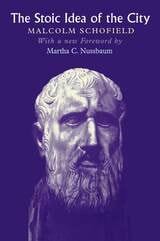
The Stoic Idea of the City
Malcolm Schofield
University of Chicago Press, 1999
"The account emerges from a jigsaw-puzzle of items from a wide range of authorities, painstakingly pieced together and then annotated in a series of appendixes, the whole executed with fine scholarship, clarity, and good humor."—Times Literary Supplement
The Stone and the Wireless
Mediating China, 1861–1906Shaoling Ma
Duke University Press, 2021
The Stonemans
An Appalachian Family and the Music That Shaped Their LivesIvan M. Tribe
University of Illinois Press, 1993
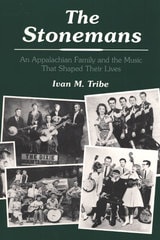
The Stonemans is an eye-opening slice of Americana---a trip through nearly twenty years of country music history following a single family from their native Blue Ridge Mountains to the slums of Washington, D.C., and the glitter of Nashville. As early as 1924 Ernest V. "Pop" Stoneman realized the potential of what is now known as country music, and he tried to carve a career from it. Successful as a recording artist from 1925 through 1929, Stoneman foundered during the Great Depression. He, his wife, and their nine children went to Washington in 1932, struggling through a decade of hardship and working to revive the musical career Pop still believed in. The Stoneman Family won the Country Music Association's Vocal Group of the Year Award in 1967. After Pop's death a year later, some of the children scattered to pursue their own careers.
Ivan Tribe relies on extensive interviews with the Stonemans and their friends in this chronicle of a family whose members have clung to their musical heritage through good times and bad.
The Store
Thomas S. Stribling
University of Alabama Press, 1933
Pulitzer Prize for the Novel in 1933
The Pulitzer prize-winning The Store is the second novel of Stribling’s monumental trilogy set in the author’s native Tennessee Valley region of north Alabama. The action begins in 1884, the year in which Grover Cleveland became the first Democratic president since the end of the Civil War; and it centers about the emergence of a figure of wealth in the city of Florence.
In The Store, Stribling succeeds in presenting the essence of an age through the everyday lives of his characters. In the New Yorker, reviewer Robert M. Coates compared Stribling with Mark Twain in his ability to convey the “very life and movement” of a small Southern town: “Groups move chatting under the trees or stand loitering in the courthouse square, townsfolk gather at political ‘speakings’ and drift homeward separately afterward; always, in their doings, one has the sense of a whole community surrounding them, binding them together.” Gerald Bullet wrote in The New Statesman and Nation that the novel “is a first-rate book…filled with diverse and vital characters; and much of it cannot be read without that primitive excitement, that eagerness to know what comes next, which is, after all, the triumph of the good story teller.”
The Story of Act 31
How Native History Came to Wisconsin ClassroomsJ P Leary
Wisconsin Historical Society Press, 2018
Since its passage in 1989, a state law known as Act 31 requires that all students in Wisconsin learn about the history, culture, and tribal sovereignty of Wisconsin’s federally recognized tribes.
The Story of Act 31 tells the story of the law’s inception—tracing its origins to a court decision in 1983 that affirmed American Indian hunting and fishing treaty rights in Wisconsin, and to the violent public outcry that followed the court’s decision. Author J P Leary paints a picture of controversy stemming from past policy decisions that denied generations of Wisconsin students the opportunity to learn about tribal history.

The Story of Alabama in Fourteen Foods
Emily Blejwas
University of Alabama Press, 2019
Alabama’s history and culture revealed through fourteen iconic foods, dishes, and beverages.
The Story of Alabama in Fourteen Foods explores well-known Alabama food traditions to reveal salient histories of the state in a new way. In this book that is part history, part travelogue, and part cookbook, Emily Blejwas pays homage to fourteen emblematic foods, dishes, and beverages, one per chapter, as a lens for exploring the diverse cultures and traditions of the state.
Throughout Alabama’s history, food traditions have been fundamental to its customs, cultures, regions, social and political movements, and events. Each featured food is deeply rooted in Alabama identity and has a story with both local and national resonance. Blejwas focuses on lesser-known food stories from around the state, illuminating the lives of a diverse populace: Poarch Creeks, Creoles of color, wild turkey hunters, civil rights activists, Alabama club women, frontier squatters, Mardi Gras revelers, sharecroppers, and Vietnamese American shrimpers, among others. A number of Alabama figures noted for their special contributions to the state’s foodways, such as George Washington Carver and Georgia Gilmore, are profiled as well. Alabama’s rich food history also unfolds through accounts of community events and a food-based economy. Highlights include Sumter County barbecue clubs, Mobile’s banana docks, Appalachian Decoration Days, cane syrup making, peanut boils, and eggnog parties.
Drawing on historical research and interviews with home cooks, chefs, and community members cooking at local gatherings and for holidays, Blejwas details the myths, legends, and truths underlying Alabama’s beloved foodways. With nearly fifty color illustrations and fifteen recipes, The Story of Alabama in Fourteen Foods will allow all Alabamians to more fully understand their shared cultural heritage.

The Story of All Things
Writing the Self in English Renaissance Narrative PoetryMarshall Grossman
Duke University Press, 1998
Relating subjectivity to the nature of language, Grossman uses the theories of Lacan to analyze the concept of the self as it encounters a transforming environment. He shows how ideological tensions arose from the reorganization and "modernization" of social life in revolutionary England and how the major poets of the time represented the division of the self in writings that are suspended between lyric and narrative genres. Beginning with the portrayals of the self inherited from Augustine, Dante, and Petrarch, he describes the influence of historic developments such as innovations in agricultural technology, civil war and regicide, and the emergence of republican state institutions on the changing representation of characters in the works of Spenser, Donne, Marvell, and Milton. Furthering this psychoanalytic critique of literary history, Grossman probes the linguistic effects of social and personal factors such as Augustine’s strained relationship with his mother and the marital disharmony of Milton and Mary Powell. With its focus on these and other "literary historical events," The Story of All Things not only proposes a new structural theory of narrative but constitutes a significant challenge to New Historicist conceptions of the self.
The Story of Big Bend National Park
By John Jameson
University of Texas Press, 1996
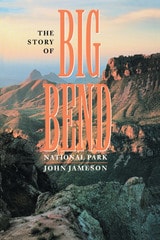
A breathtaking country of rugged mountain peaks, uninhabited desert, and spectacular river canyons, Big Bend is one of the United States' most remote national parks and among Texas' most popular tourist attractions. Located in the great bend of the Rio Grande that separates Texas and Mexico, the park comprises some 800,000 acres, an area larger than the state of Rhode Island, and draws over 300,000 visitors each year.
The Story of Big Bend National Park offers a comprehensive, highly readable history of the park from before its founding in 1944 up to the present. John Jameson opens with a fascinating look at the mighty efforts involved in persuading Washington officials and local landowners that such a park was needed. He details how money was raised and land acquired, as well as how the park was publicized and developed for visitors. Moving into the present, he discusses such issues as natural resource management, predator protection in the park, and challenges to land, water, and air. Along the way, he paints colorful portraits of many individuals, from area residents to park rangers to Lady Bird Johnson, whose 1966 float trip down the Rio Grande brought the park to national attention.
This history will be required reading for all visitors and prospective visitors to Big Bend National Park. For everyone concerned about our national parks, it makes a persuasive case for continued funding and wise stewardship of the parks as they face the twin pressures of skyrocketing attendance and declining budgets.

The Story of Coal and Iron in Alabama
Ethel Armes
University of Alabama Press, 2011
“The principal authority for the general treatment of the history of coal, and of iron and steel, in
Alabama is the work of Miss Ethel Armes. The Story of Coal and Iron in Alabama is a comprehensive
and scholarly work portraying in attractive style the growth of the mineral industries in its
relation to the development of the state and of the South, in preparation of which the author spent
more than five years.”
—Thomas McAdory Owen, History of Alabama and Dictionary of Alabama Biography
The Story of Food in the Human Past
How What We Ate Made Us Who We AreRobyn E. Cutright
University of Alabama Press, 2021
Explore how food shaped humanity in this compelling archaeological journey.
The Story of Food in the Human Past: How What We Ate Made Us Who We Are uses case studies from recent archaeological research to tell the story of food in human prehistory. Beginning with the earliest members of our genus, Robyn E. Cutright investigates the role of food in shaping who we are as humans during the emergence of modern Homo sapiens and through major transitions in human prehistory such as the development of agriculture and the emergence of complex societies.
This fascinating study begins with a discussion of how food shaped humans in evolutionary terms by examining what makes human eating unique, the use of fire to cook, and the origins of cuisine as culture and adaptation through the example of Neandertals. The second part of the book describes how cuisine was reshaped when humans domesticated plants and animals and examines how food expressed ancient social structures and identities such as gender, class, and ethnicity. Cutright shows how food took on special meaning in feasts and religious rituals and also pays attention to the daily preparation and consumption of food as central to human society.
Cutright synthesizes recent paleoanthropological and archaeological research on ancient diet and cuisine and complements her research on daily diet, culinary practice, and special-purpose mortuary and celebratory meals in the Andes with comparative case studies from around the world to offer readers a holistic view of what humans ate in the past and what that reveals about who we are.

The Story of Gefilte Fish
András Koerner
Central European University Press, 2027

The Story of Jane
The Legendary Underground Feminist Abortion ServiceLaura Kaplan
University of Chicago Press, 1997
"The Story of Jane is a piece of women's history in step with feminist theory demanding that women tell their own stories. It serves to remind people of an important and often overlooked moment in the women's rights movement."—Seattle Weekly
"Laura Kaplan's The Story of Jane is the first book to chronicle this controversial sliver of history, and it is a fascinating, if partisan, close-up of the group."—Newsday
"[Kaplan] draws on her personal recollections and interviews with Jane members and clients and the doctors who performed the abortions to provide a well-written, detailed history of this radical group."—Publisher's Weekly
"Weaving together the voices and memories of her former co-workers, Kaplan recounts how the group initially focused on counseling women and helping them find reliable, reasonably priced doctors....Kaplan's account of this remarkable story recaptures the political idealism of the early '70s...23 years after Roe vs. Wade, the issues and memories raised by the books are close and all too relevant."—K Kaufmann, San Francisco Chronicle
"Laura Kaplan's The Story of Jane is the first book to chronicle this controversial sliver of history, and it is a fascinating, if partisan, close-up of the group....The Story of Jane succeeds on the steam of Kaplan's gripping subject and her moving belief in the power of small-scale change."—Cynthia Leive, New York Newsday
"During the four years before the Supreme Court's Roe v. Wade decision legalized abortion in 1973, the 100 members of Jane helped some 11,000 women end their pregnancies....There is more in this remarkable book that will further raise eyebrows....Kaplan's engrossing tales of the quiet courage of the women who risked their reputations and freedom to help others may remind many readers of other kinds of outlaws who have resisted tyranny throughout history."—Chicago Sun-Times

The Story of Jane
The Legendary Underground Feminist Abortion ServiceLaura Kaplan
University of Chicago Press, 1997
"The Story of Jane is a piece of women's history in step with feminist theory demanding that women tell their own stories. It serves to remind people of an important and often overlooked moment in the women's rights movement."—Seattle Weekly
"Laura Kaplan's The Story of Jane is the first book to chronicle this controversial sliver of history, and it is a fascinating, if partisan, close-up of the group."—Newsday
"[Kaplan] draws on her personal recollections and interviews with Jane members and clients and the doctors who performed the abortions to provide a well-written, detailed history of this radical group."—Publisher's Weekly
"Weaving together the voices and memories of her former co-workers, Kaplan recounts how the group initially focused on counseling women and helping them find reliable, reasonably priced doctors....Kaplan's account of this remarkable story recaptures the political idealism of the early '70s...23 years after Roe vs. Wade, the issues and memories raised by the books are close and all too relevant."—K Kaufmann, San Francisco Chronicle
"Laura Kaplan's The Story of Jane is the first book to chronicle this controversial sliver of history, and it is a fascinating, if partisan, close-up of the group....The Story of Jane succeeds on the steam of Kaplan's gripping subject and her moving belief in the power of small-scale change."—Cynthia Leive, New York Newsday
"During the four years before the Supreme Court's Roe v. Wade decision legalized abortion in 1973, the 100 members of Jane helped some 11,000 women end their pregnancies....There is more in this remarkable book that will further raise eyebrows....Kaplan's engrossing tales of the quiet courage of the women who risked their reputations and freedom to help others may remind many readers of other kinds of outlaws who have resisted tyranny throughout history."—Chicago Sun-Times

The Story of Modern Skiing
John Fry
University Press of New England, 2010
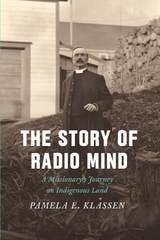
The Story of Radio Mind
A Missionary's Journey on Indigenous LandPamela E. Klassen
University of Chicago Press, 2018
Following Du Vernet’s journey westward from Toronto to Ojibwe territory and across the young nation of Canada, Pamela Klassen examines how contests over the mediation of stories—via photography, maps, printing presses, and radio—lucidly reveal the spiritual work of colonial settlement. A city builder who bargained away Indigenous land to make way for the railroad, Du Vernet knew that he lived on the territory of Ts’msyen, Nisga’a, and Haida nations who had never ceded their land to the onrush of Canadian settlers. He condemned the devastating effects on Indigenous families of the residential schools run by his church while still serving that church. Testifying to the power of radio mind with evidence from the apostle Paul and the philosopher Henri Bergson, Du Vernet found a way to explain the world that he, his church and his country made.
Expanding approaches to religion and media studies to ask how sovereignty is made through stories, Klassen shows how the spiritual invention of colonial nations takes place at the same time that Indigenous peoples—including Indigenous Christians—resist colonial dispossession through stories and spirits of their own.
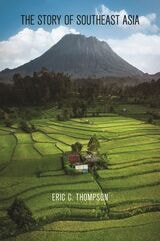
The Story of Southeast Asia
Edited by Eric Thompson
National University of Singapore Press, 2024
The oldest figurative cave paintings in the world are found on the island of Sulawesi in Indonesia. Hand stencils and animals painted some 45,000 years ago attest to a long history of human creativity. The Story of Southeast Asia tells how the peoples of the region have crafted their diverse societies and cultures over thousands of years. Southeast Asia has been a remarkable crossroads of global connections for millennia. Whereas other regions have been defined by centralizing forces, Southeast Asia’s story is one of complex networks of trade, ideas, and social relationships. Southeast Asians have created, localized, and remade their own cultural values by drawing on influences from around the world.
Marshalling the latest literature from anthropology, archaeology, history, and other disciplines, Eric C. Thompson highlights broad themes that cut across history: including the making—and evasion—of states, adoption of diverse religious practices, tolerance and flexibility regarding gender, processes of forging modern identities, struggles over sovereignty, and the making of modern nations in a postcolonial world. This readable, single-volume history reckons with the narrative pull of familiar colonial and national perspectives but maintains a regional and deep-historical focus. It will be a stimulating read for scholars as well as students and newcomers to Southeast Asian history.

The Story of Spin
Sin-itiro Tomonaga
University of Chicago Press, 1998
"This piece of the history of physics will provide excellent and exciting reading. . . . It also provides the personal touch of an expert in the field that is so often lacking in the physics literature. I recommend it very highly."—Fritz Rohrlich, Physics Today
Sin-itiro Tomonaga was awarded the Nobel Prize for Physics in 1965.
The Story of Swahili
John M. Mugane
Ohio University Press, 2015
Swahili was once an obscure dialect of an East African Bantu language. Today more than one hundred million people use it: Swahili is to eastern and central Africa what English is to the world. From its embrace in the 1960s by the black freedom movement in the United States to its adoption in 2004 as the African Union’s official language, Swahili has become a truly international language. How this came about and why, of all African languages, it happened only to Swahili is the story that John M. Mugane sets out to explore.
The remarkable adaptability of Swahili has allowed Africans and others to tailor the language to their needs, extending its influence far beyond its place of origin. Its symbolic as well as its practical power has evolved from its status as a language of contact among diverse cultures, even as it embodies the history of communities in eastern and central Africa and throughout the Indian Ocean world.
The Story of Swahili calls for a reevaluation of the widespread assumption that cultural superiority, military conquest, and economic dominance determine a language’s prosperity. This sweeping history gives a vibrant, living language its due, highlighting its nimbleness from its beginnings to its place today in the fast-changing world of global communication.
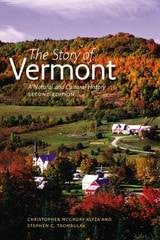
The Story of Vermont
A Natural and Cultural History, Second EditionChristopher McGrory Klyza and Stephen C. Trombulak
University Press of New England, 2015
The Story of Wamba
Julian of Toledo's Historia Wambae regisJoaquín Martínez Julian of Toledo
Catholic University of America Press, 2005
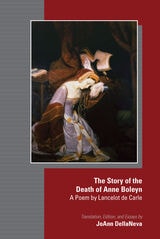
The Story of the Death of Anne Boleyn
A Poem by Lancelot de CarleEdited, Translated, and with Essays by JoAnn DellaNeva
Arizona Center for Medieval and Renaissance Studies, 2021
The Story of the Death of Anne Boleyn is a critical edition and translation of a long narrative poem written by the secretary to the French ambassador in London within two weeks of Anne Boleyn’s execution. It was intended as a diplomatic dispatch, relating the astonishing news of the queen’s demise (along with that of five alleged lovers). Uniquely among diplomatic correspondence, this dispatch was written in verse form. It thus straddles the domains of literature and history, of chronicle and fiction.
The base text for this edition is a previously unstudied manuscript housed at the British Library. Variants are given from all other known manuscripts found in Europe, including several key verses that were previously unpublished and that shed new light on the interpretation of the poem. The book features a sense-for-sense translation into modern English in free verse form, along with extensive explanatory notes. It also provides a study focusing on the historical background to the poem, an essay on the poet and the reception of his work, and a literary analysis of the poem.
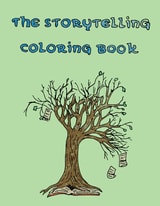
The Storytelling Coloring Book
Ojibwe Traditions Coloring Book SeriesCassie Brown
Wisconsin Historical Society Press, 2018
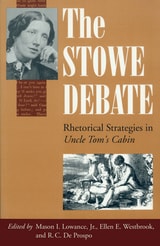
The Stowe Debate
Rhetorical Strategies in "Uncle Tom's Cabin"Mason I. Lowance
University of Massachusetts Press, 1994
The thirteen contributors to this volume enter these debates from a variety of critical perspectives. They address questions of language and ideology, the tradition of the sentimental novel, biblical influences, and the rhetoric of antislavery discourse. As much as they disagree on various points, they share a keen interest in the cultural work that texts can do and an appreciation of the enduring power of Uncle Tom's Cabin.

The Straight Line
How the Fringe Science of Ex-Gay Therapy Reoriented SexualityTom Waidzunas
University of Minnesota Press, 2015
To be taken seriously, therapies that claim to “cure” homosexuality wrap themselves in lab coats. Even though the fit is bad, and such therapies and their theorists now inhabit the scientific fringe, the science of sexuality has made some adjustments, too, Tom Waidzunas tells us in this provocative work.
Intervening in the politics of sexuality and science, The Straight Line argues that scientific definitions of sexual orientation do not merely reflect the results of investigations into human nature, but rather emerge through a process of social negotiation between opposing groups. The demedicalization of homosexuality and the discrediting of reparative therapies, ex-gay ministries, and reorientation research have, Waidzunas contends, required scientists to enforce key boundaries around scientific expertise and research methods. Drawing on extensive participant observation at conferences for ex-gays, reorientation therapists, mainstream psychologists, and survivors of ex-gay therapy, as well as interviews with experts and activists, The Straight Line traces reorientation debates in the United States from the 1950s to the present, following homosexuality therapies from the mainstream to the margins. As the ex-gay movement has become increasingly transnational in recent years, Waidzunas turns to Uganda, where ideas about the scientific nature of homosexuality influenced the passage of the Anti-Homosexuality Act of 2014.
While most studies treat the ex-gay movement as a religious phenomenon, this book looks at how the movement, in its attempts to establish legitimacy, has engaged with scientific institutions, shaping virulent anti-gay public policy.
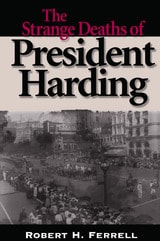
The Strange Deaths of President Harding
Robert H. Ferrell
University of Missouri Press, 1998
Available for the first time in paperback, The Strange Deaths of President Harding challenges readers to reexamine Warren G. Harding's rightful place in American history.
For nearly half a century, the twenty-ninth president of the United States has consistently finished last in polls ranking the presidents. After Harding's untimely death in 1923, a variety of attacks and unsubstantiated claims left the public with a tainted impression of him. In this meticulously researched scrutiny of the mystery surrounding Harding's death, Robert H. Ferrell, distinguished presidential historian, examines the claims against this unpopular president and uses new material to counter those accusations.
At the time of Harding's death there was talk of his similarity, personally if not politically, to Abraham Lincoln. Secretary of State Charles Evans Hughes described Harding as one of nature's noblemen, truehearted and generous. But soon after Harding's death, his reputation began to spiral downward. Rumors circulated of the president's death by poison, either by his own hand or by that of his wife; allegations of an illegitimate daughter were made; and question were raised concerning the extent of Harding's knowledge of the Teapot Dome scandal and of irregularities in the Veterans' Bureau, as well as his tolerance of a corrupt attorney general who was an Ohio political fixer. Journalists and historians of the time added to his tarnished reputation by using sources that were easily available but not factually accurate.
In The Strange Deaths of President Harding, Ferrell lays out the facts behind these allegations for the reader to ponder. Making the most of the recently opened papers of assistant White House physician Dr. Joel T. Boone, Ferrell shows that for years Harding suffered from high blood pressure, was under a great deal of stress, and overexerted himself; it was a heart attack that caused his death, not poison. There was no proof of an illegitimate child. And Harding did not know much about the scandals intensifying in the White House at the time of his death. In fact, these events were not as scandalous as they have since been made to seem.
In this meticulously researched and eminently readable scrutiny of the mystery surrounding Harding's death, as well as the deathblows dealt his reputation by journalists, Ferrell asks for a reexamination of Harding's place in American history.

The Strange and Terrible Visions of Wilhelm Friess
The Paths of Prophecy in Reformation EuropeJonathan Green
University of Michigan Press, 2014
Dutch scholars have recognized that Frans Fraet was executed for printing a prognostication by Willem de Vriese, but this prognostication was thought to be lost. A few scholars of sixteenth-century German apocalypticism have briefly noted the prophecies of Wilhelm Friess but have not studied them in depth. The Strange and Terrible Visions of Wilhelm Friess is the first to connect de Vriese and Friess, as well as recognize the prophecy of Wilhelm Friess as an adaptation of a French version of theVademecum of Johannes de Rupescissa, making these pamphlets by far the most widespread source for Rupescissa’s apocalyptic thought in Reformation Germany. The book explains the connection between the first and second prophecies of Wilhelm Friess and discovers the Calvinist context of the second prophecy and its connection to Johann Fischart, one of the most important German writers of the time.
Jonathan Green provides a study of how textual history interacts with print history in early modern pamphlets and proposes a model of how early modern prophecies were created and transmitted. The Strange and Terrible Visions of Wilhelm Friess makes important contributions to the study of early modern German and Dutch literature, apocalypticism and confessionalization during the Reformation, and the history of printing in the sixteenth century.