Results by title
805 books match the query '18th century' and 11 start with u
Uncomfortable Situations
Emotion between Science and the HumanitiesDaniel M. Gross
University of Chicago Press, 2017
Science and the humanities typically offer two different paradigms for thinking about emotion—the first rooted in brain and biology, the second in a social world. With rhetoric as a field guide, Uncomfortable Situations establishes common ground between these two paradigms, focusing on a theory of situated emotion. Daniel M. Gross anchors the argument in Charles Darwin, whose work on emotion has been misunderstood across the disciplines as it has been shoehorned into the perceived science-humanities divide. Then Gross turns to sentimental literature as the single best domain for studying emotional situations. There’s lost composure (Sterne), bearing up (Equiano), environmental hostility (Radcliffe), and feeling mixed (Austen). Rounding out the book, an epilogue written with ecological neuroscientist Stephanie Preston provides a different kind of cross-disciplinary collaboration. Uncomfortable Situations is a conciliatory work across science and the humanities—a groundbreaking model for future studies.

Uncommon Vernacular
The Early Houses of Jefferson County, West Virginia, 1735-1835John C. Allen, Jr.
West Virginia University Press, 2011
Allen’s refreshing perspective illuminates the vibrant vernacular architecture of Jefferson County, connecting the housing of this area to the rich history of the Shenandoah Valley. Varying features of house siting, plan types, construction techniques, building materials, outbuildings, and exterior and interior detailing illustrate the blending of German, Scots-Irish, English, and African cultures into a distinct, regional style.

Under the Shadow of Napoleon
The US Army’s Doctrine, Education, and Theory of Victory from 1814 to 1941. Second EditionMichael A. Bonura
University of North Texas Press, 2026
Understanding and Teaching the Age of Revolutions
Edited by Ben Marsh and Mike Rapport
University of Wisconsin Press, 2017
The volume includes chapters on sources and methods for stimulating student debate and learning, including Tom Paine's Common Sense, the Haitian Declaration of Independence, and other key documents; role-playing games; visual arts and culture; and music, including opera and popular songs. Other chapters delve into specific themes, including revolution and riot, revolutionary terror, enlightenment, gender, slavery, nationalism, environment and climate, and the roles of politically excluded groups. Collectively, the contributions ensure a broad Atlantic scope, discussing the revolutions in Britain's North American colonies, Haiti, and Latin America, and European revolutions including France, Belgium, and the Netherlands.
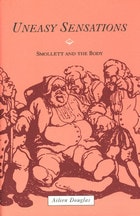
Uneasy Sensations
Smollett and the BodyAileen Douglas
University of Chicago Press, 1995
Aileen Douglas draws on feminist and other new theoretical perspectives to reassess Smollett's entire body of fiction as well as his classic Travels through France and Italy. Like many writers of his time, Douglas argues, Smollett was interested in the body and in how accurately it reflects internal disposition. But Smollett's special contribution to the eighteenth-century novel is his emphasis on sentience, or the sensations of the physical body. Looking at such works as The Adventures of Roderick Random, The Expedition of Humphry Clinker, The Adventures of Peregrine Pickle, and The History and Adventures of an Atom, Douglas explores the ways Smollett uses representations of sentience—especially torment and pain—in his critique of the social and political order.
Trained in medicine, Smollett was especially alert to the ways in which the discourses of medicine, philosophy, and law construct (as we would put it now) the body as an object of knowledge, and yet his work always returns to the importance of the physical world of the body and its feelings. Smollett reminds us, as Douglas aptly puts it, that "if you prick a socially constructed body, it still bleeds."
Unitarianism in the Antebellum South
The Other Invisible InstitutionJohn Allen Macaulay
University of Alabama Press, 2001
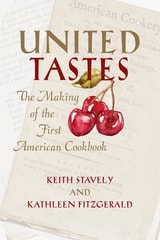
United Tastes
The Making of the First American CookbookKeith Stavely
University of Massachusetts Press, 2017
Winner of the 2017 Bruce Fraser Award from the Association for the Study of Connecticut History
The Library of Congress has designated American Cookery (1796) by Amelia Simmons one of the eighty-eight “Books That Shaped America.” Its recognition as “the first American cookbook” has attracted an enthusiastic modern audience of historians, food journalists, and general readers, yet until now American Cookery has not received the sustained scholarly attention it deserves. Keith Stavely and Kathleen Fitzgerald's United Tastes fills this gap by providing a detailed examination of the social circumstances and culinary tradition that produced this American classic.
Situating American Cookery within the post-Revolutionary effort to develop a distinct national identity, Stavely and Fitzgerald demonstrate the book's significance in cultural as well as culinary terms. Ultimately the separation between these categories dissolves as the authors show that the formation of “taste,” in matters of food as well as other material expressions, was essential to building a consensus on what it was to be American. United Tastes explores multiple histories—of food, cookbooks, printing, material and literary culture, and region—to illuminate the meaning and affirm the importance of America's first cookbook.
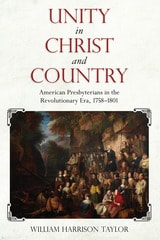
Unity in Christ and Country
American Presbyterians in the Revolutionary Era, 1758–1801William Harrison Taylor
University of Alabama Press, 2017
In Unity in Christ and Country: American Presbyterians in the Revolutionary Era, 1758–1801, William Harrison Taylor investigates the American Presbyterian Church’s pursuit of Christian unity and demonstrates how, through this effort, the church helped to shape the issues that gripped the American imagination, including evangelism, the conflict with Great Britain, slavery, nationalism, and sectionalism. When the colonial Presbyterian Church reunited in 1758, a nearly twenty-year schism was brought to an end. To aid in reconciling the factions, church leaders called for Presbyterians to work more closely with other Christian denominations. Their ultimate goal was to heal divisions, not just within their own faith but also within colonial North America as a whole.
Taylor contends that a self-imposed interdenominational transformation began in the American Presbyterian Church upon its reunion in 1758. However, this process was altered by the church’s experience during the American Revolution, which resulted in goals of Christian unity that had both spiritual and national objectives. Nonetheless, by the end of the century, even as the leaders in the Presbyterian Church strove for unity in Christ and country, fissures began to develop in the church that would one day divide it and further the sectional rift that would lead to the Civil War.
Taylor engages a variety of sources, including the published and unpublished works of both the Synods of New York and Philadelphia and the General Assembly of the Presbyterian Church in the United States, as well as numerous published and unpublished Presbyterian sermons, lectures, hymnals, poetry, and letters. Scholars of religious history, particularly those interested in the Reformed tradition, and specifically Presbyterianism, should find Unity in Christ and Country useful as a way to consider the importance of the theology’s intellectual and pragmatic implications for members of the faith.
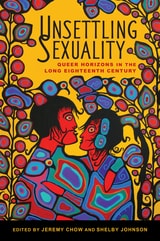
Unsettling Sexuality
Queer Horizons in the Long Eighteenth CenturyJeremy Chow
University of Delaware Press, 2025
This book is also freely available online as an open access digital edition on Manifold, here: https://openpub.udel.edu/projects/unsettling-sexuality.
Unsettling Sexuality: Queer Horizons in the Long Eighteenth Century challenges the traditional ways that scholarship has approached sexuality, gender nonconformity, and sex (as well as its absence) in the long eighteenth century. Drawing from recent and emerging criticisms in Middle Eastern and Asian studies, Black studies, and Native American and Indigenous studies, the collected authors perform intersectional queer readings, reimagine queer historiographic methods, and spearhead new citational models that can invigorate the field. Contributors read with and against diverse European, transatlantic, and global archives to explore mutually informative frameworks of gender, sexuality, race, indigeneity, ability, and class. In charting multidirectional queer horizons, this collection locates new prospective desires and intimacies in the literature, culture, and media of the period to imagine new directions and simultaneously unsettle eighteenth-century studies.
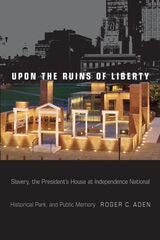
Upon the Ruins of Liberty
Slavery, the President's House at Independence National Historical Park, and Public MemoryRoger C. Aden
Temple University Press, 2014
In Upon the Ruins of Liberty, Roger Aden offers a compelling account that explores the development of this important historic site and how history, space, and public memory intersected with contemporary racial politics. Aden constructs this engrossing tale by drawing on archival material and interviews with principal figures in the controversy-including historian Ed Lawler, site activist Michael Coard, and site designer Emanuel Kelly.
Upon the Ruins of Liberty chronicles the politically-charged efforts to create a fitting tribute to the place where George Washington (and later, John Adams) shaped the presidency while denying freedom to the nine enslaved Africans in his household. From design to execution, the plans prompted advocates to embrace stories informed by race, and address difficulties that included how to handle the results of the site excavation. As such, this landmark project raised concerns and provided lessons about the role of public memory and how places are made to shape the nation's identity.
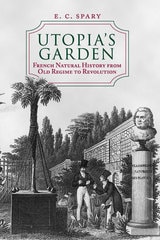
Utopia's Garden
French Natural History from Old Regime to RevolutionE. C. Spary
University of Chicago Press, 2000
E. C. Spary traces the scientific, administrative, and political strategies that enabled the foundation of the Muséum, arguing that agriculture and animal breeding rank alongside classification and collections in explaining why natural history was important for French rulers. But the Muséum's success was also a consequence of its employees' Revolutionary rhetoric: by displaying the natural order, they suggested, the institution could assist in fashioning a self-educating, self-policing Republican people. Natural history was presented as an indispensable source of national prosperity and individual virtue.
Spary's fascinating account opens a new chapter in the history of France, science, and the Enlightenment.