Results by title
87 books match the query 'AIDS (Disease)' and 3 start with u

Unbecoming
Eric Michaels
Duke University Press, 1997

Unstable Frontiers
Technomedicine and the Cultural Politics of “Curing” AIDSJohn Nguyet Erni
University of Minnesota Press, 1994
Unstable Frontiers was first published in 1994. Minnesota Archive Editions uses digital technology to make long-unavailable books once again accessible, and are published unaltered from the original University of Minnesota Press editions.
"John Erni's heartfelt and insightful book is a valuable contribution to the study of the cultural politics of AIDS."–Jeff Nunokawa Princeton University
The "cure" for AIDS: The search goes on, keeping pace with our belief that AIDS is incurable. How such a seeming paradox works-and how it may well work against the proper treatment of the disease-is the subject of Unstable Frontiers, a probing, critical look at the cultural politics behind the quest for a cure for AIDS.
This massive commercial and scientific project, John Erni suggests, actually hinges on our contradictory definitions of the disease as curable and incurable at the same time. Drawing on diverse sources, from popular media to medical literature to cultural theory, he shows how the dual discourse of curability/incurability frames the way we think about and act on issues of medical treatment for AIDS. His work makes a major advance in our understanding of—and, perhaps, humane response to—a national crisis.
In his critique of the logic and fantasies underlying the double definition of AIDS, Erni explores a broad range of issues: the scientific paradigm used to develop AZT; the politics of alternative treatment practices, of clinical drug trials, and of AIDS activism; and the notions of time and temporality operating in AIDS treatment science. He also addresses the problematic popular themes, such as "AIDS is invariably fatal" and "Knowledge = Cure."
Unique in its approach to a social and political issue still in the making, the book reveals how AIDS has challenged technomedicine's historical position of authority-and in doing so, recasts this challenge in a powerful and ultimately hopeful way.
John Nguyet Erni is assistant professor of communication at the University of New Hampshire. He has published essays on AIDS and is currently working on a book about AIDS in Thailand.
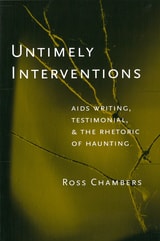
Untimely Interventions
AIDS Writing, Testimonial, and the Rhetoric of HauntingRoss Chambers
University of Michigan Press, 2004
Ross Chambers argues that culture produces itself as civilized by denying the forms of collective violence and other traumatic experience that it cannot control. In the context of such denial, personal accounts of collective disaster can function as a form of counter-denial. By investigating a range of writing on AIDS, the First World War, and the Holocaust, Chambers shows how such writing produces a rhetorical effect of haunting, as it seeks to describe the reality of those experiences culture renders unspeakable.
Ross Chambers is Professor of Romance Languages at the University of Michigan. His other books includeFacing It: AIDS Diaries and the Death of the Author.