Results by title
157 books match the query 'African Americans in literature' and 3 start with u

Uncle Tom's Cabin and the Reading Revolution
Hochman Barbara
University of Massachusetts Press, 2011
[more]
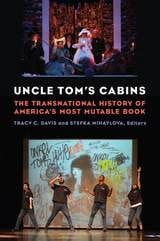
Uncle Tom's Cabins
The Transnational History of America's Most Mutable BookTracy C. Davis and Stefka Mihaylova, Editors
University of Michigan Press, 2018
As Harriet Beecher Stowe’s novel Uncle Tom’s Cabin traveled around the world, it was molded by the imaginations and needs of international audiences. For over 150 years it has been coopted for a dazzling array of causes far from what its author envisioned. This book tells thirteen variants of Uncle Tom’s journey, explicating the novel’s significance for Canadian abolitionists and the Liberian political elite that constituted the runaway characters’ landing points; nineteenth-century French theatergoers; liberal Cuban, Romanian, and Spanish intellectuals and social reformers; Dutch colonizers and Filipino nationalists in Southeast Asia; Eastern European Cold War communists; Muslim readers and spectators in the Middle East; Brazilian television audiences; and twentieth-century German holidaymakers.
Throughout these encounters, Stowe’s story of American slavery serves as a paradigm for understanding oppression, selectively and strategically refracting the African American slave onto other iconic victims and freedom fighters. The book brings together performance historians, literary critics, and media theorists to demonstrate how the myriad cultural and political effects of Stowe’s enduring story has transformed it into a global metanarrative with national, regional, and local specificity.
Throughout these encounters, Stowe’s story of American slavery serves as a paradigm for understanding oppression, selectively and strategically refracting the African American slave onto other iconic victims and freedom fighters. The book brings together performance historians, literary critics, and media theorists to demonstrate how the myriad cultural and political effects of Stowe’s enduring story has transformed it into a global metanarrative with national, regional, and local specificity.
[more]
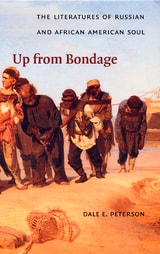
Up from Bondage
The Literatures of Russian and African American SoulDale E. Peterson
Duke University Press, 2000
During the nineteenth century, literate Russians and educated American blacks encountered a dominant Western narrative of world civilization that seemed to ignore the histories of Slavs and African Americans. In response, generations of Russian and black American intellectuals have asserted eloquent counterclaims for the cultural significance of a collective national “soul” veiled from prejudiced Western eyes. Up from Bondage is the first study to parallel the evolution of Russian and African American cultural nationalism in literary works and philosophical writings.
Illuminating a remarkably widespread cross-pollination between the two cultural and intellectual traditions, Dale E. Peterson frames much of his argument around W. E. B. DuBois’s concept of “double-consciousness,” wherein members of an oppressed section of society view themselves simultaneously through their own self-awareness and through the internalized standards of the dominant culture. He shows how the writings of Dostoevsky, Hurston, Chesnutt, Turgenev, Ellison, Wright, Gorky, and Naylor—texts that enacted and described this sense of double awareness—were used both to perform and to contest the established genres of Western literacy. Woven through Peterson’s textual analyses is his consideration of cultural hybridism and its effects: The writers he examines find multiple ways to testify to and challenge the symptoms of postcolonial trauma. After discussing the strong and significant affinity expressed by contemporary African American cultural theorists for the dialogic thought of Russian linguist Mikhail Bakhtin, Peterson argues that a fuller appreciation of the historic connection between the two cultures will enrich the complicated meanings of being black or Russian in a world that has traditionally avoided acknowledging pluralistic standards of civilization and cultural excellence.
This investigation of comparable moments in the development of Russian and African American ethnic self-consciousness will be valuable to students and scholars of comparative literature, philosophy, cultural theory, ethnicity, linguistics, and postcolonialism, in addition to Slavic and African American studies.
[more]