Results by title
336 books match the query 'Age' and 3 start with u
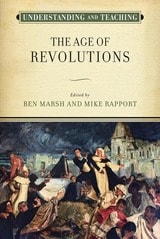
Understanding and Teaching the Age of Revolutions
Edited by Ben Marsh and Mike Rapport
University of Wisconsin Press, 2017
To learn about the "Age of Revolutions" in Europe and the Americas is to engage with the emergence of the modern world. In the late eighteenth and early nineteenth centuries, nations were founded, old empires collapsed, and new ones arose. Struggles for emancipation—whether from royal authority, colonial rule, slavery, or patriarchy—inspired both hopes and fears. This book, designed for university and secondary school teachers, provides up-to-date content and perspectives, classroom-tested techniques, innovative ideas, and an exciting variety of pathways to introduce students to this complex era of history.
The volume includes chapters on sources and methods for stimulating student debate and learning, including Tom Paine's Common Sense, the Haitian Declaration of Independence, and other key documents; role-playing games; visual arts and culture; and music, including opera and popular songs. Other chapters delve into specific themes, including revolution and riot, revolutionary terror, enlightenment, gender, slavery, nationalism, environment and climate, and the roles of politically excluded groups. Collectively, the contributions ensure a broad Atlantic scope, discussing the revolutions in Britain's North American colonies, Haiti, and Latin America, and European revolutions including France, Belgium, and the Netherlands.
The volume includes chapters on sources and methods for stimulating student debate and learning, including Tom Paine's Common Sense, the Haitian Declaration of Independence, and other key documents; role-playing games; visual arts and culture; and music, including opera and popular songs. Other chapters delve into specific themes, including revolution and riot, revolutionary terror, enlightenment, gender, slavery, nationalism, environment and climate, and the roles of politically excluded groups. Collectively, the contributions ensure a broad Atlantic scope, discussing the revolutions in Britain's North American colonies, Haiti, and Latin America, and European revolutions including France, Belgium, and the Netherlands.
[more]
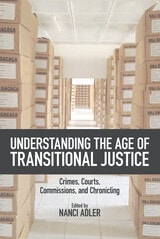
Understanding the Age of Transitional Justice
Crimes, Courts, Commissions, and ChroniclingAdler, Nanci
Rutgers University Press, 2018
Since the 1980s, an array of legal and non-legal practices—labeled Transitional Justice—has been developed to support post-repressive, post-authoritarian, and post-conflict societies in dealing with their traumatic past. In Understanding the Age of Transitional Justice, the contributors analyze the processes, products, and efficacy of a number of transitional justice mechanisms and look at how genocide, mass political violence, and historical injustices are being institutionally addressed. They invite readers to speculate on what (else) the transcripts produced by these institutions tell us about the past and the present, calling attention to the influence of implicit history conveyed in the narratives that have gained an audience through international criminal tribunals, trials, and truth commissions. Nanci Adler has gathered leading specialists to scrutinize the responses to and effects of violent pasts that provide new perspectives for understanding and applying transitional justice mechanisms in an effort to stop the recycling of old repressions into new ones.
[more]
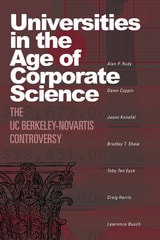
Universities in the Age of Corporate Science
The UC Berkeley-Novartis ControversyAlan P. Rudy, Dawn Coppin, Jason Konefal, Bradley T. Shaw, Toby Ten Eyck, Craig Harris and Lawrence Busch
Temple University Press, 2007
As a result of widespread financial pressures, U.S. research universities increasingly stress the pursuit of funding beyond that available from government grants and contracts. Concomitantly, recent legal changes have encouraged universities to develop closer ties to the private business sector.This book represents the most thorough review ever undertaken of a major collaboration between industry and academe. A professional evaluation team obtained authorization for unprecedented access to those associated with the landmark $25 million contract entered into by the Plant and Microbial Biology Department at the University of California, Berkeley, and the Novartis Agricultural Discovery Institute, a subsidiary of Novartis, an international pharmaceutical and agribusiness conglomerate.This model study presents the inside story of the partnership itself, places it in the context of contemporary university-industry relationships, and provides a larger theoretical framework for evaluating such collaborations in the future.
[more]