1272 books match the query 'Asia' and 19 start with u
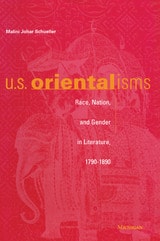
cover of U.S. Orientalisms: Race, Nation, and Gender in Literature, 1790-1890

U.S. Orientalisms

Race, Nation, and Gender in Literature, 1790-1890

Malini Johar Schueller

University of Michigan Press, 2001

U.S. Orientalisms is the first extensive and politicized study of nineteenth century American discourses that helped build an idea of nationhood with control over three "Orients": the "Barbary" Orient; the Orient of Egypt; and the Orient of India. Malini Johar Schueller persuasively argues that current notions about the East can be better understood as latter-day manifestations of the earlier U.S. visions of the Orient refracted variously through millennial fervor, racial-cultural difference, and ideas of Westerly empire.
This book begins with an examination of the literature of the "Barbary" Orient generated by the U.S. Algerian conflict in the late eighteenth century in the works of such writers as Royall Tyler, Susanna Rowson, and Washington Irving. It then moves on to the Near East Orientalist literature of the nineteenth century in light of Egyptology, theories of race, and the growth of missionary fervor in writers such as John DeForest, Maria Susanna Cummins, Herman Melville, Edgar Allan Poe, and Harriet Prescott Spofford. Finally, Schueller considers the Indic Orientalism of the period in the context of Indology, British colonialism, and the push for Asian trade in the United States, focusing particularly on Emerson and Whitman. U.S. Orientalisms demonstrates how these writers strove to create an Orientalism premised on the idea of civilization and empire moving West, from Asia, through Europe, and culminating in the New World.
Schueller draws on the work of Michel Foucault, Edward Said, Homi Bhabha, Rey Chow, and Judith Butler and compellingly demonstrates how a raced, compensatory "Orientalist" discourse of empire was both contested and evoked in the literary works of a wide variety of writers. The book will be of interest to readers in American history, postcolonial studies, gender studies, and literary theory.
Malini Johar Schueller is Associate Professor, Department of English, University of Florida. She is the author of The Politics of Voice: Liberalism and Social Criticism from Franklin to Kingston.
[more]
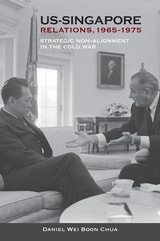
cover of US-Singapore Relations, 1965-1975: Strategic Non-alignment in the Cold War

US-Singapore Relations, 1965-1975

Strategic Non-alignment in the Cold War

Daniel Wei Boon Chua

National University of Singapore Press, 2017
During the Vietnam War, the newly-independent Singapore struck the position of being non-aligned. It maintained an anti-communist stance while, at least initially, criticizing the United States’ intervention into Vietnam. Yet Singapore might not have achieved its post-colonial success so rapidly without the support of the United States. As the war in Vietnam raged on, Singapore became a critical refueling point, also providing ship and aircraft repair for the US military. Commercial and strategic support from the United States lifted Singapore out of the economic doom predicted for the city-state after secession from Malaysia. Without this strategic and economic assistance, Singapore’s history might have been different. By considering the importance of the role of the United States in Singapore’s nation-building, this book provides an important supplement to the well-trodden narrative that attributes Singapore’s success solely to good governance.
[more]
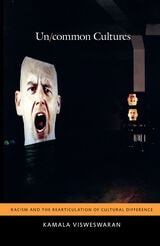
cover of Un/common Cultures: Racism and the Rearticulation of Cultural Difference

Un/common Cultures

Racism and the Rearticulation of Cultural Difference

Kamala Visweswaran

Duke University Press, 2010
In Un/common Cultures, Kamala Visweswaran develops an incisive critique of the idea of culture at the heart of anthropology, describing how it lends itself to culturalist assumptions. She holds that the new culturalism—the idea that cultural differences are definitive, and thus divisive—produces a view of “uncommon cultures” defined by relations of conflict rather than forms of collaboration. The essays in Un/common Cultures straddle the line between an analysis of how racism works to form the idea of “uncommon cultures” and a reaffirmation of the possibilities of “common cultures,” those that enact new forms of solidarity in seeking common cause. Such “cultures in common” or “cultures of the common” also produce new intellectual formations that demand different analytic frames for understanding their emergence. By tracking the emergence and circulation of the culture concept in American anthropology and Indian and French sociology, Visweswaran offers an alternative to strictly disciplinary histories. She uses critical race theory to locate the intersection between ethnic/diaspora studies and area studies as a generative site for addressing the formation of culturalist discourses. In so doing, she interprets the work of social scientists and intellectuals such as Elsie Clews Parsons, Alice Fletcher, Franz Boas, Louis Dumont, Claude Lévi-Strauss, Clifford Geertz, W. E. B. Du Bois, and B. R. Ambedkar.
[more]
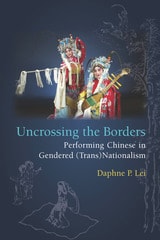
cover of Uncrossing the Borders: Performing Chinese in Gendered (Trans)Nationalism

Uncrossing the Borders

Performing Chinese in Gendered (Trans)Nationalism

Daphne P. Lei

University of Michigan Press, 2019

Over many centuries, women on the Chinese stage committed suicide in beautiful and pathetic ways just before crossing the border for an interracial marriage. Uncrossing the Borders asks why this theatrical trope has remained so powerful and attractive. The book analyzes how national, cultural, and ethnic borders are inevitably gendered and incite violence against women in the name of the nation. The book surveys two millennia of historical, literary, dramatic texts, and sociopolitical references to reveal that this type of drama was especially popular when China was under foreign rule, such as in the Yuan (Mongol) and Qing (Manchu) dynasties, and when Chinese male literati felt desperate about their economic and political future, due to the dysfunctional imperial examination system. Daphne P. Lei covers border-crossing Chinese drama in major theatrical genres such as zaju and chuanqi, regional drama such as jingju (Beijing opera) and yueju (Cantonese opera), and modernized operatic and musical forms of such stories today.
[more]
cover of Undaunted Women of Nanking: The Wartime Diaries of Minnie Vautrin and Tsen Shui-fang

Undaunted Women of Nanking

The Wartime Diaries of Minnie Vautrin and Tsen Shui-fang

Edited and Translated by Hua-ling Hu and Zhang Lian-hong

Southern Illinois University Press, 2010

One of the Chinese American Librarians Association’s Ten Best Books of 2010

During the infamous “Rape of Nanking,” a brutal military occupation of Nanking, China, that began on December 13, 1937, it is estimated that Japanese soldiers killed between 200,000 and 300,000 Chinese and raped between 20,000 and 80,000 women. To shelter civilian refugees, a group of Westerners established a Nanking Safety Zone. Among these humanitarians was Minnie Vautrin, an American missionary and acting president of Ginling College. She and Tsen Shui-fang, her Chinese assistant and a trained nurse, turned the college into a refugee camp, which protected more than 10,000 women and children during the height of the ordeal. The Undaunted Women of Nanking juxtaposes day-by-day the exhausted and terrified women’s wartime diaries, providing vital eyewitness accounts of the Rape of Nanking and a unique focus on the Ginling refugee camp and the sufferings of women and children. Vautrin's diary reveals the humanity and courage of a female missionary in a time of terror. Tsen Shui-fang’s diary, never before published in English and translated here for the first time, is the only known daily account by a Chinese national written during the crisis and not retrospectively. As such, it records a unique perspective: that of a woman grappling with feelings of anger, sorrow, and compassion as she witnesses the atrocities being committed in her war-torn country.

Editors Hua-ling Hu and Zhang Lian-hong have added many informative annotations to the diary entries from sources including the proceedings of the Tokyo War Crimes Trial of 1946, Vautrin’s correspondence, John Rabe’s diary, and other historical documents. Also included are biographical sketches of the two women, a note on the diaries, and information about the aftermath of the tragedy, as well as maps and photos—some of which appear in print in this book for the first time.
[more]
cover of Underglobalization: Beijing's Media Urbanism and the Chimera of Legitimacy

Underglobalization

Beijing's Media Urbanism and the Chimera of Legitimacy

Joshua Neves

Duke University Press, 2020
Despite China's recent emergence as a major global economic and geopolitical power, its association with counterfeit goods and intellectual property piracy has led many in the West to dismiss its urbanization and globalization as suspect or inauthentic. In Underglobalization Joshua Neves examines the cultural politics of the “fake” and how frictions between legality and legitimacy propel dominant models of economic development and political life in contemporary China. Focusing on a wide range of media technologies and practices in Beijing, Neves shows how piracy and fakes are manifestations of what he calls underglobalization—the ways social actors undermine and refuse to implement the specific procedures and protocols required by globalization at different scales. By tracking the rise of fake politics and transformations in political society, in China and globally, Neves demonstrates that they are alternate outcomes of globalizing processes rather than anathema to them.
[more]
cover of Underground Front: The Chinese Communist Party in Hong Kong, Second Edition

Underground Front

The Chinese Communist Party in Hong Kong, Second Edition

Christine Loh

Hong Kong University Press, 2019
Underground Front is a pioneering examination of the role that the Chinese Communist Party has played in Hong Kong since the creation of the party in 1921, through to the present day. The second edition goes into greater depth on the party’s view on “one country, two systems”, “patriotism”, and “elections”. The introduction has been extensively revised and the concluding chapter has been completely rewritten in order to give a thorough account of the post-1997 governance and political system in Hong Kong, and where challenges lie. Christine Loh endeavours to keep the data and the materials up to date and to include the discussion of some recent events in Hong Kong. The appendices on the key targets of the party’s united front activities also make the book an especially useful read for all who are interested in Hong Kong history and politics, and the history of modern China.
[more]
cover of Understanding and Teaching the Vietnam War

Understanding and Teaching the Vietnam War

Edited by John Day Tully, Matthew Masur, and Brad Austin

University of Wisconsin Press, 2013

Just as the Vietnam War presented the United States with a series of challenges, it presents a unique challenge to teachers at all levels. The war had a deep and lasting impact on American culture, politics, and foreign policy. Still fraught with controversy, this crucial chapter of the American experience is as rich in teachable moments as it is riddled with potential pitfalls—especially for students a generation or more removed from the events themselves.
            Addressing this challenge, Understanding and Teaching the Vietnam War offers a wealth of resources for teachers at the secondary and university levels. An introductory section features essays by eminent Vietnam War scholars George Herring and Marilyn Young, who reflect on teaching developments since their first pioneering classes on the Vietnam War in the early 1970s. A methods section includes essays that address specific methods and materials and discuss the use of music and film, the White House tapes, oral histories, the Internet, and other multimedia to infuse fresh and innovative dimensions to teaching the war. A topical section offers essays that highlight creative and effective ways to teach important topics, drawing on recently available primary sources and exploring the war's most critical aspects—the Cold War, decolonization, Vietnamese perspectives, the French in Vietnam, the role of the Hmong, and the Tet Offensive. Every essay in the volume offers classroom-tested pedagogical strategies and detailed practical advice.
            Taken as a whole, Understanding and Teaching the Vietnam War will help teachers at all levels navigate through cultural touchstones, myths, political debates, and the myriad trouble spots enmeshed within the national memory of one of the most significant moments in American history.

Honorable Mention, Franklin Buchanan Prize for Curricular Materials, Association for Asian Studies and the Committee for Teaching about Asia
[more]
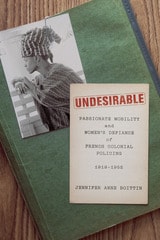
cover of Undesirable: Passionate Mobility and Women’s Defiance of French Colonial Policing, 1919–1952

Undesirable

Passionate Mobility and Women’s Defiance of French Colonial Policing, 1919–1952

Jennifer Anne Boittin

University of Chicago Press, 2022

Archival research into policing and surveillance of migrant women illuminates pressing contemporary issues.

Examining little-known policing archives in France, Senegal, and Cambodia, Jennifer Anne Boittin unearths the stories of hundreds of women labeled “undesirable” by the French colonial police and society in the early twentieth century. These “undesirables” were often women traveling alone, women who were poor or ill, women of color, or women whose intimate lives were deemed unruly. To refute the label and be able to move freely, they spoke out or wrote impassioned letters: some emphasized their “undesirable” qualities to suggest that they needed the care and protection of the state to support their movements, while others used the empire’s own laws around Frenchness and mobility to challenge state or societal interference. Tacking between advocacy and supplication, these women summoned intimate details to move beyond, contest, or confound surveillance efforts, bringing to life a practice that Boittin terms “passionate mobility.” In considering how ordinary women pursued autonomy, security, companionship, or simply a better existence in the face of surveillance and control, Undesirable illuminates pressing contemporary issues of migration and violence.
[more]
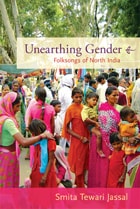
cover of Unearthing Gender: Folksongs of North India

Unearthing Gender

Folksongs of North India

Smita Tewari Jassal

Duke University Press, 2012

Unearthing Gender is a compelling ethnographic analysis of folksongs sung primarily by lower-caste women in north India, in the fields, at weddings, during travels, and in other settings. Smita Tewari Jassal uses these songs to explore how ideas of caste, gender, sexuality, labor, and power may be strengthened, questioned, and fine-tuned through music. At the heart of the book is a library of songs, in their original Bhojpuri and in English translation, framed by Jassal’s insights into the complexities of gender and power.

The significance of these folksongs, Jassal argues, lies in their suggesting and hinting at themes, rather than directly addressing them: women sing what they often cannot talk about. Women’s lives, their feelings, their relationships, and their social and familial bonds are persuasively presented in song. For the ethnographer, the songs offer an entry into the everyday cultures of marginalized groups of women who have rarely been the focus of systematic analytical inquiry.
[more]
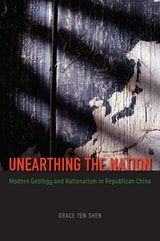
cover of Unearthing the Nation: Modern Geology and Nationalism in Republican China

Unearthing the Nation

Modern Geology and Nationalism in Republican China

Grace Yen Shen

University of Chicago Press, 2014

Questions of national identity have long dominated China’s political, social, and cultural horizons. So in the early 1900s, when diverse groups in China began to covet foreign science in the name of new technology and modernization, questions of nationhood came to the fore. In Unearthing the Nation, Grace Yen Shen uses the development of modern geology to explore this complex relationship between science and nationalism in Republican China.
           
Shen shows that Chinese geologists—in battling growing Western and Japanese encroachment of Chinese sovereignty—faced two ongoing challenges: how to develop objective, internationally recognized scientific authority without effacing native identity, and how to serve China when China was still searching for a stable national form. Shen argues that Chinese geologists overcame these obstacles by experimenting with different ways to associate the subjects of their scientific study, the land and its features, with the object of their political and cultural loyalties. This, in turn, led them to link national survival with the establishment of scientific authority in Chinese society.

The first major history of modern Chinese geology, Unearthing the Nation introduces the key figures in the rise of the field, as well as several key organizations, such as the Geological Society of China, and explains how they helped bring Chinese geology onto the world stage.
[more]
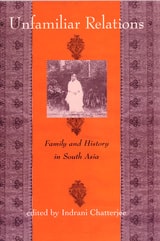
cover of Unfamiliar Relations: Family and History in South Asia

Unfamiliar Relations

Family and History in South Asia

Chatterjee, Indrani

Rutgers University Press, 2004

Unfamiliar Relations restores the family and its many forms and meanings to a central place in the history of South Asia between the seventeenth and nineteenth centuries.

In her incisive introduction, Indrani Chatterjee argues that the recent wealth of scholarship on ethnicity, sexuality, gender, imperialism, and patriarchy in South Asia during the colonial period often overlooks careful historical analysis of the highly contested concept of family. Together, the essays in this book demolish "family" as an abstract concept in South Asian colonial history, demonstrating its exceedingly different meanings across temporal and geographical space.

The scholarship in this volume reveals a far more complex set of dynamics than a simple binary between indigenous and colonial forms and structures. It approaches this study from the pre-colonial period on, rather than backwards as has been the case with previous scholarship. Topics include a British colonial officer who married a Mughal noblewoman and converted to Islam around the turn of the nineteenth century, the role gossip and taboo play in the formation of Indian family history, and an analysis of social relations in the penal colony on the Andaman Islands.
[more]
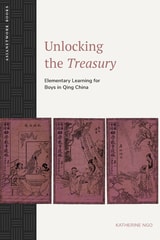
cover of Unlocking the Treasury: Elementary Learning for Boys in Qing China

Unlocking the Treasury

Elementary Learning for Boys in Qing China

Katherine Ngo

Lever Press, 2025

In recent years, the renewed interest in traditional Chinese elementary educational material has led to an increased use of these texts as teaching materials in Chinese schools, as well as popular literature and in academic research. Unlocking the Treasury: Elementary Learning for Boys in Qing China seeks to address the existing gap in Western scholarship regarding pre-modern Chinese primary education, its theories, and textbooks. With a focus on the Qing dynasty textbook, Treasury of Elementary Learning (Youxue qionglin 幼學瓊林), this volume is the first major study of the Treasury in English and reveals a rich tradition of education through close and critical readings of the text. 

Unlocking the Treasury grounds its study of primary education in the intellectual history of the period. Using the concept of interpretive communities, Katherine Ngo explores the impact of socio-political influences and differences in Qing schools of thought, including the school of principle, the school of heart-mind, and practical learning. As such, this volume examines the Treasury through three critical readings of the text: as a handbook for practical learning, a child-oriented reading of the school of heart-mind, and the instrumental perspective of education as examination training. 

Ngo reframes the curricular content, skills, learning approaches, and teaching strategies of Chinese pre-modern elementary education with the goal of facilitating a broader transcultural dialogue in contemporary education. Far from the notion of traditional Chinese elementary education being monolithic and “rote learning,” Unlocking the Treasury reveals that elementary learning in the Qing dynasty offered a sophisticated and complex educational agenda with diverse learning goals of examination, preparation, moral development, and textual scholarship training that were shaped by intellectual trends of the time. An engaging text for scholars of Qing China and historians of education alike, Katherine Ngo’s Unlocking the Treasury is essential to understanding the philosophical, historical, literary, and psychological dimensions of education and educational theory in the Qing era.
[more]
cover of Unmaking Botany: Science and Vernacular Knowledge in the Colonial Philippines

Unmaking Botany

Science and Vernacular Knowledge in the Colonial Philippines

Kathleen Cruz Gutierrez

Duke University Press, 2025
In Anglo-European botany, it is customary to think of the vernacular as that which is not a Latin or Latinized scientific plant name. In Unmaking Botany, Kathleen Cruz Gutierrez traces a history of botany in the Philippines during the last decades of Spanish rule and the first decades of US colonization. Through this history, she redefines the vernacular, expanding it to include embodied, cosmological, artistic, and varied taxonomic practices. From the culinary textures of rice and the lyrics crooned to honor a flower to the touch of a skirt woven from banana fiber, she illuminates how vernaculars of plant knowing in the Philippines exposed the philosophical and practical limits of botany. Such vernaculars remained as sovereign forms of knowledge production. Yet, at the same time, they fueled botany’s dominance over other ways of knowing plants. Revealing this tension allows Gutierrez to theorize “sovereign vernaculars,” or insight into plants that made and unmade the science, which serves as a methodological provocation to examine the interplay of different knowledge systems and to study the history of science from multiple vantage points.
[more]
cover of Unruly Cinema: History, Politics, and Bollywood

Unruly Cinema

History, Politics, and Bollywood

Rini Bhattacharya Mehta

University of Illinois Press, 2020

Between 1931 and 2000, India's popular cinema steadily overcame Hollywood domination. Bollywood, the film industry centered in Mumbai, became nothing less than a global cultural juggernaut. But Bollywood is merely one part of the country's prolific, multilingual cinema. Unruly Cinema looks at the complex series of events that allowed the entire Indian film industry to defy attempts to control, reform, and refine it in the twentieth century and beyond.

Rini Bhattacharya Mehta considers four aspects of Indian cinema's complicated history. She begins with the industry's surprising, market-driven triumph over imports from Hollywood and elsewhere in the 1930s. From there she explores how the nationalist social melodrama outwitted the government with its 1950s cinematic lyrical manifestoes. In the 1970s, an action cinema centered on the angry young male co-opted the voice of the oppressed. Finally, Mehta examines Indian film's discovery of the global neoliberal aesthetic that encouraged the emergence of Bollywood.

[more]
cover of Untying the Afghan Knot: Negotiating Soviet Withdrawal

Untying the Afghan Knot

Negotiating Soviet Withdrawal

Riaz M. Khan

Duke University Press, 1991

Diplomatic efforts to resolve the Afghanistan crisis began almost immediately after the Soviet Union’s military intervention in that country in December 1979. Untying the Afghan Knot offers the first detailed account of the diplomatic process set in motion by that intervention and culminating in the April 1988 Geneva Accords—a milestone in multilateralism and United Nations (UN) peacemaking.
Riaz M. Khan, a senior Pakistani diplomat, participated actively in all meetings on Afghanistan in the United Nations, the Non-Aligned Movement, and the Organization of the Islamic Conference, and in all of the Geneva negotiating rounds (1882–1988). Drawing upon his personal experience, official documents, scholarly literature, and press accounts, he provides a unique insider’s view of these precedent-setting negotiations, which were often shrouded in secrecy and misperceptions.
Khan examines the interests, positions, and behind-the-scenes maneuverings of the major players—Afghan governments and resistance groups, Pakistan, the Soviet Union, the United States, and UN mediators—and assesses the impact of military and political developments inside Afghanistan and elsewhere, including the advent of Mikhail Gorbachev. Khan’s authoritative account of these critical diplomatic initiatives sheds important light on the internal dynamics of the multilateral Afghanistan negotiations.
[more]
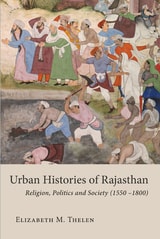
cover of Urban Histories of Rajasthan: Religion, Politics and Society (1550–1800)

Urban Histories of Rajasthan

Religion, Politics and Society (1550–1800)

Elizabeth M. Thelen

Gingko, 2022

An exploration of religious conflicts in premodern urban India.
 
Diverse peoples intermingled in the streets and markets of premodern Indian cities. This book considers how these diverse residents lived together and negotiated their differences. Which differences mattered, when and to whom? How did state actions and policies affect urban society and the lives of various communities? How and why did conflict occur in urban spaces? Through these questions, this book explores the histories of urban communities in the three cities of Ajmer, Nagaur, and Pushkar in Rajasthan, between the sixteenth and eighteenth centuries. The focus of this study is on everyday life, contextualizing religious practices and conflicts by considering patterns of patronage and broader conflict patterns within society. The book examines various archival documents, from family and institutional records to state registers, and uses these documents to demonstrate the complex and sometimes contradictory ways religion intersected with politics, economics, and society. The author shows how many patronage patterns and processes persisted in altered forms, and how the robustness of these structures contributed to the resilience of urban spaces and society in precolonial Rajasthan.
 
[more]
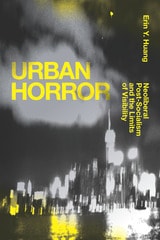
cover of Urban Horror: Neoliberal Post-Socialism and the Limits of Visibility

Urban Horror

Neoliberal Post-Socialism and the Limits of Visibility

Erin Y. Huang

Duke University Press, 2020
In Urban Horror Erin Y. Huang theorizes the economic, cultural, and political conditions of neoliberal post-socialist China. Drawing on Marxist phenomenology, geography, and aesthetics from Engels and Merleau-Ponty to Lefebvre and Rancière, Huang traces the emergence and mediation of what she calls urban horror—a sociopolitical public affect that exceeds comprehension and provides the grounds for possible future revolutionary dissent. She shows how documentaries, blockbuster feature films, and video art from China, Hong Kong, and Taiwan made between the 1990s and the present rehearse and communicate urban horror. In these films urban horror circulates through myriad urban spaces characterized by the creation of speculative crises, shifting temporalities, and dystopic environments inhospitable to the human body. The cinematic image and the aesthetics of urban horror in neoliberal post-socialist China lay the groundwork for the future to such an extent, Huang contends, that the seeds of dissent at the heart of urban horror make it possible to imagine new forms of resistance.
[more]
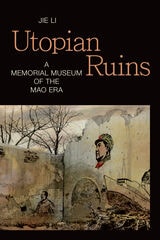
cover of Utopian Ruins: A Memorial Museum of the Mao Era

Utopian Ruins

A Memorial Museum of the Mao Era

Jie Li

Duke University Press, 2020

In Utopian Ruins Jie Li traces the creation, preservation, and elision of memories about China's Mao era by envisioning a virtual museum that reckons with both its utopian yearnings and its cataclysmic reverberations. Li proposes a critical framework for understanding the documentation and transmission of the socialist past that mediates between nostalgia and trauma, anticipation and retrospection, propaganda and testimony. Assembling each chapter like a memorial exhibit, Li explores how corporeal traces, archival documents, camera images, and material relics serve as commemorative media. Prison writings and police files reveal the infrastructure of state surveillance and testify to revolutionary ideals and violence, victimhood and complicity. Photojournalism from the Great Leap Forward and documentaries from the Cultural Revolution promoted faith in communist miracles while excluding darker realities, whereas Mao memorabilia collections, factory ruins, and memorials at trauma sites remind audiences of the Chinese Revolution's unrealized dreams and staggering losses.
[more]