Results by title
384 books match the query 'Black Studies (Global)' and 6 start with u
Undead Ends
Stories of ApocalypseS. Trimble
Rutgers University Press, 2019
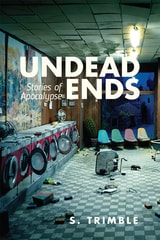
Undead Ends is about how we imagine humanness and survival in the aftermath of disaster. This book frames modern British and American apocalypse films as sites of interpretive struggle. It asks what, exactly, is ending? Whose dreams of starting over take center stage, and why? And how do these films, sometimes in spite of themselves, make room to dream of new beginnings that don’t just reboot the world we know? Trimble argues that contemporary apocalypse films aren’t so much envisioning The End of the world as the end of a particular world; not The End of humanness but, rather, the end of Man. Through readings of The Road, I Am Legend, 28 Days Later, 28 Weeks Later, Children of Men, and Beasts of the Southern Wild, this book demonstrates that popular stories of apocalypse can trouble, rather than reproduce, Man’s story of humanness. With some creative re-reading, they can even unfold towards unexpected futures. Mainstream apocalypse films are, in short, an occasion to imagine a world After Man.
[more]
Unseen Flesh
Gynecology and Black Queer Worth-Making in BrazilNessette Falu
Duke University Press, 2023
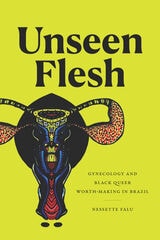
In Unseen Flesh Nessette Falu explores how Black lesbians in Brazil define and sustain their well-being and self-worth against persistent racial, sexual, class, and gender-based prejudice. Focusing on the trauma caused by interactions with gynecologists, Falu draws on in-depth ethnographic work among the Black lesbian community to reveal their profoundly negative affective experiences within Brazil’s deeply biased medical system. In the face of such entrenched, intersectional intimate violence, Falu’s informants actively pursue well-being in ways that channel their struggle for self-worth toward broader goals of social change, self care, and communal action. Demonstrating how the racist and heteronormative underpinnings of gynecology erase Black lesbian subjecthood through mental, emotional, and physical traumas, Falu explores the daily resistance and abolitionist practices of worth-making that claim and sustain Black queer identity and living. Falu rethinks the medicalization of race, sex, and gender in Brazil and elsewhere while offering a new perspective on Black queer life through well-being grounded in relationships, socioeconomic struggles, the erotic, and freedom strivings.
[more]
Unsettled History
Making South African Public PastsLeslie Witz, Gary Minkley, and Ciraj Rassool
University of Michigan Press, 2017
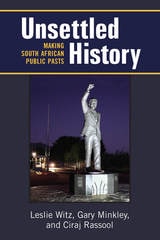
Unsettled History examines South African society and the construction and presentation of its public pasts, from Nelson Mandela’s release from prison in 1990 to South Africa’s hosting of the 2010 FIFA World Cup ®. Conventionally represented as a time of rectifying the silences and distortions of settler history through inclusion and recovery, the focus here instead is on the shifts in processes and locations of historicizing and the unsettled state of categories of framing history in post-apartheid South Africa. This era saw fundamental transformations in the order of knowledge: from the academy to the public; from popular history to public history; from history-as-lesson to history-as-forum.
Leslie Witz, Gary Minkley, and Ciraj Rassool take the reader to sites of historical production in which complex ideas about pasts are invoked, and navigate a path toward understanding the agencies of image-making and memory production. This volume is the outcome of the authors’ intensive collaborative research and engagement over twenty-five years on questions including the production and performance of apartheid history; the cultural politics of social history; South Africa’s Truth and Reconciliation Commission and practices of orality; tourism as an arena of image-making and historical construction; museums as sites of heritage production for a new South Africa; photographs, archival meanings, and the construction of the social documentary; and the centenary commemorations of the South African War and the making of race. The authors not only witnessed many of these instances of history-making but were also participants in their constitution.
Leslie Witz, Gary Minkley, and Ciraj Rassool take the reader to sites of historical production in which complex ideas about pasts are invoked, and navigate a path toward understanding the agencies of image-making and memory production. This volume is the outcome of the authors’ intensive collaborative research and engagement over twenty-five years on questions including the production and performance of apartheid history; the cultural politics of social history; South Africa’s Truth and Reconciliation Commission and practices of orality; tourism as an arena of image-making and historical construction; museums as sites of heritage production for a new South Africa; photographs, archival meanings, and the construction of the social documentary; and the centenary commemorations of the South African War and the making of race. The authors not only witnessed many of these instances of history-making but were also participants in their constitution.
[more]

Unsettling Geographies
Antiblackness, Gendered Violence, and Indigenous Dispossession in GuyanaShanya Cordis
Duke University Press, 2027
Unsettling Geographies offers an original approach to examining Guyana’s post-independence political landscape, tracing how colonial imaginaries of frontier extraction—the plantation and the bush—haunt everyday life. From an embodied ethnographic attunement to the erasure of Indigenous political life and the racialized intimacies that transgress partitioned geographies of the coastland and hinterland, Shanya Cordis puts forth what she calls “relational difference,” a feminist framework that illuminates the co-constitutive logics of Indigenous dispossession, antiblackness, and gendered violence that undergird capital. She critically interrogates state and party politics that promise the good life yet situate Indigenous peoples and working-class Afro- and Indo-Guyanese as sacrifices to developmentalism’s seemingly progressive arc. These colonial logics operate through the gendered and sexualized positioning of Amerindian, African, and Indian bodies under the plantation system, recognition policies, and the appropriation and economic management of Indigenous territories that inform contemporary land relations. Formulating relational difference as a means to render visible interlocking relations of power, Cordis disrupts the mirage of political parties and the state as the arbiters of redress, gesturing toward liberatory possibilities and relational ways of being.
[more]
Unwelcome Shores
Black Refugees in AmericaBernadette Ludwig
Rutgers University Press, 2026
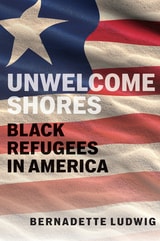
Unwelcome Shores is an ethnographic study of the Liberian refugee community in Staten Island, New York, home to the largest per capita concentration of Liberians in the U.S., that sheds light on the racialization of Black refugees and the racism they have experienced at every step of their migration journey. In this pioneering study, sociologist Bernadette Ludwig explores how Liberians have responded to such racist exclusions, noting how members of this community reject the informal refugee label once they are resettled in the United States. Liberian migrants often view the label as a liability since the larger general public, the media, and the U.S. government tend to regard Black refugees as an economic and social burden unworthy of assistance. Indeed, Black refugees’ humanity is often ignored, Ludwig contends, in favor of overemphasizing presumed barbaric violence, endemic wars, cultural backwardness, and diseases. By detailing the lack of aid and support for Black refugees and describing how Liberian refugees in particular have had to overcome various struggles and barriers in coming to the U.S. and while living here, Unwelcome Shores highlights the overarching role of race and anti-Black racism in American society.
[more]
Up Against the Archive
Experiments in Writing British Empire History OtherwiseAntoinette Burton, editor
Duke University Press, 2027
In essays covering five centuries of British imperialism and a variety of genres and forms, the contributors to Up Against the Archive make the case for experimental historical writing as a way to work through the gaps and erasures of imperial archives. Drawing on Black feminist theory and Saidiya Hartman’s method to “creatively disorder the institutional fictions and the violent abstractions authorized as fact and truth,” they challenge ways of knowing and telling inherited from British imperialism. Each contribution centers on a distinct archival object or moment in time, exploring ways of understanding historical subjectivity from means and material not included or legible in the traditional archive. In Up Against the Archive, interdisciplinary scholars meet the challenges of our contemporary moment with inventive forms of storytelling that suggest possibilities for doing empire history in an anti-imperial mode.
[more]