Results by title
3071 books match the query 'Business & Economics' and 28 start with u

U.S. Engineering in a Global Economy
Edited by Richard B. Freeman and Hal Salzman
University of Chicago Press, 2018
The volume provides insights on engineering education, practice, and careers that can inform educational institutions, funding agencies, and policy makers about the challenges facing the United States in developing its engineering workforce in the global economy.

Un Catecismo para los Negocios
Andrew V. Abela
Catholic University of America Press, 2016
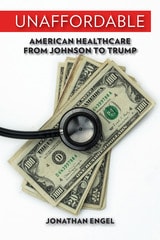
Unaffordable
American Healthcare from Johnson to TrumpJonathan Engel
University of Wisconsin Press, 2018
Unaffordable covers, in a conversational style punctuated by apt examples, topics ranging from health insurance, pharmaceutical pricing, and physician training to health maintenance organizations and hospital networks. Along the way, Engel introduces approaches that other nations have taken in organizing and paying for healthcare and offers insights on ethical quandaries around end-of-life decisions, neonatal care, life-sustaining treatments, and the limits of our ability to define death. While describing the political origins of many of the federal and state laws that govern our healthcare system today, he never loses sight of the impact that healthcare delivery has on our wallets and on the balance sheets of hospitals, doctors' offices, government agencies, and private companies.

Unavoidable Industrial Restructuring in Latin America
Fernando Fajnzylber
Duke University Press, 1990
Fernando Fajnzylber argues that technological and industrial progress is the driving force of a positive relationship among dynamism, competitiveness, austerity, and equity. Latin America’s failure to master this technological progress underlies its economic difficulties. To overcome the inheritance of past mistakes, the author maintains, Latin America must undergo not only macroeconomic stabilization and a reduction of the debt burden, but also a complete transformation of the production structure. The role of the state and the institutional setup need to be modified and new social and sectoral policies devised. Fajnzylber sees this radical restructuring as an unavoidable step if Latin America is ever to achieve a workable balance between growth and equity.

Unbeatable
The Brutally Honest Case for Free MarketsBryan Caplan
University of Chicago Press, 2027
From economist and New York Times bestselling author Bryan Caplan, a provocative and powerful argument for ending the age of big government and embracing free markets as the best tool to foster prosperity for all.
“Markets do the good things that sound bad; governments do the bad things that sound good.” So begins the audacious argument from New York Times bestselling author Bryan Caplan in his essential treatise on modern economies, Unbeatable. Caplan’s case is not merely ideological: he shows compellingly that markets—by lowering prices, giving consumers what they want, and weighing risks—deliver the raw materials for human prosperity that history tells us are unbeatable by other means. Their more popular alternative, governments, focus on addressing crowd-pleasing complaints, incurring high costs and delivering dubious benefits. With this historical foundation, Caplan makes the case for unabashed support of free markets and fervent opposition to government intervention.
Unbeatable imagines a world where markets are allowed in all the places where we think we don’t want them—schools, immigration, social care, and housing policy—and sketches the positive social and economic transformations that would follow from privatization. These include the miracle effects of giving people money instead of Medicare and Social Security; the ability of open borders to solve demographic and labor problems; and the universal benefits of less regulation. In prose that is uncoded and uncommonly honest, Caplan explains how our aversion to markets emerged from our shared wish to avoid wrestling with tradeoffs—the social desirability bias that leads us to favor bad things that sound good over good things that sound bad. Markets, it turns out, can save us from those disappointments, especially compared to the alternatives. Unlike many free-market economists, Caplan freely concedes the ugly downsides of the policies he favors—but argues that the policies should be evaluated on their overall performance rather than their emotional appeal.
Unbeatable is the maximalist, politically unbeholden case for markets as tools for human flourishing. For readers with open hearts, it offers nothing short of an antidote to our economic discontents.
Uncertain Times
Kenneth Arrow and the Changing Economics of Health CarePeter J. Hammer, Deborah Haas-Wilson, Mark A. Peterson, and William M. Sage, eds.
Duke University Press, 2003
Coming from diverse backgrounds—economics, law, political science, and the health care industry itself—the contributors use Arrow’s article to address a range of present-day health-policy questions. They examine everything from health insurance and technological innovation to the roles of charity, nonprofit institutions, and self-regulation in addressing medical needs. The collection concludes with a new essay by Arrow, in which he reflects on the health care markets of the new millennium. At a time when medical costs continue to rise, the ranks of the uninsured grow, and uncertainty reigns even among those with health insurance, this volume looks back at a seminal work of scholarship to provide critical guidance for the years ahead.
Contributors
Linda H. Aiken
Kenneth J. Arrow
Gloria J. Bazzoli
M. Gregg Bloche
Lawrence Casalino
Michael Chernew
Richard A. Cooper
Victor R. Fuchs
Annetine C. Gelijns
Sherry A. Glied
Deborah Haas-Wilson
Mark A. Hall
Peter J. Hammer
Clark C. Havighurst
Peter D. Jacobson
Richard Kronick
Michael L. Millenson
Jack Needleman
Richard R. Nelson
Mark V. Pauly
Mark A. Peterson
Uwe E. Reinhardt
James C. Robinson
William M. Sage
J. B. Silvers
Frank A. Sloan
Joshua Graff Zivin
Uncharitable
How Restraints on Nonprofits Undermine Their PotentialDan Pallotta
University Press of New England, 2010
Uncharitable
How Restraints on Nonprofits Undermine Their PotentialDan Pallotta
Brandeis University Press, 2022
Uncharitable goes where no other book on the nonprofit sector has dared to tread. Where other texts suggest ways to optimize performance inside the existing charity paradigm, Uncharitable suggests that the paradigm itself is the problem and calls into question our fundamental canons about charity. Dan Pallotta argues that society’s nonprofit ethic creates an inequality that denies the nonprofit sector critical tools and permissions that the for-profit sector is allowed to use without restraint. These double standards place the nonprofit sector at an extreme disadvantage. While the for-profit sector is permitted to use all the tools of capitalism, the nonprofit sector is prohibited from using any of them. Capitalism is blamed for creating inequities in our society, but charity is prohibited from using the tools of capitalism to rectify them—and ironically, this is all done in the name of charity. This irrational system, Pallotta explains, has its roots in four-hundred-year-old Puritan ethics that banished self-interest from the realm of charity. The ideology is policed today by watchdog agencies and the use of so-called efficiency measures, which Pallotta argues are flawed, unjust, and should be abandoned. By declaring our independence from these obsolete ideas, Pallotta theorizes, we can dramatically accelerate progress on the most urgent social issues of our time. Uncharitable is an important, provocative, timely, and accessible book—a manifesto about equal economic rights for charity. This edition has a new, updated introduction by the author.
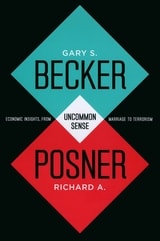
Uncommon Sense
Economic Insights, from Marriage to TerrorismGary S. Becker and Richard A. Posner
University of Chicago Press, 2009
On December 5, 2004, the still-developing blogosphere took one of its biggest steps toward mainstream credibility, as Nobel Prize–winning economist Gary S. Becker and renowned jurist and legal scholar Richard A. Posner announced the formation of the Becker-Posner Blog.
In no time, the blog had established a wide readership and reputation as a reliable source of lively, thought-provoking commentary on current events, its pithy and profound weekly essays highlighting the value of economic reasoning when applied to unexpected topics. Uncommon Sense gathers the most important and innovative entries from the blog, arranged by topic, along with updates and even reconsiderations when subsequent events have shed new light on a question. Whether it’s Posner making the economic case for the legalization of gay marriage, Becker arguing in favor of the sale of human organs for transplant, or even the pair of scholars vigorously disagreeing about the utility of collective punishment, the writing is always clear, the interplay energetic, and the resulting discussion deeply informed and intellectually substantial.
To have a single thinker of the stature of a Becker or Posner addressing questions of this nature would make for fascinating reading; to have both, writing and responding to each other, is an exceptionally rare treat. With Uncommon Sense, they invite the adventurous reader to join them on a whirlwind intellectual journey. All they ask is that you leave your preconceptions behind.
Under Discussion
The Encyclopedic MuseumDonatien Grau
J. Paul Getty Trust, The, 2021
Over the last two decades, the encyclopedic museum has been criticized and praised, constantly discussed, and often in the news. Encyclopedic museums are a phenomenon of Europe and the United States, and their locations and mostly Eurocentric collections have in more recent years drawn attention to what many see as bias. Debates on provenance in general, cultural origins, and restitutions of African heritage have exerted pressure on encyclopedic museums, and indeed on all manner of museums. Is there still a place for an institution dedicated to gathering, preserving, and showcasing all the world’s cultures?
Donatien Grau’s conversations with international arts officials, museum leaders, artists, architects, and journalists go beyond the history of the encyclopedic format and the last decades’ issues that have burdened existing institutions. Are encyclopedic museums still relevant? What can they contribute when the Internet now seems to offer the greater encyclopedia? How important is it for us to have in-person access to objects from all over the world that can directly articulate something to us about humanity? The fresh ideas and nuances of new voices on the core principles important to museums in Dakar, Abu Dhabi, and Mumbai complement some of the world’s arts leaders from European and American institutions—resulting in some revealing and unexpected answers. Every interviewee offers differing views, making for exciting, stimulating reading.
Includes interviews with George Abungu, National Museums of Kenya; Kwame Anthony Appiah, New York University; Homi K. Bhabha, Harvard University; Hamady Bocoum, Musée des Civilisationes Noires, Dakar; Irina Bokova, UNESCO; Partha Chatterjee, Columbia University; Thomas Campbell, Fine Arts Museum of San Francisco; James Cuno, J. Paul Getty Trust; Philippe de Montebello, New York University; Bachir Souleymane Diagne, Columbia University; Kaywin Feldman, National Gallery of Art; Marc Fumaroli, Collège de France; Massimiliano Gioni, New Museum; Michael Govan, Los Angeles County Museum of Art; Camille Henrot, artist; Max Hollein, Metropolitan Museum of Art; Henri Loyrette, Musée du Louvre; Jean Nouvel, architect; Zaki Nusseibeh, United Arab Emirates; Mikhail Piotrovsky, State Hermitage Museum; Grayson Perry, artist; Krzysztof Pomian, École des Hautes Études en Sciences Sociales; Mari Carmen Ramírez, Museum of Fine Arts, Houston; Fiammetta Rocco, The Economist; Sabyasachi Mukherjee, CSMVS Mumbai; Bénédicte Savoy; Collège de France; Kavita Singh, Jawaharlal Nehru University, New Delhi; Amit Sood, Google Arts & Culture.
Underdeveloping the Amazon
Extraction, Unequal Exchange, and the Failure of the Modern StateStephen G. Bunker
University of Chicago Press, 1988
Understanding Economic Recovery in the 1930s
Endogenous Propagation in the Great DepressionFrank G. Steindl
University of Michigan Press, 2003
Providing strong evidence for the role of the quantity of money in the revitalization, the author ultimately concludes that the seemingly robust monetary explanation of the recovery is deficient, as is any that relies principally on aggregate demand impulses. An accurate understanding of this phenomenon must account for the inherent tendency of the economy to revert to its long-run high employment trend.
Frank G. Steindl is Regents Professor of Economics and Ardmore Professor of Business Administration, Oklahoma State University.
Understanding Long-Run Economic Growth
Geography, Institutions, and the Knowledge EconomyEdited by Dora L. Costa and Naomi R. Lamoreaux
University of Chicago Press, 2011
The conditions for sustainable growth and development are among the most debated topics in economics, and the consensus is that institutions matter greatly in explaining why some economies are more successful than others over time. Probing the long-term effects of early colonial differences on immigration policy, land distribution, and financial development in a variety of settings, Understanding Long-Run Economic Growth explores the relationship between economic conditions, growth, and inequality, with a focus on how the monopolization of resources by the political elite limits incentives for ordinary people to invest in human capital or technological discovery. Among the topics discussed are the development of credit markets in France, the evolution of transportation companies in the United Kingdom and the United States, and the organization of innovation in the United States.
Understanding NAFTA
Mexico, Free Trade, and the New North AmericaBy William A. Orme, Jr.
University of Texas Press, 1996
Understanding NAFTA was first published in 1993 as Continental Shift: Free Trade & the New North America. This edition includes a new introduction that brings the NAFTA story up through 1995.
Understanding the Arts and Creative Sector in the United States
Cherbo, Joni Maya
Rutgers University Press, 2008
Illuminating key issues and reflecting the rapid growth of the field of arts and cultural policy, this book will be of interest to students at both the undergraduate and graduate levels, to arts educators and management professionals, government agency and foundation officials, and researchers and academics in the cultural policy field.
Understanding the National Debt
What Every American Needs to KnowCarl Lane
Westholme Publishing, 0
The United States has a debt problem—we owe more than $18 trillion while our gross domestic product, the value of all goods and services produced in America, is only $17.5 trillion. To pay down the debt, some recommend austerity, cutting federal expenditures. Others suggest increasing taxes, especially on the wealthiest Americans. In Understanding the National Debt: What Every American Needs to Know, economic historian Carl Lane urges that the national debt must be addressed in ways beyond program cuts or tax increase alternatives, but change can only occur when more Americans understand what constitutes our debt and the problems it causes. The gross national debt is composed of two elements: the public debt and “intragovernment holdings.” The public debt consists of bonds, bills, and notes purchased by individuals, banks, insurance companies, hedge and retirement funds, foreign governments, and university endowments. Intragovernment holdings refers to money that the U.S. Treasury borrows from other parts of the government, principally Social Security and Medicare. This accounts for approximately a quarter of the gross national debt, but that is money that we owe to ourselves, not another entity. The more the government borrows, the less is available for private sector investment, creating a “squeeze” effect that inhibits economic growth. The most burdensome problem is the interest due each year on the debt. Every dollar spent on interest is a dollar less for other purposes. Those elements of the federal budget which are termed “discretionary” suffer. The mandatory elements of the budget—Social Security, Medicare, Medicaid, and the interest on the debt—must be provided for, but defense and national security, education, energy, infrastructure repair and development, and other needs wind up with less. By understanding the national debt we have an opportunity to address our real debt challenge—its principal and interest.
Unequal Time
Gender, Class, and Family in Employment SchedulesDan Clawson is professor of sociology at the University of Massachusetts, Amherst. Naomi Gerstel is a distinguished university professor of sociology at the University of Massachusetts, Amherst.
Russell Sage Foundation, 2014

Unforgiving Places
The Unexpected Origins of American Gun ViolenceJens Ludwig
University of Chicago Press, 2025
In 2007, economist Jens Ludwig moved to the South Side of Chicago to research two big questions: Why does gun violence happen, and is there anything we can do about it? Almost two decades later, the answers aren’t what he expected. Unforgiving Places is Ludwig’s revelatory portrait of gun violence in America’s most famously maligned city.
Disproving the popular narrative that shootings are the calculated acts of malicious or desperate people, Ludwig shows how most shootings actually grow out of a more fleeting source: interpersonal conflict, especially arguments. By examining why some arguments turn tragic while others don't, Ludwig shows gun violence to be more circumstantial—and more solvable—than our traditional approaches lead us to believe.
Drawing on decades of research and Ludwig’s immersive fieldwork in Chicago, including “countless hours spent in schools, parks, playgrounds, housing developments, courtrooms, jails, police stations, police cars, and lots and lots of McDonald'ses,” Unforgiving Places is a breakthrough work at the cutting edge of behavioral economics. As Ludwig shows, progress on gun violence doesn’t require America to solve every other social problem first; it only requires that we find ways to intervene in the places and the ten-minute windows where human behaviors predictably go haywire.
Unraveling the Garment Industry
Transnational Organizing and Women’s WorkEthel C. Brooks
University of Minnesota Press, 2007
Brooks analyzes a two-pronged problem in consumer boycott campaigns against labor abuse in the garment industry. First, how are we to understand the political necessities of local protest such as the right to unionize against the emphasis placed on consumer boycotts? Second, what and whose agency is privileged or obscured within the symbolic economies and the politics of information deployed by these campaigns? Tying both of these questions together is a commitment to seeing globalization as embedded in the everyday realities of the local.
Drawing attention to the race, class, and gender assumptions central to powerful consumer boycotts, Brooks reveals how these movements unintentionally reinforce the global economic forces they denounce.
Ethel C. Brooks is assistant professor of women’s and gender studies and sociology at Rutgers University.
Unrefined
How Capitalism Reinvented SugarDavid Singerman
University of Chicago Press, 2025
Sugar is everywhere in the western diet, blamed for epidemics of obesity, diabetes, and other modern maladies. Our addiction to sweetness has a long and unsavory history. Over the past five hundred years, sugar has shaped empires, made fortunes for a few, and brought misery for millions of workers both enslaved and free. How did sugar become a defining modern food and an essential global commodity?
In Unrefined, David Singerman recasts our thinking about this crucial substance in the history of capitalism. Before the nineteenth century, sugar’s value depended on natural qualities: its color, its taste, where it was grown, and who had made it. But beginning around 1850, a combination of plantation owners, industrialists, and scientists set out to redefine sugar itself. Deploying the tools and rhetoric of science, they transformed not just how sugar was produced or traded but even how people thought about it. By changing sugar into a pure chemical object, these forces stripped power from workers and enabled—and obscured—new kinds of fraud, corruption, and monopoly.
Taking us to unexplored spaces in the world of sugar, from laboratories and docks to refineries and the halls of Congress, Singerman illuminates dark intersections of the histories of corruption, science, and capitalism.

Unsocial Europe
Social Protection Or Flexploitation?Anne Gray
Pluto Press, 2004

Untold Stories
Tyler Clementi's Death and Crisis Leadership in Higher EducationJudy Farmer Jarvis
Rutgers University Press, 2027
Untold Stories: Tyler Clementi’s Death and Crisis Leadership in Higher Education delves into the well-known but poorly understood death of gay first-year Rutgers student Tyler Clementi in 2010 and explains how social identities shaped the responses to his tragic death, the media firestorm, Rutgers University’s actions, and the legacy of his life and death. It offers insights for higher education crisis responders and anyone who wants to learn more about this well-known but poorly understood case.
Unveiling Inequality
A World-Historical PerspectiveRoberto Patricio Korzeniewicz
Russell Sage Foundation, 2009
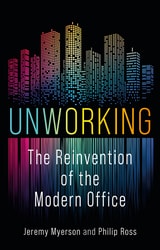
Unworking
The Reinvention of the Modern OfficeJeremy Myserson and Phillip Ross
Reaktion Books, 2022
Over the past one hundred years, the office has been integral to the development of modern society. It has shaped the architecture of our cities, the behavior of our organizations, and the everyday movements of millions of people. In 2020, however, the global pandemic brought our attendance in the office to an abrupt halt and triggered a complete reevaluation of the purpose of the workplace. This book offers a panoramic view of the office and explores what happens next. The authors advance a manifesto for “unworking”—unlearning old habits and rituals established for an outdated office and crafting and creating new ones fit for an age of digital technology, design innovation, and diverse workforces.
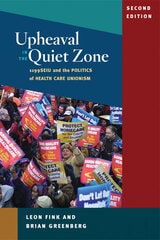
Upheaval in the Quiet Zone
1199/SEIU and the Politics of Healthcare UnionismLeon Fink and Brian Greenberg
University of Illinois Press, 2008
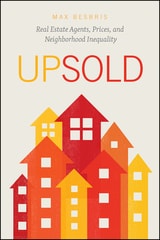
Upsold
Real Estate Agents, Prices, and Neighborhood InequalityMax Besbris
University of Chicago Press, 2020
Stratification defines cities in the contemporary United States. In an era marked by increasing income segregation, one of the main sources of this inequality is housing prices. A crucial part of wealth inequality, housing prices are also directly linked to the uneven distribution of resources across neighborhoods and to racial and ethnic segregation. Upsold shows how the interactions between real estate agents and buyers make or break neighborhood reputations and construct neighborhoods by price.
Employing revealing ethnographic and quantitative housing data, Besbris outlines precisely how social influences come together during the sales process. In Upsold, we get a deep dive into the role that the interactions with sales agents play in buyers’ decision-making and how neighborhoods are differentiated, valorized, and deemed to be worthy of a certain price.

Urban Land Use Planning, Fifth Edition
Philip R. Berke, David R. Godschalk, and Edward J. Kaiser, with Daniel A. Rodriguez
University of Illinois Press, 2006
Divided into three sections, this edition of Urban Land Use Planning deftly balances an authoritative, up-to-date discussion of current practices with a vision of what land use planning should become. It explores the societal context of land use planning and proposes a model for understanding and reconciling the divergent priorities among competing stakeholders; it explains how to build planning support systems to assess future conditions, evaluate policy choices, create visions, and compare scenarios; and it sets forth a methodology for creating plans that will influence future land use change.
Discussions new to the fifth edition include how to incorporate the three Es of sustainable development (economy, environment, and equity) into sustainable communities, methods for including livability objectives and techniques, the integration of transportation and land use, the use of digital media in planning support systems, and collective urban design based on analysis and public participation.
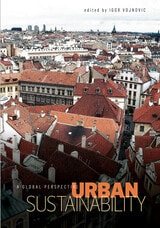
Urban Sustainability
A Global PerspectiveIgor Vojnovic
Michigan State University Press, 2012
More than half the world’s population currently lives in urban areas, and virtually all of the world’s population growth over the next three decades is expected to be in cities. What impact will this growth have on the environment? What can we do now to pave the way for resource longevity? Sustainability has received considerable attention in recent years, though conceptions of the term remain vague. Using a wide array of cities around the globe as case studies, this timely book explores the varying nature of global urban-environmental stresses and the complexities involved in defining sustainability policies. Working with six core themes, the editor examines the past, present, and future of urban sustainability within local, national, and global contexts.