547 books match the query 'California' and 4 start with u

cover of Unpacking My Father's Bookstore

Unpacking My Father's Bookstore

Laurence Roth

Rutgers University Press, 2025

2026 Independent Publisher Book Awards (IPPY) Silver Medal in the West – Pacific Non-Fiction category

Unpacking My Father’s Bookstore brings to life the history of J. Roth / Bookseller of Fine & Scholarly Judaica, which was a microcosm of the Los Angeles Jewish community from 1966 to 1994 and one of the premier Jewish bookstores in the United States. Blending critical analysis with a personal account of growing up in his father’s bookstore, and connecting both to larger forces that helped shape Jewish and American book retailing in the twentieth-century, Laurence Roth crafts a richly felt narrative about his family’s Jewish experience in America. It is a reminder, too, that while most independent bookstores like J. Roth Bookseller disappear from history, these retailers often had outsized effects on their communities. Breaking with conventional modes of scholarship, Unpacking My Father’s Bookstore tells a unique and troubled story that rarely gets told, one that is both personal and analytical, theoretical but rooted in the everyday.
[more]
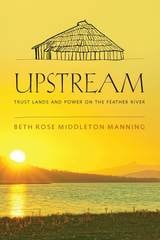
cover of Upstream: Trust Lands and Power on the Feather River

Upstream

Trust Lands and Power on the Feather River

Beth Rose Middleton Manning

University of Arizona Press, 2018

From Mandan, Hidatsa, and Arikara lands in South Dakota; to Cherokee lands in Tennessee; to Sin-Aikst, Lakes, and Colville lands in Washington; to Chemehuevi lands in Arizona; to Maidu, Pit River, and Wintu lands in northern California, Native lands and communities have been treated as sacrifice zones for national priorities of irrigation, flood control, and hydroelectric development.

Upstream documents the significance of the Allotment Era to a long and ongoing history of cultural and community disruption. It also details Indigenous resistance to both hydropower and disruptive conservation efforts. With a focus on northeastern California, this book highlights points of intervention to increase justice for Indigenous peoples in contemporary natural resource policy making.

Author Beth Rose Middleton Manning relates the history behind the nation’s largest state-built water and power conveyance system, California’s State Water Project, with a focus on Indigenous resistance and activism. She illustrates how Indigenous history should inform contemporary conservation measures and reveals institutionalized injustices in natural resource planning and the persistent need for advocacy for Indigenous restitution and recognition.

Upstream uses a multidisciplinary and multitemporal approach, weaving together compelling stories with a study of placemaking and land development. It offers a vision of policy reform that will lead to improved Indigenous futures at sites of Indigenous land and water divestiture around the nation.
 
[more]
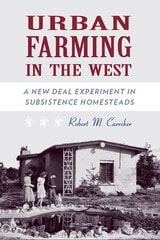
cover of Urban Farming in the West: A New Deal Experiment in Subsistence Homesteads

Urban Farming in the West

A New Deal Experiment in Subsistence Homesteads

Robert Carriker

University of Arizona Press, 2010

From 1933 to 1935, the federal government’s Division of Subsistence Homesteads created thirty-four New Deal communities that sought to provide a healthier and more economically secure life for disadvantaged Americans. These settlements were designed to combine the benefits of rural and urban living by offering part-time farming, uplifting social functions, and inexpensive homes. Four were located in the West: in Phoenix, Arizona; El Monte and San Fernando, California; and Longview, Washington.

Robert Carriker examines for the first time the intricate histories of these subsistence homestead projects, which have long been buried in bureaucratic records and clouded by misunderstanding, showing that in many ways they were among the agency’s most successful efforts. He provides case studies of the projects, rescuing their obscure histories using archival documents and rare photographs. He also reveals the machinations of civic groups and private citizens across the West who jockeyed for access to the funds being allotted for New Deal community building.

By describing what took place on these western homesteads, Carriker shows that the DSH’s agenda was not as far-fetched as some have reported. The tendency to condemn the Division and its projects, he argues, has failed to appreciate the good that came from some of the individual homestead communities—particularly those in the Far West.

Although overshadowed by the larger undertakings of the New Deal, some of these western communities remain thriving neighborhoods—living legacies to FDR’s efforts that show how the country once chose to deal with economic hardship. Too often the DSH is noted for its failures; Carriker’s study shows that its western homesteads were instead qualified accomplishments.
[more]
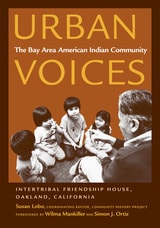
cover of Urban Voices: The Bay Area American Indian Community

Urban Voices

The Bay Area American Indian Community

Susan Lobo, Coordinating Editor, Community History Project; Forewords by Wilma Mankiller and Simon J. Ortiz

University of Arizona Press, 2002

California has always been America's promised land—for American Indians as much as anyone. In the 1950s, Native people from all over the United States moved to the San Francisco Bay Area as part of the Bureau of Indian Affairs Relocation Program. Oakland was a major destination of this program, and once there, Indian people arriving from rural and reservation areas had to adjust to urban living. They did it by creating a cooperative, multi-tribal community—not a geographic community, but rather a network of people linked by shared experiences and understandings. The Intertribal Friendship House in Oakland became a sanctuary during times of upheaval in people's lives and the heart of a vibrant American Indian community. As one long-time resident observes, "The Wednesday Night Dinner at the Friendship House was a must if you wanted to know what was happening among Native people." One of the oldest urban Indian organizations in the country, it continues to serve as a gathering place for newcomers as well as for the descendants of families who arrived half a century ago. This album of essays, photographs, stories, and art chronicles some of the people and events that have played—and continue to play—a role in the lives of Native families in the Bay Area Indian community over the past seventy years. Based on years of work by more than ninety individuals who have participated in the Bay Area Indian community and assembled by the Community History Project at the Intertribal Friendship House, it traces the community's changes from before and during the relocation period through the building of community institutions. It then offers insight into American Indian activism of the 1960s and '70s—including the occupation of Alcatraz—and shows how the Indian community continues to be created and re-created for future generations. Together, these perspectives weave a richly textured portrait that offers an extraordinary inside view of American Indian urban life. Through oral histories, written pieces prepared especially for this book, graphic images, and even news clippings, Urban Voices collects a bundle of memories that hold deep and rich meaning for those who are a part of the Bay Area Indian community—accounts that will be familiar to Indian people living in cities throughout the United States. And through this collection, non-Indians can gain a better understanding of Indian people in America today. "If anything this book is expressive of, it is the insistence that Native people will be who they are as Indians living in urban communities, Natives thriving as cultural people strong in Indian ethnicity, and Natives helping each other socially, spiritually, economically, and politically no matter what. I lived in the Bay Area in 1975-79 and 1986-87, and I was always struck by the Native (many people do say 'American Indian' emphatically!) community and its cultural identity that has always insisted on being second to none. Yes, indeed this book is a dynamic, living document and tribute to the Oakland Indian community as well as to the Bay Area Indian community as a whole." —Simon J. Ortiz "When my family arrived in San Francisco in 1957, the people at the original San Francisco Indian Center helped us adjust to urban living. Many years later, I moved to Oakland and the Intertribal Friendship House became my sanctuary during a tumultuous time in my life. The Intertribal Friendship House was more than an organization. It was the heart of a vibrant tribal community. When we returned to our Oklahoma homelands twenty years later, we took incredible memories of the many people in the Bay Area who helped shape our values and beliefs, some of whom are included in this book." —Wilma Mankiller, former Principal Chief, Cherokee Nation
[more]