Results by title
282 books match the query 'Caribbean & West Indies' and 4 start with u
Undisciplined Cuba
Tracing Continuities of Resistance and Archipelagic GeographiesChristina M. García
Rutgers University Press, 2027
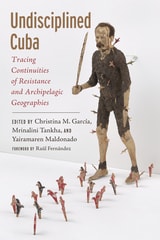
Undisciplined Cuba brings scholars of diverse disciplines and moves through multiple temporalities and geographies, allowing Cuba to emerge as a negotiated reality. Rather than rehearse narratives of exceptionalism and Cold War relationships that have detached the nation from its Antillean neighbors, this edited volume understands Cuba as deeply embedded in the Caribbean archipelago. Its chapters encompass feminist activism, public health, cinema for social justice, marine geopoetics, racial geographies, and literary corporealities. Drawing from an archipelagic framework and a decolonial practice of undisciplining, the anthology counters the tendency to treat landscapes, and cultural and political manifestations as artifacts of a national identity or evidence of a discrete geopolitical entity. Instead, Undisciplined Cuba attends to processes, to dynamic relations and continuities of resistance that defy periodization and institutional representation. The book offers a granular view of Cuba and an approach to Caribbean studies that imagines networks in excess of traditional categories of thought.
Undocumented Dominican Migration
By Frank Graziano
University of Texas Press, 2013
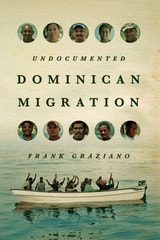
Undocumented Dominican Migration is the first comprehensive study of boat migration from the Dominican Republic to Puerto Rico. It brings together the interactive global, cultural, and personal factors that induce thousands of Dominicans to journey across the Mona Passage in attempts to escape chronic poverty. The book provides in-depth treatment of decision-making, experiences at sea, migrant smuggling operations, and U.S. border enforcement. It also explores several topics that are rare in migration studies. These include the psychology of migrant motivation, religious beliefs, corruption and impunity, procreation and parenting, compulsive recidivism after failed attempts, social values in relation to law, marriage fraud, and the use of false documents for air travel from Puerto Rico to the mainland United States.
Frank Graziano’s extensive fieldwork among migrants, smugglers, and federal agencies provides an authority and immediacy that brings the reader close to the migrants’ experiences. The exhaustive research and multidisciplinary approach, highly readable narrative, and focus on lesser-known emigrants make Undocumented Dominican Migration an essential addition to public and academic debates about migration.

Ups and Downs of Life in the Indies
P. A. Daum
University of Massachusetts Press, 1987
Urban Space as Heritage in Late Colonial Cuba
Classicism and Dissonance on the Plaza de Armas of Havana, 1754-1828By Paul Niell
University of Texas Press, 2015
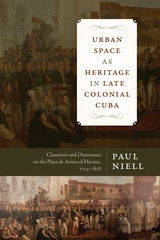
According to national legend, Havana, Cuba, was founded under the shade of a ceiba tree whose branches sheltered the island’s first Catholic mass and meeting of the town council (cabildo) in 1519. The founding site was first memorialized in 1754 by the erection of a baroque monument in Havana’s central Plaza de Armas, which was reconfigured in 1828 by the addition of a neoclassical work, El Templete. Viewing the transformation of the Plaza de Armas from the new perspective of heritage studies, this book investigates how late colonial Cuban society narrated Havana’s founding to valorize Spanish imperial power and used the monuments to underpin a local sense of place and cultural authenticity, civic achievement, and social order.
Paul Niell analyzes how Cubans produced heritage at the site of the symbolic ceiba tree by endowing the collective urban space of the plaza with a cultural authority that used the past to validate various place identities in the present. Niell’s close examination of the extant forms of the 1754 and 1828 civic monuments, which include academic history paintings, neoclassical architecture, and idealized sculpture in tandem with period documents and printed texts, reveals a “dissonance of heritage”—in other words, a lack of agreement as to the works’ significance and use. He considers the implications of this dissonance with respect to a wide array of interests in late colonial Havana, showing how heritage as a dominant cultural discourse was used to manage and even disinherit certain sectors of the colonial population.