Results by title
208 books match the query 'Christian Church' and 3 start with u
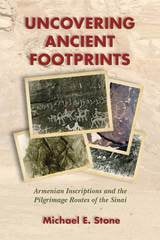
Uncovering Ancient Footprints
Armenian Inscriptions and the Pilgrimage Routes of the SinaiMichael E. Stone
SBL Press, 2017
Explore pilgrimage routes, epigraphy, and the history of writing with an expert guide
From the late 1970s through 1982, Michael E. Stone conducted a number of expeditions to the Sinai peninsula, searching for ancient inscriptions. In this book Stone describes his search, crowned by the discovery of the most ancient Armenian inscriptions known. Here Stone describes not only the inscriptions discovered along his journeys but also the Sinai, its past and present, its human inhabitants, its flora and fauna, and its history. Though once common, well-informed travel books to the Middle East with a broad academic interest and a specific focus have become rare. Stone’s diary of his expeditions in the Sinai fill this gap with vivid descriptions, poetry, and illustrations.
Features
- An account of five expeditions into the Sinai
- Thirteen poems written by Stone
- Twenty-six figures and five maps
Unity in Christ and Country
American Presbyterians in the Revolutionary Era, 1758–1801William Harrison Taylor
University of Alabama Press, 2017
In Unity in Christ and Country: American Presbyterians in the Revolutionary Era, 1758–1801, William Harrison Taylor investigates the American Presbyterian Church’s pursuit of Christian unity and demonstrates how, through this effort, the church helped to shape the issues that gripped the American imagination, including evangelism, the conflict with Great Britain, slavery, nationalism, and sectionalism. When the colonial Presbyterian Church reunited in 1758, a nearly twenty-year schism was brought to an end. To aid in reconciling the factions, church leaders called for Presbyterians to work more closely with other Christian denominations. Their ultimate goal was to heal divisions, not just within their own faith but also within colonial North America as a whole.
Taylor contends that a self-imposed interdenominational transformation began in the American Presbyterian Church upon its reunion in 1758. However, this process was altered by the church’s experience during the American Revolution, which resulted in goals of Christian unity that had both spiritual and national objectives. Nonetheless, by the end of the century, even as the leaders in the Presbyterian Church strove for unity in Christ and country, fissures began to develop in the church that would one day divide it and further the sectional rift that would lead to the Civil War.
Taylor engages a variety of sources, including the published and unpublished works of both the Synods of New York and Philadelphia and the General Assembly of the Presbyterian Church in the United States, as well as numerous published and unpublished Presbyterian sermons, lectures, hymnals, poetry, and letters. Scholars of religious history, particularly those interested in the Reformed tradition, and specifically Presbyterianism, should find Unity in Christ and Country useful as a way to consider the importance of the theology’s intellectual and pragmatic implications for members of the faith.
Uplifting the People
Three Centuries of Black Baptists in AlabamaWilson Fallin Jr.
University of Alabama Press, 2007
Three centuries of faith, leadership, and community building in Alabama's Black Baptist tradition.
Uplifting the People is a history of the Alabama Missionary Baptist State Convention—its origins, churches, associations, conventions, and leaders. Fallin demonstrates that a distinctive Afro-Baptist faith emerged as slaves in Alabama combined the African religious emphasis on spirit possession, soul-travel, and rebirth with the evangelical faith of Baptists. The denomination emphasizes a conversion experience that brings salvation, spiritual freedom, love, joy, and patience, and also stresses liberation from slavery and oppression and highlights the exodus experience. In examining the social and theological development of the Afro-Baptist faith over the course of three centuries, Uplifting the People demonstrates how black Baptists in Alabama used faith to cope with hostility and repression.
Fallin reveals that black Baptist churches were far more than places of worship. They functioned as self-help institutions within black communities and served as gathering places for social clubs, benevolent organizations, and political meetings. Church leaders did more than conduct services; they protested segregation and disfranchisement, founded and operated schools, and provided community leaders for the civil rights movement of the mid-20th century.
Through black churches, members built banking systems, insurance companies, and welfare structures. Since the gains of the civil rights era, black Baptists have worked to maintain the accomplishments of that struggle, church leaders continue to speak for social justice and the rights of the poor, and churches now house day care and Head Start programs. Uplifting the People also explores the role of women, the relations between black and white Baptists, and class formation within the black church.