Results by title
172 books match the query 'Citizenship' and 2 start with u
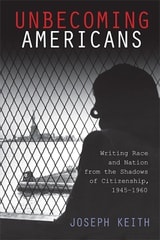
Unbecoming Americans
Writing Race and Nation from the Shadows of Citizenship, 1945-1960Keith, Joseph
Rutgers University Press, 2013
During the Cold War, Ellis Island no longer served as the largest port of entry for immigrants, but as a prison for holding aliens the state wished to deport. The government criminalized those it considered un-assimilable (from left-wing intellectuals and black radicals to racialized migrant laborers) through the denial, annulment, and curtailment of citizenship and its rights. The island, ceasing to represent the iconic ideal of immigrant America, came to symbolize its very limits.
Unbecoming Americans sets out to recover the shadow narratives of un-American writers forged out of the racial and political limits of citizenship. In this collection of Afro-Caribbean, Filipino, and African American writers—C.L.R. James, Carlos Bulosan, Claudia Jones, and Richard Wright—Joseph Keith examines how they used their exclusion from the nation, a condition he terms “alienage,” as a standpoint from which to imagine alternative global solidarities and to interrogate the contradictions of the United States as a country, a republic, and an empire at the dawn of the "American Century.”
Building on scholarship linking the forms of the novel to those of the nation, the book explores how these writers employed alternative aesthetic forms, including memoir, cultural criticism, and travel narrative, to contest prevailing notions of race, nation, and citizenship. Ultimately they produced a vital counter-discourse of freedom in opposition to the new formations of empire emerging in the years after World War II, forms that continue to shape our world today.
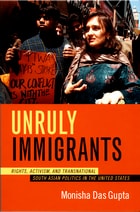
Unruly Immigrants
Rights, Activism, and Transnational South Asian Politics in the United StatesMonisha Das Gupta
Duke University Press, 2006
Das Gupta offers an ethnography of seven South Asian organizations in the northeastern United States, looking at their development and politics as well as the conflicts that have emerged within the groups over questions of sexual, class, and political identities. She examines the ways that women’s organizations have defined and responded to questions of domestic violence as they relate to women’s immigration status; she describes the construction of a transnational South Asian queer identity and culture by people often marginalized by both mainstream South Asian and queer communities in the United States; and she draws attention to the efforts of labor groups who have sought economic justice for taxi drivers and domestic workers by confronting local policies that exploit cheap immigrant labor. Responding to the shortcomings of the state, their communities, and the larger social movements of which they are a part, these groups challenge the assumption that citizenship is the necessary basis of rights claims.