Results by title
188 books match the query 'City planning' and 10 start with u
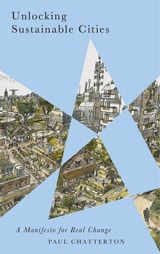
Unlocking Sustainable Cities
A Manifesto for Real ChangePaul Chatterton
Pluto Press, 2018
Across the world, people are implementing promising new practices—from transforming abandoned public spaces and setting up community co-operatives, to rewilding urban nature and powering up civic energy. Paul Chatterton explores how these grassroots experiments harness the creative power of the collective to transform our city systems, from transportation, energy, and economy, to community, democracy, and nature. Imagining radical alternatives—such as car-free, post-carbon, “bio cities”—this is a toolkit for realizing a better urban future.

Urban Design
Alex Krieger
University of Minnesota Press, 2009
Highlights key issues in contemporary urban design through a discussion of its origins, current state, and future
Fifty years ago a landmark conference at Harvard University established urban design as a distinct architectural and planning practice. Today, with the world’s urban population surpassing three billion people, urban design has become more crucial than ever. Indeed, the concerns that initially brought leading architects and city planners together—including concerns over sprawl, pollution, and aging infrastructure—have only intensified over the past half century.
In Urban Design, Alex Krieger and William S. Saunders have assembled prominent figures in architecture, planning, and landscape design to look back on the evolution of the discipline of urban design; assess the current state of the field; and anticipate the challenges posed by the unprecedented rate of urbanization, particularly in the developing world, and how the profession will need to adapt in order to confront them. The volume opens with excerpts from transcripts of the 1956 Harvard conference followed by essays that contextualize and critique its assumptions and ambitions. Subsequent essays address such topics as the social conscience of urban design and stake out the competing sensibilities in the field, from New Urbanism to avant-garde. As humanity becomes an urban species to a degree that was unimaginable fifty years ago, this comprehensive volume seeks to encourage today’s designers to draw on the energy and messy vitality of cities in shaping tomorrow’s urban environments.Contributors: Jonathan Barnett, Denise Scott Brown, Joan Busquets, Kenneth Greenberg, John Kaliski, Timothy Love, Fumihiko Maki, Richard Marshall, Eric Mumford, Michelle Provoost, Peter G. Rowe, Edward W. Soja, Richard M. Sommer, Michael Sorkin, Emily Talen, Marilyn Jordan Taylor, Wouter Vanstiphout, Charles Waldheim.
Urban Design in Western Europe
Regime and Architecture, 900-1900Wolfgang Braunfels
University of Chicago Press, 1990

Urban Land Use Planning, Fifth Edition
Philip R. Berke, David R. Godschalk, and Edward J. Kaiser, with Daniel A. Rodriguez
University of Illinois Press, 2006
Divided into three sections, this edition of Urban Land Use Planning deftly balances an authoritative, up-to-date discussion of current practices with a vision of what land use planning should become. It explores the societal context of land use planning and proposes a model for understanding and reconciling the divergent priorities among competing stakeholders; it explains how to build planning support systems to assess future conditions, evaluate policy choices, create visions, and compare scenarios; and it sets forth a methodology for creating plans that will influence future land use change.
Discussions new to the fifth edition include how to incorporate the three Es of sustainable development (economy, environment, and equity) into sustainable communities, methods for including livability objectives and techniques, the integration of transportation and land use, the use of digital media in planning support systems, and collective urban design based on analysis and public participation.
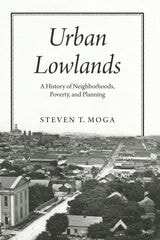
Urban Lowlands
A History of Neighborhoods, Poverty, and PlanningSteven T. Moga
University of Chicago Press, 2020
In Urban Lowlands, Steven T. Moga looks closely at the Harlem Flats in New York City, Black Bottom in Nashville, Swede Hollow in Saint Paul, and the Flats in Los Angeles, to interrogate the connections between a city’s actual landscape and the poverty and social problems that are often concentrated at its literal lowest points. Taking an interdisciplinary perspective on the history of US urban development from the nineteenth to the mid-twentieth century, Moga reveals patterns of inequitable land use, economic dispossession, and social discrimination against immigrants and minorities. In attending to the landscapes of neighborhoods typically considered slums, Moga shows how physical and policy-driven containment has shaped the lives of the urban poor, while wealth and access to resources have been historically concentrated in elevated areas—truly “the heights.” Moga’s innovative framework expands our understanding of how planning and economic segregation alike have molded the American city.
Urban Planning in the Nordic World
Ellen Braae
University of Wisconsin Press, 2022
Urban planning is a keystone in the materialization of the Nordic welfare states. That is not to say that there is one particular city form or planning practice that is synonymous with the emerging welfare city, as welfare per se is far from normative. On the contrary, welfare is a highly ambiguous and contested notion that has changed over the postwar decades, which is also reflected in the development of the welfare city.
However, welfare in urban planning has mainly been associated with ideas of “the good life” and egalitarianism. In a Nordic context, the state has taken the lead in providing the social engineering “hardware” for advancing this universal aim. Social demographic welfare is economically based on full employment, and in this regard housing and caregiving support are key components. Yet education, infrastructure, and leisure facilities are also basic features in the distribution of universal welfare services for citizens’ entire lives. The results, ideally, are green and spacious welfare cities.
This book outlines the origins, development, challenges, and lived realities of the changing welfare city, focusing primarily on Denmark. Strategies have changed over the decades as models of development have shifted and as the needs of society and a warming planet have come into focus. The current welfare city can be described as an urban landscape characterized by, on the one hand, a division of functions and, on the other, mutual competition. The role of the state has been minimized, turning municipalities into the new major agents in attracting taxpayers and providing goods—both by means of urban planning.
Urban Policy in the Time of Obama
James DeFilippis
University of Minnesota Press, 2016
With his background as a community organizer and as a state legislator representing Chicago’s South Side, Barack Obama became America’s most “urban” president since Teddy Roosevelt. But what has been his record in dealing with the issues most impacting our metropolitan areas today? Looking past the current administration, what are the future prospects of the nation’s cities, and how have they been shaped by our policies in this century? Seeking to answer these questions, the contributors to Urban Policy in the Time of Obama explore a broad range of policy arenas that shape, both directly and indirectly, metropolitan areas and urbanization processes.
This volume reveals the Obama administration’s surprisingly limited impact on cities, through direct policy initiatives such as Strong Cities, Strong Communities, Promise Neighborhoods, and Choice Neighborhood Initiatives. There has been greater impact with broader policies that shape urban life and governance, including immigration reform, education, and health care.
Closing with Cedric Johnson’s afterword illuminating the Black Lives Matter movement and what its broader social context says about city governance in our times, Urban Policy in the Time of Obama finds that most of the dominant policies and policy regimes of recent years have fallen short of easing the ills of America’s cities, and calls for a more equitable and just urban policy regime.
Contributors: Rachel G. Bratt, Tufts University; Christine Thurlow Brenner, University of Massachusetts Boston; Karen Chapple, University of California, Berkeley; James Fraser, Vanderbilt University; Edward G. Goetz, University of Minnesota; Dan Immergluck, Georgia Tech; Amy T. Khare, University of Chicago; Robert W. Lake, Rutgers University; Pauline Lipman, University of Illinois at Chicago; Lorraine C. Minnite, Rutgers University–Camden; Kathe Newman, Rutgers University; Deirdre Oakley, Georgia State; Frances Fox Piven, City University of New York; Hilary Silver, Brown University; Janet Smith, University of Illinois at Chicago; Preston H. Smith II, Mount Holyoke College; Todd Swanstrom, University of Missouri–St. Louis; Nik Theodore, University of Illinois at Chicago; J. Phillip Thompson, MIT.

Urban Regimes and Strategies
Building Europe's Central Executive District in BrusselsAlex G. Papadopoulos
University of Chicago Press, 1996
In Brussels, Belgium—since 1957 home to the European Union—such change is taking place. Observing the change, Alexis G. Papadopoulos explores a new geographical concept, the Central Executive District. This urban form is significantly different from the Central Business District, its conventional counterpart. Drawing on game and rational choice theories, spatial analysis, and land economics, the author analyzes how the landscape of the city's center has evolved over the last three decades under the influence of successive coalitions of local and foreign elites. He describes how foreign diplomats, international corporate executives, and real-estate developers cooperate with one another to carry out major urban projects in the face of resistance from local neighborhood groups, conservationists, and political factions.
This study makes a substantial contribution to geography and urban studies both for its implications about the future of world cities like New York, London, and Paris and for its original application of the notion of cooperative regimes.
Urban Sustainability
A Global PerspectiveIgor Vojnovic
Michigan State University Press, 2012
More than half the world’s population currently lives in urban areas, and virtually all of the world’s population growth over the next three decades is expected to be in cities. What impact will this growth have on the environment? What can we do now to pave the way for resource longevity? Sustainability has received considerable attention in recent years, though conceptions of the term remain vague. Using a wide array of cities around the globe as case studies, this timely book explores the varying nature of global urban-environmental stresses and the complexities involved in defining sustainability policies. Working with six core themes, the editor examines the past, present, and future of urban sustainability within local, national, and global contexts.
Urban Transformations in Sierra Leone
Knowledge Co-Production and Partnerships for a Just CityEdited by Joseph M. Macarthy, Braima Koroma, Andrea Rigon, Alexandre Apsan Frediani, and Andrea Klingel
University College London, 2024
With a population of over one million, Freetown, Sierra Leone faces serious challenges with service provisions, housing, infrastructure, employment, and climate change. In 2015, the Sierra Leone Urban Research Centre (SLURC) was established to address these challenges through research, capacity building, and advocacy. Urban Transformations in Sierra Leone shares SLURC’s progress, articulating its key findings and reflections on the partnerships it helped enable.