Results by title
808 books match the query 'Civilization' and 11 start with u
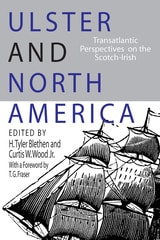
Ulster and North America
Transatlantic Perspectives on the Scotch IrishH. Tyler Blethen
University of Alabama Press, 2001
The 11 essays in this volume, originally presented at meetings of the Ulster-American Heritage Symposium by scholars from Scotland, Ireland, Canada, and the United States, explore the nature of Scotch-Irish culture by examining values, traditions, demographics, and language. The essays also investigate the process of migration, which transmitted that culture to the New World, and the subsequent assimilation of Celtic ways into American culture.
The themes presented are wide-ranging and complex. First is the dynamic nature of Ulster society in the 17th and 18th centuries and the rapid changes occurring there, especially those affecting Presbyterianism and community cohesiveness. Also examined is the experience of migration, asking such questions as who migrated and when, what their expectations were, and how closely colonial reality matched those expectations. A third theme is the development of economic strategies and community-building both in Ulster and North America, making important contributions to the "new rural history" and explaining the success of the Scotch-Irish on the American frontier. Finally, the volume addresses ethnic identity and cultural diffusion, advancing the ongoing debate initiated by Forrest McDonald and Grady McWhiney and elaborated on by David Hackett Fischer. Ulster and North America illustrates the value of transatlantic dialog and of comparative studies for the understanding of ethnicity and migration history.
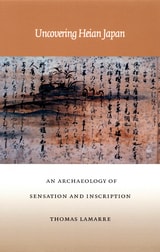
Uncovering Heian Japan
An Archaeology of Sensation and InscriptionThomas LaMarre
Duke University Press, 2000
Combining a pathbreaking visual analysis of the calligraphy with which this poetry was transcribed, a more traditional textual analysis, and a review of the politics of the period, LaMarre presents a dramatically new view of Heian poetry and culture. He challenges the assumption of a cohesive “national imagination,” seeing instead an early Japan that is ethnically diverse, territorially porous, and indifferent to linguistic boundaries. Working through the problems posed by institutionalized notions of nationalism, nativism, and modernism, LaMarre rethinks the theories of scholars such as Suzuki Hideo, Yoshimoto Takaaki, and Komatsu Shigemi, in conjunction with theorists such as Derrida, Karatani, Foucault, and Deleuze. Contesting the notion that speech is central to the formation of community, Uncovering Heian Japan focuses instead on the potential centrality of the more figural operations of poetic practice.
Specialists in Japanese history and culture as well as scholars working in other areas of cultural criticism will find that this book enriches their understanding of an early Japan that has exerted so much influence on later concepts of what it means to be Japanese.
Understanding Europe (The Works of Christopher Dawson)
Christopher Dawson
Catholic University of America Press, 2009
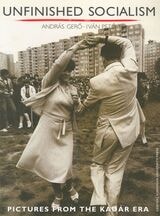
Unfinished Socialism
Pictures from the Kádár EraAndrás Gero
Central European University Press, 1999
This extraordinary book provides a snapshot of socialism throughout the Kádár regime in Hungary (1956-1989) and captures the essence of the world behind the ‘iron curtain’ in a stunning, and often stark, collection of photographs.
Unfinished Socialism is a visually stunning anthropological study containing 450 photographs, many previously unpublished, which portray life in Hungary from every angle: from the May Day March to pop music and from the homeless to sport.
With an introduction that will help the reader understand and appreciate the true meaning of the photographs, this political, social and cultural study of the Kádár years transports the reader back to a time of great significance in Hungary’s long and turbulent history.
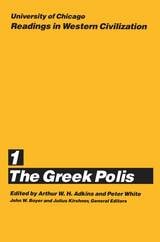
University of Chicago Readings in Western Civilization, Volume 1
The Greek PolisEdited by Arthur W. H. Adkins and Peter White
University of Chicago Press, 1986
Individual volumes provide essential background reading for courses covering specific eras and periods. The complete nine-volume series is ideal for general courses in history and Western civilization sequences.
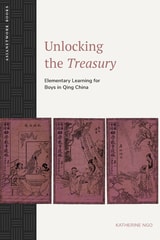
Unlocking the Treasury
Elementary Learning for Boys in Qing ChinaKatherine Ngo
Lever Press, 2025
Unlocking the Treasury grounds its study of primary education in the intellectual history of the period. Using the concept of interpretive communities, Katherine Ngo explores the impact of socio-political influences and differences in Qing schools of thought, including the school of principle, the school of heart-mind, and practical learning. As such, this volume examines the Treasury through three critical readings of the text: as a handbook for practical learning, a child-oriented reading of the school of heart-mind, and the instrumental perspective of education as examination training.
Ngo reframes the curricular content, skills, learning approaches, and teaching strategies of Chinese pre-modern elementary education with the goal of facilitating a broader transcultural dialogue in contemporary education. Far from the notion of traditional Chinese elementary education being monolithic and “rote learning,” Unlocking the Treasury reveals that elementary learning in the Qing dynasty offered a sophisticated and complex educational agenda with diverse learning goals of examination, preparation, moral development, and textual scholarship training that were shaped by intellectual trends of the time. An engaging text for scholars of Qing China and historians of education alike, Katherine Ngo’s Unlocking the Treasury is essential to understanding the philosophical, historical, literary, and psychological dimensions of education and educational theory in the Qing era.
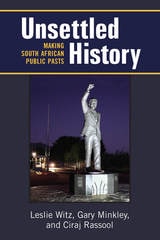
Unsettled History
Making South African Public PastsLeslie Witz, Gary Minkley, and Ciraj Rassool
University of Michigan Press, 2017
Leslie Witz, Gary Minkley, and Ciraj Rassool take the reader to sites of historical production in which complex ideas about pasts are invoked, and navigate a path toward understanding the agencies of image-making and memory production. This volume is the outcome of the authors’ intensive collaborative research and engagement over twenty-five years on questions including the production and performance of apartheid history; the cultural politics of social history; South Africa’s Truth and Reconciliation Commission and practices of orality; tourism as an arena of image-making and historical construction; museums as sites of heritage production for a new South Africa; photographs, archival meanings, and the construction of the social documentary; and the centenary commemorations of the South African War and the making of race. The authors not only witnessed many of these instances of history-making but were also participants in their constitution.
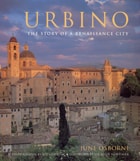
Urbino
The Story of a Renaissance CityJune Osborne
University of Chicago Press, 2003
With Urbino: The Story of a Renaissance City, art historian June Osborne brings to life not only the great city and its art but also its turbulent history and the intrigue surrounding its ruling family. First settled by the ancient Umbrians, Urbino reached its zenith during the fifteenth century under the rule of Duke Federico da Montefeltro and his son Guidobaldo. Federico may have been a usurper and a fierce, opportunistic warlord, but his lust for power was more than matched by his passion for great art. Indeed it was under his direct guidance that the magnificent Ducal Palace was built—its perfectly proportioned courtyard a wonder of early Renaissance architecture.
Today the Ducal Palace hosts the National Gallery of the Marches, one of the most important art galleries in Italy, featuring works by no lesser lights than Raphael, Uccello, Piero della Francesca, and Titian. Exploring such sites as the fourteenth-century Oratorio di San Giovanni Battista and the Gothic Church of San Domenico, Osborne captures not only the startling beauty of Urbino and the Apennine foothills but also the tumultuous legacy of Frederico and his son (and their many wives and courtiers).
With over a hundred lavish color photographs, many by renowned landscape photographer Joe Cornish, Urbino is the best—and the only—guide to this gem of the Italian Marches.
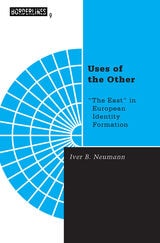
Uses Of The Other
“The East” in European Identity FormationIver B. Neumann
University of Minnesota Press, 1998
Examines identity politics in the context of international relations.
The field of international relations has recently witnessed a tremendous growth of interest in the theme of identity and its formation, construction, and deconstruction. In Uses of the Other, Iver B. Neumann demonstrates how thinking about identity in terms of the self and other may prove highly useful in the study of world politics.
Neumann begins by tracing the four different paths along which this thinking has developed during this century-ethnographic, psychological, Continental philosophical, and “Eastern excursion”-and he shows how these blended at the margins of the discipline of international relations at the end of the 1980s. There follow several incisive readings of European identity formations on the all-European, regional, and national levels. The theme that draws these readings together is how “the East” is used as a sign of otherness at all three levels. Whereas previous studies framed this process as part of colonial and postcolonial developments, this book suggests that “Easternness” is also present as a marker in contemporary discourses about Russia, Turkey, Central Europe, and Bashkortostan, among others. Situating his work in contemporary critical debates, Neumann argues that, while the self/other perspective is always of relevance, it is now more in need of being used as a perspective on specific sequences of identity formation than of further embellishment.ISBN: 0-8166-3082-8 Cloth $49.95xxISBN: 0-8166-3083-6 Paper $19.95x248 Pages 5-7/8x9 NovemberBorderlines Series, Volume 9Translation inquiries: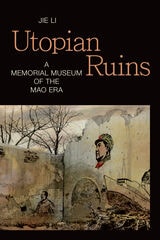
Utopian Ruins
A Memorial Museum of the Mao EraJie Li
Duke University Press, 2020
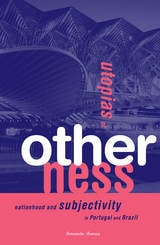
Utopias Of Otherness
Nationhood And Subjectivity In Portugal And BrazilFernando Arenas
University of Minnesota Press, 2003
Forges a new understanding of how these two Lusophone nations are connected
The closely entwined histories of Portugal and Brazil remain key references for understanding developments—past and present—in either country. Accordingly, Fernando Arenas considers Portugal and Brazil in relation to one another in this exploration of changing definitions of nationhood, subjectivity, and utopias in both cultures. Examining the two nations’s shared language and histories as well as their cultural, social, and political points of divergence, Arenas pursues these definitive changes through the realms of literature, intellectual thought, popular culture, and political discourse.
Both Brazil and Portugal are subject to the economic, political, and cultural forces of postmodern globalization. Arenas analyzes responses to these trends in contemporary writers including José Saramago, Caio Fernando Abreu, Maria Isabel Barreno, Vergílio Ferreira, Clarice Lispector, and Maria Gabriela Llansol. Ultimately, Utopias of Otherness shows how these writers have redefined the concept of nationhood, not only through their investment in utopian or emancipatory causes such as Marxist revolution, women’s liberation, or sexual revolution, but also by shifting their attention to alternative modes of conceiving the ethical and political realms.