Results by title
173 books match the query 'Collective Memory' and 4 start with u

Unbecoming Nationalism
From Commemoration to Redress in CanadaHelene Vosters
University of Manitoba Press, 2019
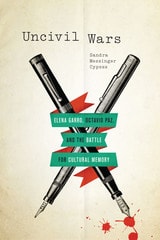
Uncivil Wars
Elena Garro, Octavio Paz, and the Battle for Cultural MemoryBy Sandra Messinger Cypess
University of Texas Press, 2012
The first English-language book to place the works of Elena Garro (1916–1998) and Octavio Paz (1914–1998) in dialogue with each other, Uncivil Wars evokes the lives of two celebrated literary figures who wrote about many of the same experiences and contributed to the formation of Mexican national identity but were judged quite differently, primarily because of gender.
While Paz’s privileged, prize-winning legacy has endured worldwide, Garro’s literary gifts garnered no international prizes and received less attention in Latin American literary circles. Restoring a dual perspective on these two dynamic writers and their world, Uncivil Wars chronicles a collective memory of wars that shaped Mexico, and in turn shaped Garro and Paz, from the Conquest period to the Mexican Revolution; the Spanish Civil War, which the couple witnessed while traveling abroad; and the student massacre at Tlatelolco Plaza in 1968, which brought about social and political changes and further tensions in the battle of the sexes. The cultural contexts of machismo and ethnicity provide an equally rich ground for Sandra Cypess’s exploration of the tandem between the writers’ personal lives and their literary production. Uncivil Wars illuminates the complexities of Mexican society as seen through a tense marriage of two talented, often oppositional writers. The result is an alternative interpretation of the myths and realities that have shaped Mexican identity, and its literary soul, well into the twenty-first century.
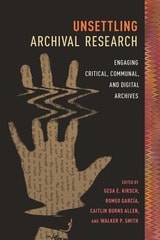
Unsettling Archival Research
Engaging Critical, Communal, and Digital ArchivesEdited by Gesa E. Kirsch, Romeo García, Caitlin Burns Allen, and Walker P. Smith
Southern Illinois University Press, 2023
A collection of accessible, interdisciplinary essays that explore archival practices to unsettle traditional archival theories and methodologies.
What would it mean to unsettle the archives? How can we better see the wounded and wounding places and histories that produce absence and silence in the name of progress and knowledge? Unsettling Archival Research sets out to answer these urgent questions and more, with essays that chart a more just path for archival work.
Unsettling Archival Research is one of the first publications in rhetoric and writing studies dedicated to scholarship that unsettles disciplinary knowledge of archival research by drawing on decolonial, Indigenous, antiracist, queer, and community perspectives. Written by established and emerging scholars, essays critique not only the practices, ideologies, and conventions of archiving, but also offer new tactics for engaging critical, communal, and digital archiving within and against systems of power. Contributors reflect on efforts to unsettle and counteract racist, colonial histories, confront the potentials and pitfalls of common archival methodologies, and chart a path for the future of archival research otherwise. Unsettling Archival Research intervenes in a critical issue: whether the discipline’s assumptions about the archives serve or fail the communities they aim to represent and what can be done to center missing voices and perspectives. The aim is to explore the ethos and praxis of bearing witness in unsettling ways, carried out as a project of queering and/or decolonizing the archives.
Unsettling Archival Research takes seriously the rhetorical force of place and wrestles honestly with histories that still haunt our nation, including the legacies of slavery, colonial violence, and systemic racism.
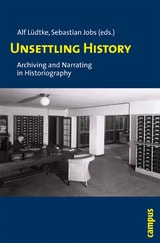
Unsettling History
Archiving and Narrating in HistoriographyEdited by Sebastian Jobs and Alf Lüdtke
Campus Verlag, 2010
In recent decades, scholars working in postcolonial history have successfully challenged the primacy of Western historiography and its Eurocentric worldview. With Unsettling History, a group of historians extend that challenge to two central components of work in history: archiving and narrating. Archival resources, they argue, despite their air of impartiality, are the product of established interests and subject to various practices of selection, cataloguing, and preservation. Narrating, too, is more complicated than it might at first seem, especially as the range of genres available to the historians for presenting their findings has expanded in recent years.