Results by title
148 books match the query 'Colonization' and 3 start with u
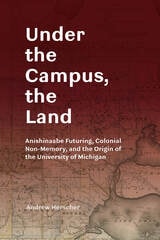
Under the Campus, the Land
Anishinaabe Futuring, Colonial Non-Memory, and the Origin of the University of MichiganAndrew Herscher
University of Michigan Press, 2025
In the 1817 Treaty of Fort Meigs, Anishinaabe leaders granted land to a college where their children could be educated. At the time, the colonial settlement of Anishinaabe homelands hardly extended beyond Detroit in what settlers called the “Michigan Territory.” Four days after the Treaty of Fort Meigs was signed, the First College of Michigania was founded to claim the land that the Anishinaabeg had just granted. Four years later, the newly-chartered University of Michigan would claim this land. By the time that the university’s successor moved to Ann Arbor twenty years later, Anishinaabe people had been forced to cede almost all their land in what had become the state of Michigan, now inhabited by almost 200,000 settlers.
Under the Campus, the Land narrates the University of Michigan’s place in both Anishinaabe and settler history, tracing the university’s participation in the colonization of Anishinaabe homelands, Anishinaabe efforts to claim their right to an education, and the university’s history of disavowing, marginalizing, and minimizing its responsibilities and obligations to Anishinaabe people. Continuing the public conversations of the same name on U-M’s campus in 2023, Under the Campus, the Land provides a new perspective on the relationship between universities and settler colonialism in the US. Members of the U-M community, scholars of Midwest history, and those interested in Indigenous studies will find this book compelling.
Under the Campus, the Land narrates the University of Michigan’s place in both Anishinaabe and settler history, tracing the university’s participation in the colonization of Anishinaabe homelands, Anishinaabe efforts to claim their right to an education, and the university’s history of disavowing, marginalizing, and minimizing its responsibilities and obligations to Anishinaabe people. Continuing the public conversations of the same name on U-M’s campus in 2023, Under the Campus, the Land provides a new perspective on the relationship between universities and settler colonialism in the US. Members of the U-M community, scholars of Midwest history, and those interested in Indigenous studies will find this book compelling.
[more]
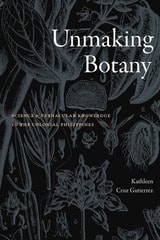
Unmaking Botany
Science and Vernacular Knowledge in the Colonial PhilippinesKathleen Cruz Gutierrez
Duke University Press, 2025
In Anglo-European botany, it is customary to think of the vernacular as that which is not a Latin or Latinized scientific plant name. In Unmaking Botany, Kathleen Cruz Gutierrez traces a history of botany in the Philippines during the last decades of Spanish rule and the first decades of US colonization. Through this history, she redefines the vernacular, expanding it to include embodied, cosmological, artistic, and varied taxonomic practices. From the culinary textures of rice and the lyrics crooned to honor a flower to the touch of a skirt woven from banana fiber, she illuminates how vernaculars of plant knowing in the Philippines exposed the philosophical and practical limits of botany. Such vernaculars remained as sovereign forms of knowledge production. Yet, at the same time, they fueled botany’s dominance over other ways of knowing plants. Revealing this tension allows Gutierrez to theorize “sovereign vernaculars,” or insight into plants that made and unmade the science, which serves as a methodological provocation to examine the interplay of different knowledge systems and to study the history of science from multiple vantage points.
[more]
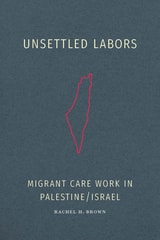
Unsettled Labors
Migrant Care Work in Palestine/IsraelRachel H. Brown
Duke University Press, 2024
In Unsettled Labors, Rachel H. Brown explores the overlooked labor of migrant workers in Israel’s eldercare industry. Brown argues that live-in eldercare in Palestine/Israel, which is primarily done by migrant workers, is an often invisible area where settler colonialism is reproduced culturally, economically, and biologically. Situating Israeli labor markets within a longer history of imperialism and dispossession of Palestinian land, Brown positions migrant eldercare within the resulting tangle of Israeli laws, policies, and social discourses. She draws from interviews with caretakers, public statements, court documents, and first-hand fieldwork to uncover the inherently contradictory nature of elder care work: the intimate presence of South and Southeast Asian workers in the home unsettles the idea of the Israeli home as an exclusively Jewish space. By paying close attention to the comparative racialization of migrant workers, Palestinians, asylum seekers, and Mizrahi and Ashkenazi settlers, Brown raises important questions of labor, social reproduction, displacement, and citizenship told through the stories of collective care provided by migrant workers in a settler colonial state.
[more]