Results by title
198 books match the query 'Community' and 3 start with u

Unionizing the Jungles
Labor and Community in the Twentieth-Century Meat-packing IndustryShelton Stromquist
University of Iowa Press, 1997
After Upton Sinclair's powerful novel appeared in 1906, “the jungle” became a compelling metaphor for life and work in the nation's meatpacking industry. Harsh living and working conditions from the killing floor to the hide cellar to the packingtowns, cycles of overwork and underemployment, and the ever-present crowds of new and unskilled laborers characterized an often-violent industry in which the appetite of workers for the protection of unions was exceeded only by the zeal of their employers to prevent workers from organizing. Unionizing the Jungles—which originated in a seminar at the University of Iowa sponsored by the Center for Recent United States History—brings together historians and anthropologists whose studies of various phases of the meatpacking industry, its unions, and its impact on communities in the twentieth century both raise and answer important questions.
The rise and decline of industrial unionism in the packinghouse industry is a unique story that casts into bold relief the conflicts between labor and capital and the tensions based on race and gender in a perpetually changing workforce. The essayists in Unionizing the Jungles discuss the structurally distinctive features of the packinghouse industry—such as the fact that violence and extreme antiunionism were central elements of its culture—the primary actors in the union-building process, the roots of the distinctive interracialism of the United Packinghouse Workers of America and the explosion of industrial unionism in the 1930s, and the community-based militant unionism of the Independent Union of All Workers. Central themes throughout these essays include the role of African American workers, the constant battle for racial equality, and the eruption of gender conflict in the 1950s. Structural and technological changes in the corporate economy, the increased mobility of capital, and a more hostile political economy all contributed to the difficulties the labor movement faced in the 1980s and beyond.
Focusing on the workplace and the community as arenas of conflict and accommodation, the new labor historians in these vigorous essays consider the historical and contemporary problems posed by the development of the packinghouse industry and its unions and reflect on the implications of this dramatic history for the larger story of the changing relations between labor and capital in mass production.
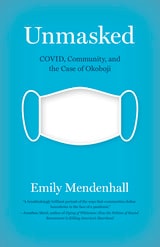
Unmasked
COVID, Community, and the Case of OkobojiEmily Mendenhall
Vanderbilt University Press, 2022
The story is both personal and political. Author Emily Mendenhall, an anthropologist at Georgetown University, grew up in Okoboji, and her family still lives there. As the events unfolded, Mendenhall was in Okoboji, where she spoke formally with over 100 people and observed a community that rejected public health guidance, revealing deep-seated mistrust in outsiders and strong commitments to local thinking. Unmasked is a fascinating and heartbreaking account of where people put their trust, and how isolationist popular beliefs can be in America's small communities.
This book is the recipient of the 2022 Norman L. and Roselea J. Goldberg Prize from Vanderbilt University Press for the best book in the area of art or medicine.
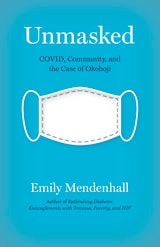
Unmasked
COVID, Community, and the Case of OkobojiEmily Mendenhall
Vanderbilt University Press, 2022
The story is both personal and political. Author Emily Mendenhall, an anthropologist at Georgetown University, grew up in Okoboji, and her family still lives there. As the events unfolded, Mendenhall was in Okoboji, where she spoke formally with over 100 people and observed a community that rejected public health guidance, revealing deep-seated mistrust in outsiders and strong commitments to local thinking. Unmasked is a fascinating and heartbreaking account of where people put their trust, and how isolationist popular beliefs can be in America's small communities.
This book is the recipient of the 2022 Norman L. and Roselea J. Goldberg Prize from Vanderbilt University Press for the best book in the area of art or medicine.