Results by title
324 books match the query 'Comparative literature' and 7 start with u
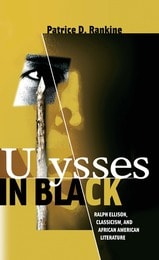
Ulysses in Black
Ralph Ellison, Classicism, and African American LiteraturePatrice D. Rankine
University of Wisconsin Press, 2008
In this groundbreaking work, Patrice D. Rankine asserts that the classics need not be a mark of Eurocentrism, as they have long been considered. Instead, the classical tradition can be part of a self-conscious, prideful approach to African American culture, esthetics, and identity. Ulysses in Black demonstrates that, similar to their white counterparts, African American authors have been students of classical languages, literature, and mythologies by such writers as Homer, Euripides, and Seneca.
Ulysses in Black closely analyzes classical themes (the nature of love and its relationship to the social, Dionysus in myth as a parallel to the black protagonist in the American scene, misplaced Ulyssean manhood) as seen in the works of such African American writers as Ralph Ellison, Toni Morrison, and Countee Cullen. Rankine finds that the merging of a black esthetic with the classics—contrary to expectations throughout American culture—has often been a radical addressing of concerns including violence against blacks, racism, and oppression. Ultimately, this unique study of black classicism becomes an exploration of America’s broader cultural integrity, one that is inclusive and historic.
Outstanding Academic Title, Choice Magazine
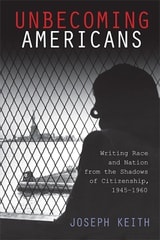
Unbecoming Americans
Writing Race and Nation from the Shadows of Citizenship, 1945-1960Keith, Joseph
Rutgers University Press, 2013
During the Cold War, Ellis Island no longer served as the largest port of entry for immigrants, but as a prison for holding aliens the state wished to deport. The government criminalized those it considered un-assimilable (from left-wing intellectuals and black radicals to racialized migrant laborers) through the denial, annulment, and curtailment of citizenship and its rights. The island, ceasing to represent the iconic ideal of immigrant America, came to symbolize its very limits.
Unbecoming Americans sets out to recover the shadow narratives of un-American writers forged out of the racial and political limits of citizenship. In this collection of Afro-Caribbean, Filipino, and African American writers—C.L.R. James, Carlos Bulosan, Claudia Jones, and Richard Wright—Joseph Keith examines how they used their exclusion from the nation, a condition he terms “alienage,” as a standpoint from which to imagine alternative global solidarities and to interrogate the contradictions of the United States as a country, a republic, and an empire at the dawn of the "American Century.”
Building on scholarship linking the forms of the novel to those of the nation, the book explores how these writers employed alternative aesthetic forms, including memoir, cultural criticism, and travel narrative, to contest prevailing notions of race, nation, and citizenship. Ultimately they produced a vital counter-discourse of freedom in opposition to the new formations of empire emerging in the years after World War II, forms that continue to shape our world today.
Unconsolable Contemporary
Observing Gerhard RichterPaul Rabinow
Duke University Press, 2017
Unsettling
Jews, Whiteness, and Incest in American Popular CultureEli Bromberg
Rutgers University Press, 2021
Unthinking Mastery
Dehumanism and Decolonial EntanglementsJulietta Singh
Duke University Press, 2018
Unwriting Maya Literature
Ts'íib as Recorded KnowledgePaul M. Worley and Rita M. Palacios
University of Arizona Press, 2019
As ts’íib refers to a broad range of artistic production from painted codices and textiles to works composed in Latin script, as well as plastic arts, the authors argue that texts by contemporary Maya writers must be read as dialoguing with a multimodal Indigenous understanding of text. In other words, ts’íib is an alternative to understanding “writing” that does not stand in opposition to but rather fully encompasses alphabetic writing, placing it alongside and in dialogue with a number of other forms of recorded knowledge. This shift in focus allows for a critical reexamination of the role that weaving and bodily performance play in these literatures, as well as for a nuanced understanding of how Maya writers articulate decolonial Maya aesthetics in their works.
Unwriting Maya Literature places contemporary Maya literatures within a context that is situated in Indigenous ways of knowing and being. Through ts’íib, the authors propose an alternative to traditional analysis of Maya cultural production that allows critics, students, and admirers to respectfully interact with the texts and their authors. Unwriting Maya Literature offers critical praxis for understanding Mesoamerican works that encompass non-Western ways of reading and creating texts.
Urban Underworlds
A Geography of Twentieth-Century American Literature and CultureHeise, Thomas
Rutgers University Press, 2010
The quarantining of minority cultures helped to promote white, middle-class privilege. Following a diverse array of literary figures who differ with the assessment of the underworld as the space of the monstrous Other, Heise contends that it is a place where besieged and neglected communities are actively trying to take possession of their own neighborhoods.