Results by title
474 books match the query 'Computers' and 5 start with u
UML for Systems Engineering
Watching the wheelsJon Holt
The Institution of Engineering and Technology, 2004
Up until a few years ago there were many different modelling languages available to software developers. However, this vast array of choice only served to hinder communication and as a result the Unified Modelling Language (UML) was born. Although the UML has its roots firmly in the software world, the benefits of adopting a standard visual notation have been recognised in many other fields, not least of which is the field of systems engineering. This book concentrates on systems-based applications, rather than the traditional software applications that are more usually associated with the UML. Now fully updated to reflect the changes to UML for its version 2.0 release, this new edition has been substantially re-written and includes new material on systems architectures and life cycle management.
[more]
Ultrascale Computing Systems
Jesus Carretero
The Institution of Engineering and Technology, 2019
The needs of future digital data and computer systems are expected to be two to three orders of magnitude larger than for today's systems, to take account of unprecedented amounts of heterogeneous hardware, lines of source code, numbers of users, and volumes of data. Ultrascale computing systems (UCS) are a solution. Envisioned as large-scale complex systems joining parallel and distributed computing systems, which can be located at multiple sites and cooperate to provide the required resources and performance to the users, these technologies will extend individual systems to provide the resources that are very much needed.
[more]

Understanding Video Activism on Social Media
Jens Eder, Britta Hartmann, and Chris Tedjasukmana
Intellect Books, 2025
How social media videos shape today’s political engagement and activism.
What political power do social media videos have? In what ways do they exert influence, shape public discourse, and change political life? How can participants in this field assert themselves against commercial interests, anti-democratic agitation, and authoritarian propaganda? These questions are being debated intensely as social media increasingly dominates global information flows, and videos increasingly dominate social media.
The forms, practices, and opportunities of activism depend on a media environment that is changing rapidly and profoundly in terms of its technological basis, ownership, legal regulations, and governmental control. This makes the act of understanding video activism even more relevant at a time when the internet is undergoing fundamental disruptions.
[more]
Understanding Virtual Universities
Roy Rada
Intellect Books, 2013
All those involved in Higher Education are under pressure to familiarise themselves with the newest developments in Information Technology, and to understand the ways in which they can make use of these resources. The purpose of this book is to help academics from all disciplines to take full advantage of IT. Anticipating a future in which distance learning and virtual reality tutoring systems play a central role in university teaching, Roy Rada provides guidelines for making use of such technological opportunities. The chapters cover:
• distance learning for individual students
• groups in classrooms - focusing on interactive technology
• the university as a whole
• emerging market forces in Higher Education and training for industry
Unlike competing books that focus on specific aspects of the subject, Understanding Virtual Universities combines managerial, social and technical issues, to provide a comprehensive approach to Information Technology for Higher Education.
[more]
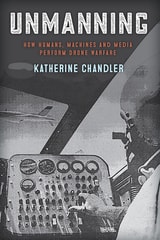
Unmanning
How Humans, Machines and Media Perform Drone WarfareKatherine Fehr Chandler
Rutgers University Press, 2020
Unmanning studies the conditions that create unmanned platforms in the United States through a genealogy of experimental, pilotless planes flown between 1936 and 1992. Characteristics often attributed to the drone—including machine-like control, enmity and remoteness—are achieved by displacements between humans and machines that shape a mediated theater of war. Rather than primarily treating the drone as a result of the war on terror, this book examines contemporary targeted killing through a series of failed experiments to develop unmanned flight in the twentieth century. The human, machine and media parts of drone aircraft are organized to make an ostensibly not human framework for war that disavows its political underpinnings as technological advance. These experiments are tied to histories of global control, cybernetics, racism and colonialism. Drone crashes and failures call attention to the significance of human action in making technopolitics that comes to be opposed to “man” and the paradoxes at their basis.
[more]