Results by title
54 books match the query 'Constitution' and 2 start with u
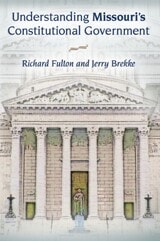
Understanding Missouri's Constitutional Government
Richard Fulton and Jerry Brekke
University of Missouri Press, 2010
In the study of American government, analysis of state governments is often neglected in favor of concentration on the national system. Certainly in-depth knowledge of our country’s constitutional structure is critical to an understanding of American government, but this continuing inattention to the complexities of state governments has left a hole in the literature available to help us understand the role state governments play in the federal system. State constitutions served as guides for the construction of the U.S. Constitution, but they have their own character and significance. As such, it is imperative that teachers, students, and historians fully understand the creation, administration, and adjudication of state governments.
Understanding Missouri’s Constitutional Government presents a case study in the foundations of state governments. The book provides a sweeping look at the constitutional foundations of the processes of Missouri government. Authors Richard Fulton and Jerry Brekke place Missouri within the context of our larger federal system while using the state’s constitution as a touchstone for the discussion of each element of state government.
Understanding Missouri’s Constitutional Government has a dual framework specifically designed to enhance the reader’s learning experience. First, the essential elements of government outlined in the constitution are introduced, and then analysis and interpretation of each of the document’s articles is covered. This organization permits readers to build an understanding of a particular element—for example, the legislature—by learning its fundamental organization, processes, and purposes in a straightforward manner. After gaining that primary perspective, the reader can use the formal analysis in the second section to explore interpretations of each article. Not only helpful to the general reader, this two-part structure makes the text especially useful in courses on American government, state and local governments, and particularly Missouri government and constitution.
In short, Understanding Missouri’s Constitutional Government is an approachable, valuable exposition on Missouri government as reflected in the day-to-day operations outlined in the Missouri constitution. It fills a significant gap in the literature on the interpretation, use, and operation of state constitutions. Since Missouri law dictates that all levels of education should teach government and constitution at the national and state levels, this book will be an indispensable resource for educators while serving as a valuable reference for journalists and public officials in the state.
[more]
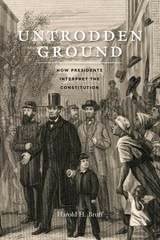
Untrodden Ground
How Presidents Interpret the ConstitutionHarold H. Bruff
University of Chicago Press, 2015
When Thomas Jefferson struck a deal for the Louisiana Purchase in 1803, he knew he was adding a new national power to those specified in the Constitution, but he also believed his actions were in the nation’s best interest. His successors would follow his example, setting their own constitutional precedents. Tracing the evolution and expansion of the president’s formal power, Untrodden Ground reveals the president to be the nation’s most important law interpreter and examines how our commanders-in-chief have shaped the law through their responses to important issues of their time.
Reviewing the processes taken by all forty-four presidents to form new legal precedents and the constitutional conventions that have developed as a result, Harold H. Bruff shows that the president is both more and less powerful than many suppose. He explores how presidents have been guided by both their predecessors’ and their own interpretations of constitutional text, as well as how they implement policies in ways that statutes do not clearly authorize or forbid. But while executive power has expanded far beyond its original conception, Bruff argues that the modern presidency is appropriately limited by the national political process—their actions are legitimized by the assent of Congress and the American people or rejected through debilitating public outcry, judicial invalidation, reactive legislation, or impeachment. Synthesizing over two hundred years of presidential activity and conflict, this timely book casts new light on executive behavior and the American constitutional system.
Reviewing the processes taken by all forty-four presidents to form new legal precedents and the constitutional conventions that have developed as a result, Harold H. Bruff shows that the president is both more and less powerful than many suppose. He explores how presidents have been guided by both their predecessors’ and their own interpretations of constitutional text, as well as how they implement policies in ways that statutes do not clearly authorize or forbid. But while executive power has expanded far beyond its original conception, Bruff argues that the modern presidency is appropriately limited by the national political process—their actions are legitimized by the assent of Congress and the American people or rejected through debilitating public outcry, judicial invalidation, reactive legislation, or impeachment. Synthesizing over two hundred years of presidential activity and conflict, this timely book casts new light on executive behavior and the American constitutional system.
[more]