Results by title
214 books match the query 'Constitutional' and 4 start with u
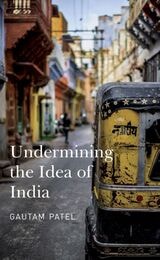
Undermining the Idea of India
Gautam Patel
Seagull Books, 2022
A searing manifesto for troubled times in India.
“India is improbable. By any measure of logic or reason, it should not be. Not in this form. And yet it is.”
With this provocation, Justice Gautam Patel of the Bombay High Court sketches the exoskeleton of this improbability—the “Constitutional” idea of India. Justice Patel argues that the devolution of power is necessary for the survival of any liberal democracy, maintaining the idea that “the right to choose one’s own government is the right to dissent.” Decrying the portrayal of politics as sport, Patel elucidates the strategies and tactics used by “nimble” governments to enforce a culture of “broad-spectrum illiberalism.” A champion of transparency in the judiciary, Patel argues that the Internet and the judiciary must serve as beacons in this age of precarity. A timely text that comes at a juncture where liberal democracies across the world are facing existential threats, Undermining the Idea of India is a searing manifesto for our troubled times.
[more]
Understanding the Arizona Constitution
Toni McClory
University of Arizona Press, 2010
Arizona became the nation’s 48th state in 1912 and since that time the Arizona constitution has served as the template by which the state is governed. Toni McClory’s Understanding the Arizona Constitution has offered insight into the inner workings and interpretations of the document—and the government that it established—for almost a decade.
Since the book’s first publication, significant constitutional changes have occurred, some even altering the very structure of state government itself. There have been dramatic veto battles, protracted budget wars, and other interbranch conflicts that have generated landmark constitutional rulings from the state courts. The new edition of this handy reference addresses many of the latest issues, including legislative term limits, Arizona’s new redistricting system, educational issues, like the controversial school voucher program, and the influence of special-interest money in the legislature. A total of 63 propositions have reached the ballot, spawning heated controversies over same-sex marriage, immigration, and other hot-button social issues.
This book is the definitive guide to Arizona government and serves as a solid introductory text for classes on the Arizona Constitution. Extensive endnotes make it a useful reference for professionals within the government. Finally, it serves as a tool for any engaged citizen looking for information about online government resources, administrative rules, and voter rights. Comprehensive and clearly written, this book belongs on every Arizonan’s bookshelf.
[more]
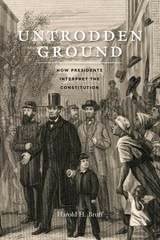
Untrodden Ground
How Presidents Interpret the ConstitutionHarold H. Bruff
University of Chicago Press, 2015
When Thomas Jefferson struck a deal for the Louisiana Purchase in 1803, he knew he was adding a new national power to those specified in the Constitution, but he also believed his actions were in the nation’s best interest. His successors would follow his example, setting their own constitutional precedents. Tracing the evolution and expansion of the president’s formal power, Untrodden Ground reveals the president to be the nation’s most important law interpreter and examines how our commanders-in-chief have shaped the law through their responses to important issues of their time.
Reviewing the processes taken by all forty-four presidents to form new legal precedents and the constitutional conventions that have developed as a result, Harold H. Bruff shows that the president is both more and less powerful than many suppose. He explores how presidents have been guided by both their predecessors’ and their own interpretations of constitutional text, as well as how they implement policies in ways that statutes do not clearly authorize or forbid. But while executive power has expanded far beyond its original conception, Bruff argues that the modern presidency is appropriately limited by the national political process—their actions are legitimized by the assent of Congress and the American people or rejected through debilitating public outcry, judicial invalidation, reactive legislation, or impeachment. Synthesizing over two hundred years of presidential activity and conflict, this timely book casts new light on executive behavior and the American constitutional system.
Reviewing the processes taken by all forty-four presidents to form new legal precedents and the constitutional conventions that have developed as a result, Harold H. Bruff shows that the president is both more and less powerful than many suppose. He explores how presidents have been guided by both their predecessors’ and their own interpretations of constitutional text, as well as how they implement policies in ways that statutes do not clearly authorize or forbid. But while executive power has expanded far beyond its original conception, Bruff argues that the modern presidency is appropriately limited by the national political process—their actions are legitimized by the assent of Congress and the American people or rejected through debilitating public outcry, judicial invalidation, reactive legislation, or impeachment. Synthesizing over two hundred years of presidential activity and conflict, this timely book casts new light on executive behavior and the American constitutional system.
[more]
Unwritten Rule
How to Fix the British ConstitutionStephen Green, Thomas Legg, and Martin Donnelly
Haus Publishing, 2021
A consideration of how to repair the British state.
Not since Ireland broke away from the United Kingdom has the British state been so fragile. Northern Ireland now operates under trading rules that are legally separate from the rest of the nation. In Wales, support for independence is running at a historical high, and Scotland is more conscious than ever of its individual identity and has aspirations for a European future. With public trust and confidence in government at record lows, the United Kingdom faces a crisis that can only be repaired by a new constitutional settlement. Unwritten Rule calls for a radical realignment, embracing a federal approach that would accommodate devolution as the best way of bringing about a successful and diverse national life, increasing democratic control over local and national decision-making, and modernizing national political structures.
Not since Ireland broke away from the United Kingdom has the British state been so fragile. Northern Ireland now operates under trading rules that are legally separate from the rest of the nation. In Wales, support for independence is running at a historical high, and Scotland is more conscious than ever of its individual identity and has aspirations for a European future. With public trust and confidence in government at record lows, the United Kingdom faces a crisis that can only be repaired by a new constitutional settlement. Unwritten Rule calls for a radical realignment, embracing a federal approach that would accommodate devolution as the best way of bringing about a successful and diverse national life, increasing democratic control over local and national decision-making, and modernizing national political structures.
[more]