Results by title
100 books match the query 'Criminal justice, Administration of' and 3 start with u
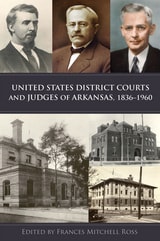
United States District Courts and Judges of Arkansas, 1836–1960
Frances Mitchell Ross
University of Arkansas Press, 2016
The book begins with statehood and continues with Congress’s decision to expand jurisdiction of the original 1836 District Court of Arkansas to include the vast Indian Territory to the west. The territory’s formidable size and rampant lawlessness brought in an overwhelming number of cases. The situation was only somewhat mitigated in 1851, when Congress split the state into eastern and western districts, which were still served by just one judge who travelled between the two courts.
A new judgeship for the Western District was created in 1871, and new seats for that court were established, but it wasn’t until 1896 that Congress finally ended all jurisdiction of Arkansas’s Western District Court over the Indian Territory.
Contributors to this collection include judges, practicing attorneys, academics, and thoughtful and informed family members who reveal how the judges made decisions on issues involving election laws, taxes, civil rights, railroads, liquor and prohibition, quack medicine, gangsters, bankruptcy, personal injury, the draft and Selective Service, school desegregation, prisons, and more. United States District Courts and Judges of Arkansas, 1836–1960 will be of value to anyone interested in Arkansas history—particularly Arkansas legal and judicial history as it relates to the local and national issues that came before these judges.
This project was supported in part by the United States District Court for the Eastern District of Arkansas and the United States District Court for the Western District of Arkansas.
Unlawful Violence
Mexican Law and Cultural ProductionRebecca Janzen
Vanderbilt University Press, 2022
The abundance of laws and constitutional amendments that have cropped up in response are mirrored in Mexico's fragmented cultural production of the same period. Contemporary Mexican literature grapples with this splintered reality through non-linear stories from multiple perspectives, often told through shifts in time. The novels, such as Jorge Volpi's Una novela criminal [A Novel Crime] (2018) and Julián Herbert's La casa del dolor ajeno [The House of the Pain of Others] (2015) take multiple perspectives and follow non-linear plotlines; other examples, such as the very short stories in ¡Basta! 100 mujeres contra la violencia de género [Enough! 100 Women against Gender-Based Violence] (2013), present perspectives from multiple authors.
Few scholars compare cultural production and legal texts in situations like Mexico, where extreme violence coexists with a high number of human rights laws. Unlawful Violence measures fictional accounts of human rights against new laws that include constitutional amendments to reform legal proceedings, laws that protect children, laws that condemn violence against women, and laws that protect migrants and Indigenous peoples. It also explores debates about these laws in the Mexican house of representatives and senate, as well as interactions between the law and the Mexican public.
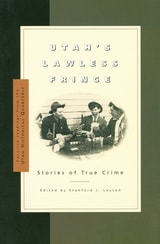
Utah's Lawless Fringe
Stories of True CrimeStanford J. Layton
Signature Books, 2001
So it went on the outskirts of Utah Territory. In this case it was the little town of Bluff where the Mormon bishop served for some ten years as de facto sheriff and his congregation as deputies. As elsewhere, law and order developed organically rather than by legislation.
In this anthology several aspects of the process are considered, including one of the worst manifestations of citizen action: vigilantism. Territorial Utah witnessed more lynchings than legal executions. Another citizen trait was an unexpected indifference to vice. In 1908 Salt Lake City had 148 registered prostitutes overseen by a madam who was recruited for the position by the mayor and city council. During Prohibition one of the largest distilleries in the West operated in a Salt Lake warehouse.
What is to be learned from this? The contributors to these fourteen articles leave moral considerations to the reader’s contemplation, while providing surprises along the way in an extremely engaging—dare we say arresting—read.