Results by title
126 books match the query 'Decolonization' and 3 start with u

Ubuntu Relational Love
Decolonizing Black MasculinitiesDevi Dee Mucina
University of Manitoba Press, 2019
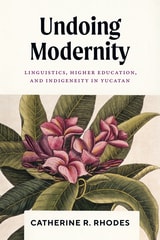
Undoing Modernity
Linguistics, Higher Education, and Indigeneity in YucatanCatherine R. Rhodes
University of Texas Press, 2025
An ethnography of the decolonization of Maya-ness.
On the Yucatan Peninsula today, undergraduates are inventing a new sense of being Maya by studying linguistics and culture in their own language: Maya. In this bold theoretical intervention informed by ethnographic research, Catherine Rhodes argues that these students are undoing the category of modernity itself. Created through colonization of the Americas, modernity is the counterpart to coloniality; the students, Rhodes suggests, are creating decoloniality’s companion: “demodernity.”
Disciplines like linguistics, anthropology, history, and archaeology invented “the Maya” as an essentialized ethnos in a colonial, modern mold. Undoing Modernity follows students and their teachers as they upset the seemingly stable ethnic definition of Maya, with its reliance on a firm dichotomy of Maya and modern. Maya linguistics does not prove that Maya is modern but instead rejects the Maya-ness that modernity built, while also fostering within the university an intellectual space in which students articulate identity on their own terms. An erudite and ultimately hopeful work of interdisciplinary scholarship that brings linguistic anthropology, Mesoamerican studies, and critical Indigenous studies into the conversation, Undoing Modernity dares to imagine the world on the other side of colonial/modern ideals of Indigeneity.
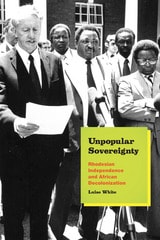
Unpopular Sovereignty
Rhodesian Independence and African DecolonizationLuise White
University of Chicago Press, 2015
White locates Rhodesia’s independence in the era of decolonization in Africa, a time of great intellectual ferment in ideas about race, citizenship, and freedom. She shows that racists and reactionaries were just as concerned with questions of sovereignty and legitimacy as African nationalists were and took special care to design voter qualifications that could preserve their version of legal statecraft. Examining how the Rhodesian state managed its own governance and electoral politics, she casts an oblique and revealing light by which to rethink the narratives of decolonization.