Results by title
603 books match the query 'Description and travel' and 4 start with u
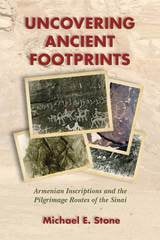
Uncovering Ancient Footprints
Armenian Inscriptions and the Pilgrimage Routes of the SinaiMichael E. Stone
SBL Press, 2017
Explore pilgrimage routes, epigraphy, and the history of writing with an expert guide
From the late 1970s through 1982, Michael E. Stone conducted a number of expeditions to the Sinai peninsula, searching for ancient inscriptions. In this book Stone describes his search, crowned by the discovery of the most ancient Armenian inscriptions known. Here Stone describes not only the inscriptions discovered along his journeys but also the Sinai, its past and present, its human inhabitants, its flora and fauna, and its history. Though once common, well-informed travel books to the Middle East with a broad academic interest and a specific focus have become rare. Stone’s diary of his expeditions in the Sinai fill this gap with vivid descriptions, poetry, and illustrations.
Features
- An account of five expeditions into the Sinai
- Thirteen poems written by Stone
- Twenty-six figures and five maps

Under Eastern Eyes
A Comparative History of East European Travel Writing on EuropeAlex Drace-Francis
Central European University Press, 2008

Up on the River
People and Wildlife of the Upper MississippiMadson, John
University of Iowa Press, 1985
@font-face { font-family: "Times";}@font-face { font-family: "Verdana";}@font-face { font-family: "Palatino";}p.MsoNormal, li.MsoNormal, div.MsoNormal { margin: 0in 0in 0.0001pt; font-size: 12pt; font-family: "Times New Roman"; }div.Section1 { page: Section1; }
Up on the River is John Madson’s loving and often hilarious tribute to the people, animal life, and places of the Upper Mississippi. Madson’s Upper Mississippi is the part “between the saints,” from St. Louis to St. Paul, where for thirty years he explored the bright waters of the upper reaches of the mighty river itself as well as the tangled multitude of sloughs, cuts, and side channels that wander through its wooded islands and floodplain forests.
“Some of my best time on the River has been in the company of game wardens, biologists, commercial fishermen, clammers, trappers, hunters, and a smelly, mud-smeared coterie of river rats in general, and my views of the River are far more likely to reflect theirs than those of the transportation industry,” Madson writes of his thirty-year acquaintance with the Mississippi. Traveling mainly by canoe and johnboat, he tells of encounters between archetypal commercial fishermen and archetypal game wardens over hot fish chowder, fishing for crappies in the tops of submerged trees and for walleyes amid gale force winds, nesting and migrating herons and ducks and eagles, the histories of river logging and pearling and button making, and towboats and barges and the lives of the “ramstugenous” people who move freight on the river.
Learning about the Upper Mississippi via the wry tutelage of John Madson, who discovered that “whenever I am out on a river some of its freeness rubs off on me,” readers of this classic book will also come under the spell of this freeness.
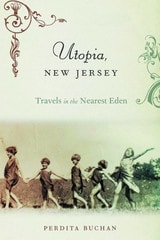
Utopia, New Jersey
Travels in the Nearest EdenBuchan, Perdita
Rutgers University Press, 2007
Winner of the 2008 Honor Book by the New Jersey Council for the Humanities
Utopia. New Jersey. For most people—even the most satisfied New Jersey residents—these words hardly belong in the same sentence. Yet, unbeknown to many, history shows that the state has been a favorite location for utopian experiments for more than a century. Thanks to its location between New York and Philadelphia and its affordable land, it became an ideal proving ground where philosophical and philanthropical organizations and individuals could test their utopian theories.
In this intriguing look at this little-known side of New Jersey, Perdita Buchan explores eight of these communities. Adopting a wide definition of the term utopia—broadening it to include experimental living arrangements with a variety of missions—Buchan explains that what the founders of each of these colonies had in common was the goal of improving life, at least as they saw it.
In every other way, the communities varied greatly, ranging from a cooperative colony in Englewood founded by Upton Sinclair, to an anarchist village in Piscataway centered on an educational experiment, to the fascinating Physical Culture City in Spotswood, where drugs, tobacco, and corsets were banned, but where nudity was widespread.
Despite their grand intentions, all but one of the utopias—a single-tax colony in Berkeley Heights—failed to survive. But Buchan shows how each of them left a legacy of much more than the buildings or street names that remain today—legacies that are inspiring, surprising, and often outright quirky.