453 books match the query 'Economic policy' and 11 start with u

cover of Unavoidable Industrial Restructuring in Latin America

Unavoidable Industrial Restructuring in Latin America

Fernando Fajnzylber

Duke University Press, 1990

In the recent economic history of Latin America no country has yet found the means to combine effectively economic growth with equity. Unavoidable Industrial Restructuring in Latin America compares the development path of Latin America with that of the East Asian newly industrialized countries (NICs), the United States, and Europe in the 1970s and 1980s to show the national policies and international cooperation necessary to set Latin American countries on the road to healthy economies.
Fernando Fajnzylber argues that technological and industrial progress is the driving force of a positive relationship among dynamism, competitiveness, austerity, and equity. Latin America’s failure to master this technological progress underlies its economic difficulties. To overcome the inheritance of past mistakes, the author maintains, Latin America must undergo not only macroeconomic stabilization and a reduction of the debt burden, but also a complete transformation of the production structure. The role of the state and the institutional setup need to be modified and new social and sectoral policies devised. Fajnzylber sees this radical restructuring as an unavoidable step if Latin America is ever to achieve a workable balance between growth and equity.

[more]
cover of Unbroken Ties: The State, Interest Associations, and Corporatism in Post-Soviet Ukraine

Unbroken Ties

The State, Interest Associations, and Corporatism in Post-Soviet Ukraine

Paul Kubicek

University of Michigan Press, 2000

Unbroken Ties examines the relationship between the state and economic interest groups representing labor, capital, and agriculture in Ukraine. The author argues that the absence of "civil society" helps to explain why, in Ukraine, the much-anticipated transition to democracy and the market has not yet been achieved.
Since the collapse of communism in Eastern Europe and the former Soviet Union, there has been a spate of books--optimistic at first--highlighting the transitions to democracy in these countries and the leading role of "civil society" in pushing forward political and economic reform. This study explains why this transition did not take place as anticipated. In essence, organized labor in Ukraine is weak and has been co-opted by the state; in the meantime, leading groups of industrialists and agricultural collectives have strong political influence and shape policies in accordance with their interests. This is very similar to the situation in Russia.
In contrast to works that implicitly assume a pluralist model of development for state-society relations, Unbroken Ties employs corporatism as the basic organizing structure for the study of state-interest group relations in post-Soviet Ukraine. Finding that much of the Soviet "residue" still functions in Ukraine, it argues that a form of state corporatism, which envisions a major role for the state in structuring and controlling interest associations, captures much of the post-Soviet Ukrainian reality. Old groups persist and prosper due to a variety of ties with state elites, whereas new and independent groups find themselves marginalized.
This book will appeal to political scientists, economists, and sociologists studying the transformation of post-communist societies, as well as those interested in the broader, more comparative aspects of democratization and economic reform.
Paul Kubicek is Kenneth Boulding Post-Doctoral Fellow, University of Colorado, Boulder.
[more]
cover of Under Construction: Technologies of Development in Urban Ethiopia

Under Construction

Technologies of Development in Urban Ethiopia

Daniel Mains

Duke University Press, 2019
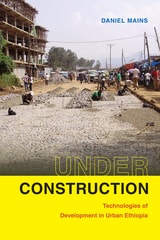
Over the past decade, Ethiopia has had one of the world's fastest growing economies, largely due to its investments in infrastructure, and it is through building dams, roads, and other infrastructure that the Ethiopian state seeks to become a middle-income country by 2025. Yet most urban Ethiopians struggle to meet their daily needs and actively oppose a ruling party that they associate with corruption and mismanagement. In Under Construction Daniel Mains explores the intersection of development and governance by examining the conflicts surrounding the construction of specific infrastructural technologies: asphalt and cobblestone roads, motorcycle taxis, and hydroelectric dams. These projects serve as sites for nation building and the means for the state to assert its legitimacy. The construction process—as well as Ethiopians' experience of living with the disruption of construction zones—reveals the tension and conflict between the promise of progress and the possibility of failure. Mains demonstrates how infrastructures as both ethnographic sites and as a means of theorizing such concepts as progress, development, and the state offer a valuable contrast to accounts of African abjection and decline.
[more]
cover of Underdeveloping the Amazon: Extraction, Unequal Exchange, and the Failure of the Modern State

Underdeveloping the Amazon

Extraction, Unequal Exchange, and the Failure of the Modern State

Stephen G. Bunker

University of Chicago Press, 1988

Underdeveloping the Amazon shows how different extractive economies have periodically enriched various dominant classes but progressively impoverished the entire region by disrupting both the Amazon Basin's ecology and human communities. Contending that traditional models of development based almost exclusively on the European and American experience of industrial production cannot apply to a regional economy founded on extraction, Stephen G. Bunker proposes a new model based on the use and depletion of energy values in natural resources as the key to understanding the disruptive forces at work in the Basin.
[more]
cover of Understanding Capitalism: Critical Analysis From Karl Marx to Amartya Sen

Understanding Capitalism

Critical Analysis From Karl Marx to Amartya Sen

Douglas Dowd

Pluto Press, 2002

Understanding Capitalism combines the essays of seven leading economists, including Robin Hahnel and John Bellamy Foster, in a critical assessment of the relationship between economic thought and the dominance of capitalism. With analyses of economists ranging from Karl Marx to Amartya Sen, the book traces the growth of the capitalist system over the past two hundred years and how economic theory has, in fact, become capitalist ideology. Relating socio-economic and analytical histories to present-day economic policy, this is a thoroughly accessible work which makes an ideal introduction to the key thinkers in economic thought past and present.

Major economists and economic schools of thought are discussed in a chapter-by-chapter guide that covers Marx, Veblen, Gramsci, post-Keynesian theory, US institutionalists, Sweezy and the Monopoly Capital school, and recent Nobel Prize winner Amartya Sen. Contributors include Michael Lebowitz, Carl Boggs, Michael Keaney, Frederic Lee, John Bellamy Foster and Robin Hahnel, with an introduction by the editor, Douglas Dowd.

[more]
cover of Understanding Economic Recovery in the 1930s: Endogenous Propagation in the Great Depression

Understanding Economic Recovery in the 1930s

Endogenous Propagation in the Great Depression

Frank G. Steindl

University of Michigan Press, 2003

Although much has been published about the economic downturn that began in mid-1929, very little has been written about the recovery from this cataclysmic period. Long, tortuous, and uneven as it was, there was indeed a recovery. In this important book, Steindl explores the much-neglected topic of the recovery, concentrating in particular on the macroeconomic developments responsible for the move back to a pre-Depression level economy.
Providing strong evidence for the role of the quantity of money in the revitalization, the author ultimately concludes that the seemingly robust monetary explanation of the recovery is deficient, as is any that relies principally on aggregate demand impulses. An accurate understanding of this phenomenon must account for the inherent tendency of the economy to revert to its long-run high employment trend.
Frank G. Steindl is Regents Professor of Economics and Ardmore Professor of Business Administration, Oklahoma State University.
[more]
cover of Understanding NAFTA: Mexico, Free Trade, and the New North America

Understanding NAFTA

Mexico, Free Trade, and the New North America

By William A. Orme, Jr.

University of Texas Press, 1996

Understanding NAFTA was first published in 1993 as Continental Shift: Free Trade & the New North America. This edition includes a new introduction that brings the NAFTA story up through 1995.
[more]
cover of Undoing the Revolution: Comparing Elite Subversion of Peasant Rebellions

Undoing the Revolution

Comparing Elite Subversion of Peasant Rebellions

Vasabjit Banerjee

Temple University Press, 2019

Undoing the Revolution looks at the way rural underclasses ally with out-of-power elites to overthrow their governments—only to be shut out of power when the new regime assumes control. Vasabjit Banerjee first examines why peasants need to ally with dissenting elites in order to rebel. He then shows how conflict resolution and subsequent bargains to form new state institutions re-empower allied elites and re-marginalize peasants.  

Banerjee evaluates three different agrarian societies during distinct time periods spanning the twentieth century: revolutionary Mexico from 1910 to 1930; late-colonial India from 1920 until 1947; and White-dominated Zimbabwe (Rhodesia) from the mid-1960s to 1980. This comparative approach also allows examination of both the underclass need for elite participation and the variety of causes that elites use to incentivize peasant classes to participate, extending from religious-ethnic identity and common political targets to the peasants’ and elites’ own economic grievances. 

Undoing the Revolution demonstrates that both international and domestic investors in cash crops, natural resources, and finance can ally with peasant rebels; and, after threatened or actual state collapse, they can bargain with each other to select new state institutions.
[more]
cover of Unequal Thailand: Aspects of Income, Wealth and Power

Unequal Thailand

Aspects of Income, Wealth and Power

Edited by Pasuk Phongpaichit and Chris Baker

National University of Singapore Press, 2015

Extreme inequalities in income,wealth and power lie behind Thailand’s political turmoil. What are the sources of this inequality?  Why does it persist, or even increase when the economy grows? How can it be addressed?


         The contributors to this important study—Thai scholars, reformers and civil servants—shed light on the many dimensions of inequality in Thailand, looking beyond simple income measures to consider land ownership, education, finance, business structures and politics. The contributors propose a series of reforms in taxation, spending and institutional reform that can address growing inequality.


        Inequality is among the biggest threats to social stability in Southeast Asia, and this close study of a key Southeast Asian country will be relevant to regional policy-makers, economists and business decision-makers, as well as students of oligarchy and inequality more generally.  
[more]
cover of Urban Inequality: Evidence From Four Cities

Urban Inequality

Evidence From Four Cities

Alice O'Connor

Russell Sage Foundation, 2001

Despite today's booming economy, secure work and upward mobility remain out of reach for many central-city residents. Urban Inequality presents an authoritative new look at the racial and economic divisions that continue to beset our nation's cities. Drawing upon a landmark survey of employers and households in four U.S. metropolises, Atlanta, Boston, Detroit, and Los Angeles, the study links both sides of the labor market, inquiring into the job requirements and hiring procedures of employers, as well as the skills, housing situation, and job search strategies of workers. Using this wealth of evidence, the authors discuss the merits of rival explanations of urban inequality. Do racial minorities lack the skills and education demanded by employers in today's global economy? Have the jobs best matched to the skills of inner-city workers moved to outlying suburbs? Or is inequality the result of racial discrimination in hiring, pay, and housing? Each of these explanations may provide part of the story, and the authors shed new light on the links between labor market disadvantage, residential segregation, and exclusionary racial attitudes. In each of the four cities, old industries have declined and new commercial centers have sprung up outside the traditional city limits, while new immigrant groups have entered all levels of the labor market. Despite these transformations, longstanding hostilities and lines of segregation between racial and ethnic communities are still apparent in each city. This book reveals how the disadvantaged position of many minority workers is compounded by racial antipathies and stereotypes that count against them in their search for housing and jobs. Until now, there has been little agreement on the sources of urban disadvantage and no convincing way of adjudicating between rival theories. Urban Inequality aims to advance our understanding of the causes of urban inequality as a first step toward ensuring that the nation's cities can prosper in the future without leaving their minority residents further behind. A Volume in the Multi-City Study of Urban Inequality
[more]
cover of Utopia and Modernity in China: Contradictions in Transition

Utopia and Modernity in China

Contradictions in Transition

David Margolies

Pluto Press, 2022

The contradictions of modernization run through the whole of modern Chinese history. The abundance of manufactured goods being sold in the West attests to China's industrial revolution, but this capitalist vision of 'utopia' sits uneasily with traditional Chinese values. It is also in conflict with the socialism that has been the bedrock of Chinese society since the foundation of the People's Republic in 1949.

Utopia and Modernity in China examines the conflicts inherent in China's attempt to achieve a 'utopia' by advancing production and technology. Through the lenses of literature, arts, law, the press and the environment, the contributors interrogate the contradictions of modernization in Chinese society and its fundamental challenges.

By unpicking both China's vision of utopia and its realities and the increasing tension between traditional Chinese values and those of the West, this book offers a unique insight into the cultural forces that are part of reshaping today's China.
[more]