Results by title
198 books match the query 'Educational Policy & Reform' and 5 start with u
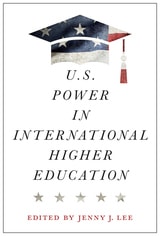
U.S. Power in International Higher Education
Jenny J. Lee
Rutgers University Press, 2021
U.S. Power in International Higher Education explores how internationalization in higher education is not just an educational endeavor, but also a geopolitical one. By centering and making explicit the role of power, the book demonstrates the United States’s advantage in international education as well as the changing geopolitical realities that will shape the field in the future. The chapter authors are leading critical scholars of international higher education, with diverse scholarly ties and professional experiences within the country and abroad. Taken together, the chapters provide broad trends as well as in-depth accounts about how power is evident across a range of key international activities. This book is intended for higher education scholars and practitioners with the aim of raising greater awareness on the unequal power dynamics in internationalization activities and for the purposes of promoting more just practices in higher education globally.
UW Struggle
When a State Attacks Its UniversityChuck Rybak
University of Minnesota Press, 2017
A Wisconsin story that serves as a national warning
UW Struggle provides an on-the-ground view of the smoldering attack on public higher education in Wisconsin. Chuck Rybak, who works in the University of Wisconsin System, provides important glimpses into the personal lives of those affected, the dismantling of tenure protections, the diminishment of shared governance, and how faculty remain the scapegoat for all of the university’s problems. This is a chronicle of failed leadership and what actions, if any, can protect this vital American institution.
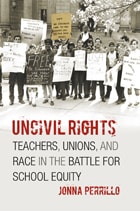
Uncivil Rights
Teachers, Unions, and Race in the Battle for School EquityJonna Perrillo
University of Chicago Press, 2012
Universities and Reflexive Modernity
Institutional Ambiguities and Unintended ConsequencesLazar Vlasceanu
Central European University Press, 2010
A book about the challenges and uncertainties facing today's university, a chronicle of recent and current changes in higher education in the world. There are many questions today that are sufficiently open to doubt and profoundly related to new developments, to justify our starting new enquiries, here and now, by looking freshly and more closely at the actual configurations and at their historical grounds, for providing the new standard account of the university today.
Vlasceanu discusses the inherent contradiction between academia on the one hand, and expectations and regulations of the market on the other. Analyses demographic and other statistical characteristics of today's higher education. Examines the financial basis of universities in various countries, and describes current governance models. Finally the author sets up a new typology of universities.
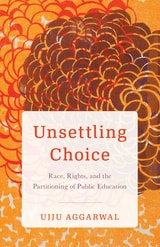
Unsettling Choice
Race, Rights, and the Partitioning of Public EducationUjju Aggarwal
University of Minnesota Press, 2024
How the Great Recession revealed a system of school choice built on crisis, precarity, and exclusion
What do universal rights to public goods like education mean when codified as individual, private choices? Is the “problem” of school choice actually not about better choices for all but, rather, about the competition and exclusion that choice engenders—guaranteeing a system of winners and losers? Unsettling Choice addresses such questions through a compelling ethnography that illuminates how one path of neoliberal restructuring in the United States emerged in tandem with, and in response to, the Civil Rights movement.
Drawing on ethnographic research in one New York City school district, Unsettling Choice traces the contestations that surfaced when, in the wake of the 2007–2009 Great Recession, public schools navigated austerity by expanding choice-based programs. Ujju Aggarwal argues that this strategy, positioned as “saving public schools,” mobilized mechanisms rooted in market logics to recruit families with economic capital on their side, thereby solidifying a public sphere that increasingly resembled the private—where contingency was anticipated and rights for some were marked by intensified precarity for poor and working-class Black and Latinx families.
As Unsettling Choice shows, these struggles over public schools—one of the last remaining universal public goods in the United States—were entrapped within neoliberal regimes that exceeded privatization and ensured exclusion even as they were couched in language of equity, diversity, care, and rights. And yet this richly detailed and engaging book also tracks an architecture of expansive rights, care, and belonging built among poor and working-class parents at a Head Start center, whose critique of choice helps us understand how we might struggle for—and reimagine—justice, and a public that remains to be won.
Retail e-book files for this title are screen-reader friendly with images accompanied by short alt text and/or extended descriptions.