Results by title
271 books match the query 'Employment' and 5 start with u

U.S. Engineering in a Global Economy
Edited by Richard B. Freeman and Hal Salzman
University of Chicago Press, 2018
Since the late 1950s, the engineering job market in the United States has been fraught with fears of a shortage of engineering skill and talent. U.S. Engineering in a Global Economy brings clarity to issues of supply and demand in this important market. Following a general overview of engineering-labor market trends, the volume examines the educational pathways of undergraduate engineers and their entry into the labor market, the impact of engineers working in firms on productivity and innovation, and different dimensions of the changing engineering labor market, from licensing to changes in demand and guest worker programs.
The volume provides insights on engineering education, practice, and careers that can inform educational institutions, funding agencies, and policy makers about the challenges facing the United States in developing its engineering workforce in the global economy.
The volume provides insights on engineering education, practice, and careers that can inform educational institutions, funding agencies, and policy makers about the challenges facing the United States in developing its engineering workforce in the global economy.
[more]

Unsettled Labors
Migrant Care Work in Palestine/IsraelRachel H. Brown
Duke University Press, 2024
In Unsettled Labors, Rachel H. Brown explores the overlooked labor of migrant workers in Israel’s eldercare industry. Brown argues that live-in eldercare in Palestine/Israel, which is primarily done by migrant workers, is an often invisible area where settler colonialism is reproduced culturally, economically, and biologically. Situating Israeli labor markets within a longer history of imperialism and dispossession of Palestinian land, Brown positions migrant eldercare within the resulting tangle of Israeli laws, policies, and social discourses. She draws from interviews with caretakers, public statements, court documents, and first-hand fieldwork to uncover the inherently contradictory nature of elder care work: the intimate presence of South and Southeast Asian workers in the home unsettles the idea of the Israeli home as an exclusively Jewish space. By paying close attention to the comparative racialization of migrant workers, Palestinians, asylum seekers, and Mizrahi and Ashkenazi settlers, Brown raises important questions of labor, social reproduction, displacement, and citizenship told through the stories of collective care provided by migrant workers in a settler colonial state.
[more]

Unsocial Europe
Social Protection Or Flexploitation?Anne Gray
Pluto Press, 2004
[more]
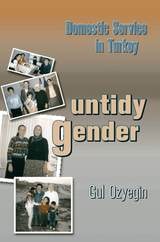
Untidy Gender
Domestic Service in TurkeyGul Ozyegin
Temple University Press, 2000
"A sophisticated and sensitive text on domestic service in Turkey that singles itself out by a powerful account of the micro-sociology of power. It engages the reader in much broader debates about the mutual relations of class and gender, the role of patriarchal controls in shaping informal female labor markets and the management of status differentials by women in their daily lives. An important scholarly contribution written in a lucid and accessible style."
--Deniz Kandiyoti, School of Oriental and African Studies, University of London
Untidy Gender takes readers into the interconnected worlds of Turkish maids and the women who employ them, tracing the incorporation of rural migrant women into the interiors of the domestic spheres of the urban middle-classes. Firmly grounded in data collected through a representative survey of 160 domestic workers, in-depth interviews, and participant observation in the kinship-based communities of domestic workers, this book forges a new understanding of the complex interaction between gender and class subordination.
Ozyegin traces the lives of two kinds of workers; those from the squatter settlements who work in a number of locations, and those who live with husbands employed as "doorkeepers" or building superintendents in the basements of middle-class apartment buildings. In a literal "upstairs, downstairs" arrangement, the latter women sometimes take on apartment cleaning for clients in the building.
At the center of the book are a number of ironies about patriarchy. On the surface, husbands have absolute control over whether or not their wives work, but some women work in secret, and those "doorkeeper" husbands who allow their wives to work often provide child care themselves. Ironically, the very constraints on the spatial and social mobility of the women creates a labor market in which domestic workers' labor is expensive and not readily forthcoming, which, in turn, gives them a degree of power in negotiating their relationship with their middle-class employers.
Untidy Gender offers insights not only into the gender and class dynamics of Turkish society, but contributes to the refinement of central terms of feminist scholarship and research on work in the informal sector, cross-class relations between women, gender and class inequality, and women's experiences of modernity and urbanization. The author ends with a personal account of her own difficulties with the class tensions of the maid-employer relationship.
"Untidy Gender makes contributions to a large number of debates in several social science fields and sub-fields. And it does so on an extraordinarily sound methodological base: Ozyegin was able to construct a random sample for her 'women in the basement.' This is the gold standard of research, and may be unique in the research annals of studies of domestic workers."
--Rae Lesser Blumberg, William R. Kenan, Jr. Professor of Sociology, University of Virginia
"This original book sheds new light on the dynamics of modernity and newly constituted urban identities. Through a careful ethnographic study of paid domestic work, Ozyegin illuminates the varied ways in which relations of class and gender inequalities are shaped and maintained. American audiences interested in rural-urban migrants, in intersectionalities of race, class, and gender, and in identities, power, and resistance in the workplace will find some of the most compelling ethnography and many valuable theoretical nuggets in this book."
--Pierrette Hondagneu-Sotelo, Associate Professor, Department of Sociology, University of Southern California
"Ozyegin presents a cutting-edge analysis of the complexities of modernization by focusing on gender relations. While avoiding numerous rhetorical traps around questions of 'difference' Ozyegin seamlessly weaves together a thoughtfully articulated theory with a meticulous empirical analysis of patriarchal and class relations among modern urban women and more traditional migrant women living at the margins of modernity. Given its significant substantive and theoretical contributions, I will look forward to teaching Untidy Gender in my courses."
--Judith M. Gerson, Associate Professor, Departments of Sociology and Women's Studies, Rutgers University, New Brunswick
[more]
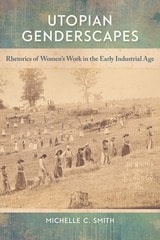
Utopian Genderscapes
Rhetorics of Women’s Work in the Early Industrial AgeMichelle C. Smith
Southern Illinois University Press, 2021
2022 Winifred Bryan Horner Outstanding Book Award, Honorable Mention!
A necessary rhetorical history of women’s work in utopian communities
Utopian Genderscapes focuses on three prominent yet understudied intentional communities—Brook Farm, Harmony Society, and the Oneida Community—who in response to industrialization experimented with radical social reform in the antebellum United States. Foremost among the avenues of reform was the place and substance of women’s work. Author Michelle C. Smith seeks in the communities’ rhetorics of teleology, choice, and exceptionalism the lived consequences of the communities' lofty goals for women members.
This feminist history captures the utopian reconfiguration of women’s bodies, spaces, objects, and discourses and delivers a needed intervention into how rhetorical gendering interacts with other race and class identities. The attention to each community’s material practices reveals a gendered ecology, which in many ways squared unevenly with utopian claims. Nevertheless, this volume argues that this utopian moment inaugurated many of the norms and practices of labor that continue to structure women’s lives and opportunities today: the rise of the factory, the shift of labor from home spaces to workplaces, the invention of housework, the role of birth control and childcare, the question of wages, and the feminization of particular kinds of labor.
An impressive and diverse array of archival and material research grounds each chapter’s examination of women’s professional, domestic, or reproductive labor in a particular community. Fleeting though they may seem, the practices and lives of those intentional women, Smith argues, pattern contemporary divisions of work along the vibrant and contentious lines of gender, race, and class and stage the continued search for what is possible.
[more]