Results by title
201 books match the query 'English fiction' and 2 start with u

Universal Grammar and Narrative Form
David Herman
Duke University Press, 1995
In a major rethinking of the functions, methods, and aims of narrative poetics, David Herman exposes important links between modernist and postmodernist literary experimentation and contemporary language theory. Ultimately a search for new tools for narrative theory, his work clarifies complex connections between science and art, theory and culture, and philosophical analysis and narrative discourse.
Following an extensive historical overview of theories about universal grammar, Herman examines Joyce’s Ulysses, Kafka’s The Trial, and Woolf’s Between the Acts as case studies of modernist literary narratives that encode grammatical principles which were (re)fashioned in logic, linguistics, and philosophy during the same period. Herman then uses the interpretation of universal grammar developed via these modernist texts to explore later twentieth-century cultural phenomena. The problem of citation in the discourses of postmodernism, for example, is discussed with reference to syntactic theory. An analysis of Peter Greenaway’s The Cook, The Thief, His Wife, and Her Lover raises the question of cinematic meaning and draws on semantic theory. In each case, Herman shows how postmodern narratives encode ideas at work in current theories about the nature and function of language.
Outlining new directions for the study of language in literature, Universal Grammar and Narrative Form provides a wealth of information about key literary, linguistic, and philosophical trends in the twentieth century.
[more]
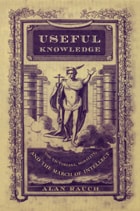
Useful Knowledge
The Victorians, Morality, and the March of IntellectAlan Rauch
Duke University Press, 2001
Nineteenth-century England witnessed an unprecedented increase in the number of publications and institutions devoted to the creation and the dissemination of knowledge: encyclopedias, scientific periodicals, instruction manuals, scientific societies, children’s literature, mechanics’ institutes, museums of natural history, and lending libraries. In Useful Knowledge Alan Rauch presents a social, cultural, and literary history of this new knowledge industry and traces its relationships within nineteenth-century literature, ending with its eventual confrontation with Charles Darwin’s Origin of Species.
Rauch discusses both the influence and the ideology of knowledge in terms of how it affected nineteenth-century anxieties about moral responsibility and religious beliefs. Drawing on a wide array of literary, scientific, and popular works of the period, the book focusses on the growing importance of scientific knowledge and its impact on Victorian culture. From discussions of Jane Webb Loudon’s The Mummy! and Mary Shelley’s Frankenstein, to Charlotte Brontë’s The Professor, Charles Kingsley’s Alton Locke, and George Eliot’s Mill on the Floss, Rauch paints a fascinating picture of nineteenth-century culture and addresses issues related to the proliferation of knowledge and the moral issues of this time period. Useful Knowledge touches on social and cultural anxieties that offer both historical and contemporary insights on our ongoing preoccupation with knowledge.
Useful Knowledge will appeal to readers interested in nineteenth century history, literature, culture, the mediation of knowledge, and the history of science.
[more]