Results by title
316 books match the query 'Ethnomusicology' and 3 start with u

Unchanged Trebles
What Boy Choirs Teach Us About Motherhood and MasculinityRebekah Peeples
Rutgers University Press, 2026
Boy choirs are one of the oldest musical traditions in the Western world. While audiences admire boy singers for their distinctive treble notes, boys who sing in soprano voices have to contend with the notion that they’re doing something effeminate, even emasculating, because they sing in a vocal range typically reserved for women and girls. Known as the “unchanged trebles” within choirs, boys who sing in soprano voices defy prevailing norms of traditional masculinity. What do boy choirs represent in a culture that increasingly sees gender as an individual choice rather than a fixed, biological category? And is this tradition, which is rooted in exclusion of girls and women, one worth saving?
In Unchanged Trebles, Rebekah Peeples charts an unexpected, thought-provoking, and deeply personal journey into the peculiar world of contemporary boy choirs, where boys learn to do something together that they’re often embarrassed to do alone: sing in their soprano voices. Considering her experience as the unlikely mother of a boy soprano alongside dozens of interviews with current directors and former choristers, she argues that some of the tools for creating a more gender-inclusive future can be found in an ancient tradition that has long recognized gender fluidity within the pre-pubescent male body. With humor, insight, and the voice of a gifted storyteller, Unchanged Trebles explores a cultural tradition in which singing and expressing emotion are encouraged for boys, showing them a more expansive form of masculinity as they transition from boyhood to manhood.
In Unchanged Trebles, Rebekah Peeples charts an unexpected, thought-provoking, and deeply personal journey into the peculiar world of contemporary boy choirs, where boys learn to do something together that they’re often embarrassed to do alone: sing in their soprano voices. Considering her experience as the unlikely mother of a boy soprano alongside dozens of interviews with current directors and former choristers, she argues that some of the tools for creating a more gender-inclusive future can be found in an ancient tradition that has long recognized gender fluidity within the pre-pubescent male body. With humor, insight, and the voice of a gifted storyteller, Unchanged Trebles explores a cultural tradition in which singing and expressing emotion are encouraged for boys, showing them a more expansive form of masculinity as they transition from boyhood to manhood.
[more]
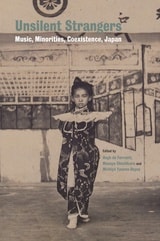
Unsilent Strangers
Music, Minorities, Co-existence, JapanEdited by Hugh de Ferranti, Michiyo Yoneno-Reyes, and Masaya Shishikura
National University of Singapore Press, 2023
An analysis of the role of music in Japanese migrant communities.
This collection of essays on the music of migrant minorities in and from Japan examines the central role music plays in the ongoing adjustment, conciliation, and transformation of newcomers and “hosts” alike. It is the first academic text to address musical activities across a range of migrant groups in Japan––particularly those of Tokyo and its neighboring areas and the first to juxtapose such communities with those of Japanese emigrants as ethnic minorities elsewhere. It presents both archival and fieldwork-based case studies that highlight music in the dynamics of encounter and attempted identity-making, under a unifying framework of migration.
The 2019 introduction of a new “Specified Skilled Worker” visa category marked the beginning of Japan’s “new immigration era,” led by the slogan of tabunka kyosei, or “multicultural coexistence.” The contributors to this volume analyze the concept itself and the many problems around realizing this ideal through ethnographic accounts of current minorities, including South Indians, Brazilians, Nepalis, Filipinos, Iranians, and Ainu domestic migrants. This volume will be of interest to ethnomusicologists, students of the cultures of migrant communities, and those engaged with cultural change and diversity in Japan and East Asia.
[more]

Urban Blues
Charles Keil
University of Chicago Press, 1968
Charles Keil examines the expressive role of blues bands and performers and stresses the intense interaction between performer and audience. Profiling bluesmen Bobby Bland and B. B. King, Keil argues that they are symbols for the black community, embodying important attitudes and roles—success, strong egos, and close ties to the community. While writing Urban Blues in the mid-1960s, Keil optimistically saw this cultural expression as contributing to the rising tide of raised political consciousness in Afro-America. His new Afterword examines black music in the context of capitalism and black culture in the context of worldwide trends toward diversification.
"Enlightening. . . . [Keil] has given a provocative indication of the role of the blues singer as a focal point of ghetto community expression."—John S. Wilson, New York Times Book Review
"Enlightening. . . . [Keil] has given a provocative indication of the role of the blues singer as a focal point of ghetto community expression."—John S. Wilson, New York Times Book Review
"A terribly valuable book and a powerful one. . . . Keil is an original thinker and . . . has offered us a major breakthrough."—Studs Terkel, Chicago Tribune
"[Urban Blues] expresses authentic concern for people who are coming to realize that their past was . . . the source of meaningful cultural values."—Atlantic
"An achievement of the first magnitude. . . . He opens our eyes and introduces a world of amazingly complex musical happening."—Robert Farris Thompson, Ethnomusicology
"[Keil's] vigorous, aggressive scholarship, lucid style and sparkling analysis stimulate the challenge. Valuable insights come from treating urban blues as artistic communication."—James A. Bonar, Boston Herald
[more]