Results by title
2706 books match the query 'European' and 31 start with u
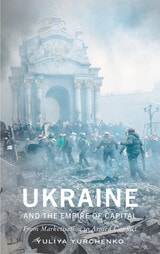
Ukraine and the Empire of Capital
From Marketisation to Armed ConflictYuliya Yurchenko
Pluto Press, 2017
Providing distinctive and unexplored reflections on the origins of the conflict, Yurchenko unpacks the four central myths that underlie Ukraine's post-Soviet reality: the myth of transition, the myth of democracy, the myth of two Ukraines, and the myth of 'the other'. In doing so, she sheds light on the current intensification of class rivalries in Ukraine, the kleptocracy, resource wars and analyses existing and potential dangers of the rightwing shift in Ukraine's polity, stressing a historic opportunity for change.
Critiquing the concept of Ukraine as ‘transition space’, she provides a sweeping analysis which includes the wider neoliberal restructuring of global political economy since the 1970s, with particular focus on Ukraine's relations with the US, the EU and Russia. This is a book for those wanting to understand the current conflict as a dangerous product of neoliberalism, of the empire of capital.
Ukraine in the Crosshairs of Geopolitical Power Play
Edited by Peter W. Schulze and Winfried Veit
Campus Verlag, 2020
Peace in Ukraine seemed possible following Volodymyr Zelensky’s 2019 election. The new president reopened conversations with both the European Union and separatist authorities, bringing an end to the Donbass conflict in sight. Such an achievement promised revitalized talks between Europe and Russia, and so the nearly forgotten conflict returned to global prominence. Ukraine in the Crosshairs of Geopolitical Power Play analyzes why European and Russian objectives in Ukraine place daunting limits of any potential compromise.
Ulysses
The Mechanics of MeaningDavid Hayman
University of Wisconsin Press, 1982
Un/Translatables
New Maps for Germanic LiteraturesEdited by Bethany Wiggin and Catriona MacLeod
Northwestern University Press, 2016
Unbecoming Language
Anti-Identitarian French Feminist FictionsAnnabel L. Kim
The Ohio State University Press, 2018
Kim’s close readings ultimately enliven the current conversation in French studies by serving as a provocation to return to reading literary texts deeply and closely, without subordinating literature to a pre-existing ideological framework—to let literature speak, to let it theorize. Tracking the influence of these writers on each other, Kim provides a new, original French feminist poetics and demonstrates that Sarraute, Wittig, and Garréta’s work allows for a hollowing out of difference from within, allowing writers and readers to unbecome—to break free of identity and exist as subjectivities without subjecthood. In looking at these writers together, Kim provides a defense of literature as liberatory— capable of effecting personal and political change—and gives readers an experience of literature’s revolutionary possibilities.
Unbecoming Language
Anti-Identitarian French Feminist FictionsAnnabel L. Kim
The Ohio State University Press, 2018
Kim’s close readings ultimately enliven the current conversation in French studies by serving as a provocation to return to reading literary texts deeply and closely, without subordinating literature to a pre-existing ideological framework—to let literature speak, to let it theorize. Tracking the influence of these writers on each other, Kim provides a new, original French feminist poetics and demonstrates that Sarraute, Wittig, and Garréta’s work allows for a hollowing out of difference from within, allowing writers and readers to unbecome—to break free of identity and exist as subjectivities without subjecthood. In looking at these writers together, Kim provides a defense of literature as liberatory— capable of effecting personal and political change—and gives readers an experience of literature’s revolutionary possibilities.
Uncanny Encounters
Literature, Psychoanalysis, and the End of AlterityJohn Zilcosky
Northwestern University Press, 2015
Winner of the Friedrich Wilhelm Bessel Research Award
Recipient, 2022 Guggenheim Fellowship
Around 1900, when the last blank spaces on their maps were filled, Europeans traveled to far-flung places hoping to find the spectacularly foreign. They discovered instead what Freud called, several years later, the uncannily familiar: disturbing reflections of themselves—either actual Europeans or Westernized natives. This experience was most extreme for German travelers, who arrived in the contact zones late, on the heels of other European colonialists, and it resulted not in understanding or tolerance but in an increased propensity for violence and destruction. The quest for a “virginal,” exotic existence proved to be ruined at its source, mirroring back to the travelers demonic parodies of their own worst aspects. In this strikingly original book, John Zilcosky demonstrates how these popular “uncanny” encounters influenced Freud’s—and the literary modernists’—use of the term, and how these encounters remain at the heart of our cross-cultural anxieties today.
Uncivil Unions
The Metaphysics of Marriage in German Idealism and RomanticismAdrian Daub
University of Chicago Press, 2012
“What a strange invention marriage is!” wrote Kierkegaard. “Is it the expression of that inexplicable erotic sentiment, that concordant elective affinity of souls, or is it a duty or a partnership . . . or is it a little of all that?”
Like Kierkegaard a few decades later, many of Germany’s most influential thinkers at the turn of the eighteenth century wondered about the nature of marriage but rejected the easy answers provided by biology and theology. In Uncivil Unions, Adrian Daub presents a truly interdisciplinary look at the story of a generation of philosophers, poets, and intellectuals who turned away from theology, reason, common sense, and empirical observation to provide a purely metaphysical justification of marriage.
Through close readings of philosophers like Fichte and Schlegel, and novelists like Sophie Mereau and Jean Paul, Daub charts the development of this new concept of marriage with an insightful blend of philosophy, cultural studies, and theory. The author delves deeply into the lives and work of the romantic and idealist poets and thinkers whose beliefs about marriage continue to shape ideas about gender, marriage, and sex to the present day.
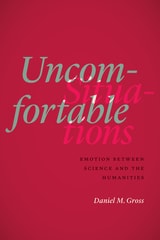
Uncomfortable Situations
Emotion between Science and the HumanitiesDaniel M. Gross
University of Chicago Press, 2017
Science and the humanities typically offer two different paradigms for thinking about emotion—the first rooted in brain and biology, the second in a social world. With rhetoric as a field guide, Uncomfortable Situations establishes common ground between these two paradigms, focusing on a theory of situated emotion. Daniel M. Gross anchors the argument in Charles Darwin, whose work on emotion has been misunderstood across the disciplines as it has been shoehorned into the perceived science-humanities divide. Then Gross turns to sentimental literature as the single best domain for studying emotional situations. There’s lost composure (Sterne), bearing up (Equiano), environmental hostility (Radcliffe), and feeling mixed (Austen). Rounding out the book, an epilogue written with ecological neuroscientist Stephanie Preston provides a different kind of cross-disciplinary collaboration. Uncomfortable Situations is a conciliatory work across science and the humanities—a groundbreaking model for future studies.

Under Briggflatts
A History of Poetry in Great Britain, 1960-1988Donald Davie
University of Chicago Press, 1989
Under Briggflatts is organized in three large chapters, one devoted to each decade. In the 1960s, Davie pays particular attention to the work of Austin Clarke, Hugh MacDiarmid, Norman McCaig, Keith Douglas, Edwin Muir, Basil Bunting (the gurus whose prose writings helped catalyze the traumatic events of 1968), Elaine Feinstein, Sylvia Townsend Warner, Philip Larkin, Charles Tomlinson, Thomas Kinsella, and Ted Hughes. The second chapter follows these figures into the new decade and explores the work of (among others) Thom Gunn, C. H. Sisson, R. S. Thomas, John Betjeman, and such themes as women's poetry, translation, poetic theory, and the later impact of T. S. Eliot and of Edward Thomas. Perhaps the most controversial chapter is the third, in which David—without abandoning the poets already introduced—assesses Geoffrey Hill, Tony Harrison, and Seamus Heaney, and looks too at the recovery of Ivor Gurney's poems, at Ted Hughes as Laureate, the posthumous work of Sylvia Townsend Warner, the burgeoning Hardy industry, and the critical writings of Kenneth Cox.
Under Review
Further Writings on Writers, 1946-1990Anthony Powell
University of Chicago Press, 1994
"Powell is one of the great novelists of our time, much more interested in other people than in his own views and ideas. The result is that his extraordinary richness of act and detail also embodies a far more arresting and penetrating quantity of critical judgements on books, authors, fashions, developments, than are to be found in the theoretical pronouncement of modern academic criticism."—John Bayley, The Sunday Times
"These delightful reviews could be said to amount to a latter-day Brief Lives."—David Plante, Times Literary Supplement
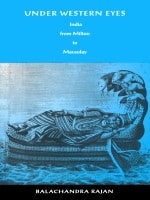
Under Western Eyes
India from Milton to MacaulayBalachandra Rajan
Duke University Press, 1999
Rajan begins with the Portuguese poet Camões, whose poem celebrating Vasco da Gama’s passage to India becomes, according to its eighteenth-century English translator, the epic of those who would possess India. He closely examines Milton’s treatment of the Orient and Dryden’s Aureng-Zebe, the first English literary work on an Indian subject. Texts by Shelley, Southey, Mill, and Macaulay, among others, come under careful scrutiny, as does Hegel’s significant impact on English imperial discourse. Comparing the initial English representation of its actions in India (as a matter of commerce, not conquest) and its contemporaneous treatment of Ireland, Rajan exposes contradictions that shed new light on the English construction of a subaltern India.
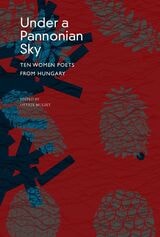
Under a Pannonian Sky
Ten Women Poets from HungaryEdited by Ottilie Mulzet
Seagull Books, 2025
Under a Pannonian Sky is a landmark anthology that brings the voices of ten extraordinary Hungarian women poets to English readers. Edited by award-winning translator Ottilie Mulzet, this collection spans generations, offering a rare glimpse into the rich and complex world of Hungarian poetry. The anthology features renowned poets like Ágnes Nemes Nagy and Zsuzsa Rakovszky, whose works have been celebrated internationally, alongside voices such as Gizella Hervay and Magda Székely, who are introduced in-depth to English readers for the first time. Through original and lyrical language, these poets chronicle the traumas of World War II, the Hungarian Holocaust, and the societal upheavals of the 1989 regime change, exploring themes of identity and resilience. Their poems reflect deeply personal confrontations with their roles as citizens, daughters, mothers, and witnesses to turbulent and often disorienting historical epochs.
Under a Pannonian Sky is an essential collection for readers seeking to discover the richness of Hungarian poetry and its profound engagement with the personal and political landscapes of the twentieth century and beyond.
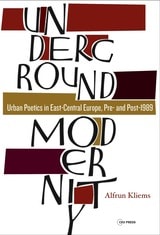
Underground Modernity
Urban Poetics in East-Central Europe, Pre- and Post-1989Alfrun Kliems
Central European University Press, 2021
The literary scholar Alfrun Kliems explores the aesthetic strategies of Eastern European underground literature, art, film and music in the decades before and after the fall of communism, ranging from the ‘father’ of Prague Underground, Egon Bondy, to the neo-Dada Club of Polish Losers in Berlin.
The works she considers are "underground" in the sense that they were produced illegally, or were received as subversive after the regimes had fallen. Her study challenges common notions of ‘Underground’ as an umbrella term for nonconformism. Rather, it depicts it as a sociopoetic reflection of modernity, intimately linked to urban settings, with tropes and aesthetic procedures related to Surrealism, Dadaism, Expressionism, and, above all, pop and counterculture.
The author discusses these commonalities and distinctions in Czech, Polish, Slovak, Ukrainian, Russian, and German authors, musicians, and filmmakers. She identifies intertextual relations across languages and generations, and situates her findings in a transatlantic context (including the Beat Generation, Susan Sontag, Neil Young) and the historical framework of Romanticism and modernity (including Baudelaire and Brecht).
Despite this wide brief, the book never loses sight of its core message: Underground is no arbitrary expression of discontent, but rather the result of a fundamental conflict at the socio-philosophical roots of modernity.
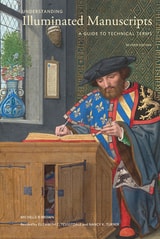
Understanding Illuminated Manuscripts
A Guide to Technical Terms, Revised EditionMichelle Brown
J. Paul Getty Trust, The, 2018
Updated to reflect current research and technologies, this beautifully illustrated guide includes images of important manuscript illuminations from the collection of the J. Paul Getty Museum and beyond. Concise, readable explanations of the technical terms most frequently encountered in manuscript studies make this portable volume an essential resource for students, scholars, and readers who wish a deeper understanding and enjoyment of illuminated manuscripts and medieval book production.
Understanding Tolstoy
Andrew D. Kaufman
The Ohio State University Press, 2010
Understanding Tolstoy recreates Tolstoy’s lifelong artistic and spiritual journey, taking readers to the core of the writer’s world through nuanced close readings of his major novels and novellas. Andrew D. Kaufman’s broad and accessible analysis of Tolstoy’s work speaks to the ways in which Tolstoy, despite living in a manner far removed from the experiences of most modern-day Americans, is still applicable and contemporary.
From a reconstruction of Olenin’s search for truth in The Cossacks to an illuminating analysis of Hadji-Murat’s tragic last stand, Understanding Tolstoy brings to life the fascinating parallels between Tolstoy’s personal quest and his characters’ journeys. Whether writing about the ballrooms and battlefields of War and Peace or the spectrum of sexual and spiritual attachments in Anna Karenina, Tolstoy emerges as a vital, searching artist who continually grows and surprises us, yet is driven by a single, unchanging belief in universal human truths.
Understanding Tolstoy is a treasure trove of critical and philosophical insights that will appeal to Tolstoy aficionados of all kinds, from advanced scholars to undergraduate students. The book offers an eminently readable guide to those entering Tolstoy’s world for the first time or the tenth, and it invites them to grapple alongside the writer and his characters with the most urgent existential questions of our time, and all times.
Underworlds of Memory
W. G. Sebald's Epic Journeys through the PastAlan Itkin
Northwestern University Press, 2017
Scholars often read Sebald’s work as a project of cultural memory that aims to reevaluate Europe's past in the wake of the traumatic and complex events of the twentieth century. Sebald’s characters seek out the traces of Europe’s destructive history in strange places. They linger in disused train stations, pause before works of art, and return to childhood homes that turn out to be more foreign than any place they have visited. Underworlds of Memory demonstrates that these strange encounters with the past are based on central tropes of classical epic: the journey to the underworld, the encounter with a work of art, and the return to the homeland.
Sebald thus follows in the footsteps of German Jewish authors, including Peter Weiss, Siegfried Kracauer, and Jean Améry, who use these same epic tropes to reconsider the cultural memory of the Holocaust. Underworlds of Memory reads Sebald's works together with the works of these German Jewish authors and the classical epics of Homer and Virgil in order to describe and trace the origins of the unique intervention into cultural memory they embody.
Une collecte d’images
Walter Benjamin à la Bibliothèque nationaleSteffen Haug
Diaphanes, 2022
Au fil de ses recherches, Benjamin se rend à l’évidence : il faudra que son Livre des passages soit enrichi par des images. Une « documentation visuelle » se constitue bientôt, écrit-il, glanée pour l’essentiel dans les recueils du Cabinet des estampes de la Bibliothèque nationale où il travaille pendant son exil parisien. Une centaine de notes témoignent de cette collecte et conservent, enfermée dans leurs plis, la mention d’une ou de plusieurs images qui sont restées pour la plupart inconnues jusqu’ici.
Steffen Haug a voulu retrouver cette réserve enfouie. Gravures et dessins de presse, tracts, réclames, affiches et photographies, de Meryon et Grandville à Daumier, en passant par l’infinie cohorte anonyme et le tout-venant de la production visuelle à grand tirage du XIXe siècle : la moisson rapportée ici est surprenante. Elle invite à lire ou relire les Passages en faisant à l’image toute la place qu’elle occupe dans la pensée du dernier Benjamin, à l’heure où s’élaborent, sous la menace de temps assombris, son essai « L’œuvre d’art à l’époque de sa reproductibilité technique », le projet de livre sur Baudelaire ou ses « Thèses sur le concept d’histoire ».
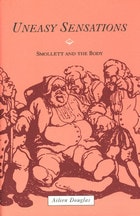
Uneasy Sensations
Smollett and the BodyAileen Douglas
University of Chicago Press, 1995
Aileen Douglas draws on feminist and other new theoretical perspectives to reassess Smollett's entire body of fiction as well as his classic Travels through France and Italy. Like many writers of his time, Douglas argues, Smollett was interested in the body and in how accurately it reflects internal disposition. But Smollett's special contribution to the eighteenth-century novel is his emphasis on sentience, or the sensations of the physical body. Looking at such works as The Adventures of Roderick Random, The Expedition of Humphry Clinker, The Adventures of Peregrine Pickle, and The History and Adventures of an Atom, Douglas explores the ways Smollett uses representations of sentience—especially torment and pain—in his critique of the social and political order.
Trained in medicine, Smollett was especially alert to the ways in which the discourses of medicine, philosophy, and law construct (as we would put it now) the body as an object of knowledge, and yet his work always returns to the importance of the physical world of the body and its feelings. Smollett reminds us, as Douglas aptly puts it, that "if you prick a socially constructed body, it still bleeds."
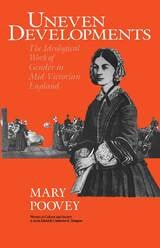
Uneven Developments
The Ideological Work of Gender in Mid-Victorian EnglandMary Poovey
University of Chicago Press, 1988
Asserting that the organization of sexual difference is a social, not natural, phenomenon, Poovey shows how representations of gender took the form of a binary opposition in mid-Victorian culture. She then reveals the role of this opposition in various discourses and institutions—medical, legal, moral, and literary. The resulting oppositions, partly because they depended on the subordination of one term to another, were always unstable. Poovey contends that this instability helps explain why various institutional versions of binary logic developed unevenly. This unevenness, in turn, helped to account for the emergence in the 1850s of a genuine oppositional voice: the voice of an organized, politicized feminist movement.
Drawing on a wide range of sources—parliamentary debates, novels, medical lectures, feminist analyses of work, middle-class periodicals on demesticity—Poovey examines various controversies that provide glimpses of the ways in which representations of gender were simultaneously constructed, deployed, and contested. These include debates about the use of chloroform in childbirth, the first divorce law, the professional status of writers, the plight of governesses, and the nature of the nursing corps. Uneven Developments is a contribution to the feminist analysis of culture and ideology that challenges the isolation of literary texts from other kinds of writing and the isolation of women's issues from economic and political histories.
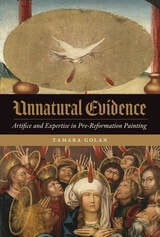
Unnatural Evidence
Artifice and Expertise in Pre-Reformation PaintingTamara Golan
University of Chicago Press, 2026
A novel account of the rise of pictorial naturalism on the eve of the Reformation.
In the summer of 1507, the town of Bern was abuzz with rumors about a sculpture at the Dominican church that had wept tears of blood. But astonishment soon gave way to doubt when a group of local artisans denounced the authenticity of the miracle, complaining that the tears were too poorly made to be the work of a skilled hand, let alone divine intervention. The resulting trial exposed an elaborate fraud staged by the church’s leaders and, with it, a tension that had been building across the region for nearly a century. In a world where claims of sanctity faced judicial scrutiny, the threshold between artistry and deception had become dangerously thin.
Tamara Golan examines how three generations of painters working in fifteenth- and sixteenth-century Switzerland navigated this fraught terrain. Golan traces how, amid intensifying skepticism over the authenticity of miracles and visions, these artists forged what she calls an “alternative naturalism,” a conspicuously unnatural mode of painting marked by distorted perspective, unusual modeling, and heavily tooled gold ground. Rather than striving for the faithful transcription of appearances, these artists drew on shared premises of artisanal expertise and juridical inquiry to advance bold claims about the capacity of their craft to represent not just the natural but the supernatural. The first study to identify this body of work as a coherent enterprise, Unnatural Evidence recovers an epistemological experiment at once ambitious and inherently unstable.
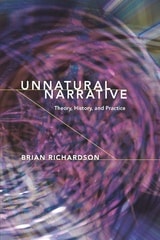
Unnatural Narrative
Theory, History, and PracticeBrian Richardson
The Ohio State University Press, 2015
Applying these theoretical insights, Richardson also provides a compelling alternative view of the history of narrative. He traces a genealogy of unnatural narratives from ancient Greek and Sanskrit works through medieval and renaissance fiction to eighteenth-century and romantic fiction. The study continues through the twentieth century, discussing the unnatural elements of Ulysses and other early twentieth-century texts, and engages with contemporary fiction by offering an alternative account of postmodernism. Unnatural Narrative makes an essential intervention in narrative theory and an important contribution to the history of the novel.
Unnatural Narratology
Extensions, Revisions, and ChallengesEdited by Jan Alber and Brian Richardson
The Ohio State University Press, 2020
Unsettled
The Culture of Mobility and the Working Poor in Early Modern EnglandPatricia Fumerton
University of Chicago Press, 2006
Migrants made up a growing class of workers in late sixteenth- and seventeenth- century England. In fact, by 1650, half of England’s rural population consisted of homeless and itinerant laborers. Unsettled is an ambitious attempt to reconstruct the everyday lives of these dispossessed people. Patricia Fumerton offers an expansive portrait of unsettledness in early modern England that includes the homeless and housed alike.
Fumerton begins by building on recent studies of vagrancy, poverty, and servants, placing all in the light of a new domestic economy of mobility. She then looks at representations of the vagrant in a variety of pamphlets and literature of the period. Since seamen were a particularly large and prominent class of mobile wage-laborers in the seventeenth century, Fumerton turns to seamen generally and to an individual poor seaman as a case study of the unsettled subject: Edward Barlow (b. 1642) provides a rare opportunity to see how the laboring poor fashioned themselves, for he authored a journal of over 225,000 words and 147 pages of drawings. Barlow’s journal, studied extensively here for the first time, vividly charts what he himself termed his “unsettled mind” and the perpetual anxieties of England’s working and wayfaring poor. Ultimately, Fumerton explores representations of seamen as unsettled in the broadside ballads of Barlow’s time.
Unsettling Opera
Staging Mozart, Verdi, Wagner, and ZemlinskyDavid J. Levin
University of Chicago Press, 2007
What happens when operas that are comfortably ensconced in the canon are thoroughly rethought and radically recast on stage? What does a staging do to our understanding of an opera, and of opera generally? While a stage production can disrupt a work that was thought to be established, David J. Levin here argues that the genre of opera is itself unsettled, and that the performance of operas, at its best, clarifies this condition by bringing opera’s restlessness and volatility to life.
Unsettling Opera explores a variety of fields, considering questions of operatic textuality, dramaturgical practice, and performance theory. Levin opens with a brief history of opera production, opera studies, and dramatic composition, and goes on to consider in detail various productions of the works of Wagner, Mozart, Verdi, and Alexander Zemlinsky. Ultimately, the book seeks to initiate a dialogue between scholars of music, literature, and performance by addressing questions raised in each field in a manner that influences them all.
Unspeakable
A Life beyond Sexual MoralityRachel Hope Cleves
University of Chicago Press, 2020
Unspeakable approaches Douglas as neither monster nor literary hero, but as a man who participated in an exploitative sexual subculture that was tolerated in ways we may find hard to understand. Using letters, diaries, memoirs, police records, novels, and photographs—including sources by the children Douglas encountered—Cleves identifies the cultural practices that structured pedophilic behaviors in England, Italy, and other places Douglas favored. Her book delineates how approaches to adult-child sex have changed over time and offers insight into how society can confront similar scandals today, celebrity and otherwise.

Urban Microcosms 1789-1940
Edited by Margit Dirscherl and Astrid Köhler
University of London Press, 2019
Urbino
The Story of a Renaissance CityJune Osborne
University of Chicago Press, 2003
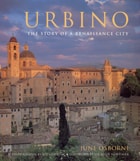
With Urbino: The Story of a Renaissance City, art historian June Osborne brings to life not only the great city and its art but also its turbulent history and the intrigue surrounding its ruling family. First settled by the ancient Umbrians, Urbino reached its zenith during the fifteenth century under the rule of Duke Federico da Montefeltro and his son Guidobaldo. Federico may have been a usurper and a fierce, opportunistic warlord, but his lust for power was more than matched by his passion for great art. Indeed it was under his direct guidance that the magnificent Ducal Palace was built—its perfectly proportioned courtyard a wonder of early Renaissance architecture.
Today the Ducal Palace hosts the National Gallery of the Marches, one of the most important art galleries in Italy, featuring works by no lesser lights than Raphael, Uccello, Piero della Francesca, and Titian. Exploring such sites as the fourteenth-century Oratorio di San Giovanni Battista and the Gothic Church of San Domenico, Osborne captures not only the startling beauty of Urbino and the Apennine foothills but also the tumultuous legacy of Frederico and his son (and their many wives and courtiers).
With over a hundred lavish color photographs, many by renowned landscape photographer Joe Cornish, Urbino is the best—and the only—guide to this gem of the Italian Marches.
Useful Knowledge
The Victorians, Morality, and the March of IntellectAlan Rauch
Duke University Press, 2001
Rauch discusses both the influence and the ideology of knowledge in terms of how it affected nineteenth-century anxieties about moral responsibility and religious beliefs. Drawing on a wide array of literary, scientific, and popular works of the period, the book focusses on the growing importance of scientific knowledge and its impact on Victorian culture. From discussions of Jane Webb Loudon’s The Mummy! and Mary Shelley’s Frankenstein, to Charlotte Brontë’s The Professor, Charles Kingsley’s Alton Locke, and George Eliot’s Mill on the Floss, Rauch paints a fascinating picture of nineteenth-century culture and addresses issues related to the proliferation of knowledge and the moral issues of this time period. Useful Knowledge touches on social and cultural anxieties that offer both historical and contemporary insights on our ongoing preoccupation with knowledge.
Useful Knowledge will appeal to readers interested in nineteenth century history, literature, culture, the mediation of knowledge, and the history of science.

Utopia
Three Plays for a Postdramatic TheatreClaire MacDonald
Intellect Books, 2015
Utopias Of Otherness
Nationhood And Subjectivity In Portugal And BrazilFernando Arenas
University of Minnesota Press, 2003
Forges a new understanding of how these two Lusophone nations are connected
The closely entwined histories of Portugal and Brazil remain key references for understanding developments—past and present—in either country. Accordingly, Fernando Arenas considers Portugal and Brazil in relation to one another in this exploration of changing definitions of nationhood, subjectivity, and utopias in both cultures. Examining the two nations’s shared language and histories as well as their cultural, social, and political points of divergence, Arenas pursues these definitive changes through the realms of literature, intellectual thought, popular culture, and political discourse.
Both Brazil and Portugal are subject to the economic, political, and cultural forces of postmodern globalization. Arenas analyzes responses to these trends in contemporary writers including José Saramago, Caio Fernando Abreu, Maria Isabel Barreno, Vergílio Ferreira, Clarice Lispector, and Maria Gabriela Llansol. Ultimately, Utopias of Otherness shows how these writers have redefined the concept of nationhood, not only through their investment in utopian or emancipatory causes such as Marxist revolution, women’s liberation, or sexual revolution, but also by shifting their attention to alternative modes of conceiving the ethical and political realms.