Results by title
208 books match the query 'Finance' and 2 start with u
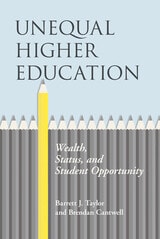
Unequal Higher Education
Wealth, Status, and Student OpportunityBarrett J. Taylor
Rutgers University Press, 2019
American higher education is often understood as a vehicle for social advancement. However, the institutions at which students enroll differ widely from one another. Some enjoy tremendous endowment savings and/or collect resources via research, which then offsets the funds that students contribute. Other institutions rely heavily on student tuition payments. These schools may struggle to remain solvent, and their students often bear the lion’s share of educational costs. Unequal Higher Education identifies and explains the sources of stratification that differentiate colleges and universities in the United States. Barrett J. Taylor and Brendan Cantwell use quantitative analysis to map the contours of this system. They then explain the mechanisms that sustain it and illustrate the ways in which rising institutional inequality has limited individual opportunity, especially for students of color and low-income individuals.
[more]
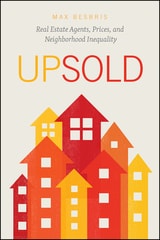
Upsold
Real Estate Agents, Prices, and Neighborhood InequalityMax Besbris
University of Chicago Press, 2020
What do you want for yourself in the next five, ten years? Do your plans involve marriage, kids, a new job? These are the questions a real estate agent might ask in an attempt to unearth information they can employ to complete a sale, which as Upsold shows, often results in upselling. In this book, sociologist Max Besbris shows how agents successfully upsell, inducing buyers to spend more than their initially stated price ceilings. His research reveals how face-to-face interactions influence buyers’ ideas about which neighborhoods are desirable and which are less-worthy investments and how these preferences ultimately contribute to neighborhood inequality.
Stratification defines cities in the contemporary United States. In an era marked by increasing income segregation, one of the main sources of this inequality is housing prices. A crucial part of wealth inequality, housing prices are also directly linked to the uneven distribution of resources across neighborhoods and to racial and ethnic segregation. Upsold shows how the interactions between real estate agents and buyers make or break neighborhood reputations and construct neighborhoods by price.
Employing revealing ethnographic and quantitative housing data, Besbris outlines precisely how social influences come together during the sales process. In Upsold, we get a deep dive into the role that the interactions with sales agents play in buyers’ decision-making and how neighborhoods are differentiated, valorized, and deemed to be worthy of a certain price.
[more]