Results by title
340 books match the query 'Folklore' and 5 start with u
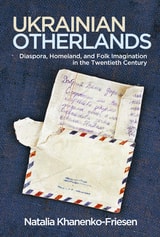
Ukrainian Otherlands
Diaspora, Homeland, and Folk Imagination in the Twentieth CenturyNatalia Khanenko-Friesen
University of Wisconsin Press, 2015
Ukrainian Otherlands is an innovative exploration of modern ethnic identity, focused on diaspora/homeland understandings of each other in Ukraine and in Ukrainian ethnic communities around the globe. Exploring a rich array of folk songs, poetry and stories, trans-Atlantic correspondence, family histories, and rituals of homecoming and hosting that developed in the Ukrainian diaspora and Ukraine during the twentieth century, Natalia Khanenko-Friesen asserts that many important aspects of modern ethnic identity form, develop, and reveal themselves not only through the diaspora's continued yearning for the homeland, but also in a homeland's deeply felt connection to its diaspora. Yet, she finds each group imagines the "otherland" and ethnic identity differently, leading to misunderstandings between Ukrainians and their ethnic-Ukrainian "brothers and sisters" abroad.
An innovative exploration of the persistence of vernacular culture in the modern world, Ukrainian Otherlands, amply informed by theory and fieldwork, will appeal to those interested in folklore, ethnic and diaspora studies, modernity, migration, folk psychology, history, and cultural anthropology.
Unlearning
Rethinking Poetics, Pandemics, and the Politics of KnowledgeCharles L. Briggs
Utah State University Press, 2021
Eschewing narrow Eurocentric modes of explanation and research foci, Briggs brings together colonialism, health, media, and psychoanalysis to rethink classic work on poetics and performance that revolutionized linguistic anthropology, folkloristics, media studies, communication, and other fields. Beginning with a candid memoir that credits the mentors whose disconcerting insights prompted him to upend existing scholarly approaches, Briggs combines his childhood experiences in New Mexico with his work in graduate school, his ethnography in Venezuela working with Indigenous peoples, and his contemporary work—which is heavily weighted in medical folklore.
Unlearning offers students, emerging scholars, and veteran researchers alike a guide for turning ethnographic objects into provocations for transforming time-worn theories and objects of analysis into sources of scholarly creativity, deep personal engagement, and efforts to confront unconscionable racial inequities. It will be of significant interest to folklorists, anthropologists, and social theorists and will stimulate conversations across these disciplines.
Unmasking Class, Gender, and Sexuality in Nicaraguan Festival
Katherine Borland
University of Arizona Press, 2006
The first extended study in English of Nicaraguan festival arts, Unmasking Class, Gender, and Sexuality in Nicaraguan Festival is an ethnographically and historically grounded inquiry into three festival enactments during the Somoza, Sandinista, and Neoliberal periods: the carnivalesque torovenado masquerades, the transvestite Negras marimba dances, and the wagon pilgrimage to Popoyuapa. Through a series of interlinked essays, Katherine Borland shows that these enactments constitute a people’s theater, articulating a range of perspectives on the homegrown and the global; on class, race, and ethnicity; on gender and sexuality; and on religious sensibilities.
Borland’s book is a case study of how the oppositional power of popular culture resides in the process of cultural negotiation itself as communities deploy cherished traditions to assert their difference from the nation and the world. It addresses both the gendered dimensions of a particular festival masquerade and the ways in which sexuality is managed in traditional festival transvestism. It demonstrates how performativity and theatricality interact to negotiate certain crucial realities in a festival complex. By showing how one locale negotiates, incorporates, and resists globally circulating ideas, identities, and material objects, it makes a major contribution to studies of ritual and festival in Latin America.
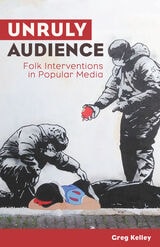
Unruly Audience
Folk Interventions in Popular MediaGreg Kelley
Utah State University Press, 2020
Greg Kelley examines how “folk interventions” challenge institutional media with active—often public—social engagement. Drawing on a diverse range of examples—popular music parodies of “The Colonel Bogey March,” jokes about Disney’s Snow White and the Seven Dwarfs, touristic performance at Jamaica’s haunted Rose Hall, internet memes about NBC’s The Office, children’s parodies of commercials, and jokes about joking—Kelley demonstrates how active audiences mobilize folklore to disrupt dominant modes of media discourse. With materials both historical and contemporary and compiled from print, internet archives, and original fieldwork, Kelley’s audience-centered analysis demonstrates that producers of media are not the sole arbiters of meaning. With folklore as an important tool, unruly audiences refashion mediated expression so that the material becomes more relevant to their own circumstances.
Unruly Audience foregrounds the fluid interplay between media production and audience reception and between forces of cultural domination and cultural resistance, bringing new analytical insights to familiar folk practices. This carefully crafted book will speak to students and scholars in folklore, popular culture, and media studies in multidisciplinary ways.
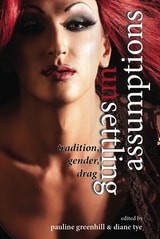
Unsettling Assumptions
Tradition, Gender, DragPauline Greenhill
Utah State University Press, 2014
In Unsettling Assumptions, editors Pauline Greenhill and Diane Tye examine how tradition and gender come together to unsettle assumptions about culture and its study.
Contributors explore the intersections of traditional expressive culture and sex/gender systems to question, investigate, or upset concepts like family, ethics, and authenticity. Individual essays consider myriad topics such as Thanksgiving turkeys, rockabilly and bar fights, Chinese tales of female ghosts, selkie stories, a noisy Mennonite New Year’s celebration, the Distaff Gospels, Kentucky tobacco farmers, international adoptions, and more.
In Unsettling Assumptions, folkloric forms express but also counteract negative aspects of culture like misogyny, homophobia, and racism. But expressive culture also emerges as fundamental to our sense of belonging to a family, an occupation, or friendship group and, most notably, to identity performativity and the construction and negotiation of power.