Results by title
96 books match the query 'Games & Activities' and 3 start with u
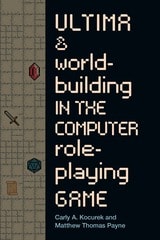
Ultima and Worldbuilding in the Computer Role-Playing Game
Carly A. Kocurek and Matthew Thomas Payne
Amherst College Press, 2024
This book first considers the contributions of series founder and lead designer, Richard Garriott, examining how his fame and notoriety as a pioneering computer game auteur shaped Ultima’s reception and paved the way for the evolution of the series. Next, the authors retrace the steps that Garriott took in fusing analog, tabletop role-playing with his self-taught lessons in computer programming. Close textual analyses of Ultima I outline how its gameplay elements offered a foundational framework for subsequent innovations in design and storytelling. Moving beyond the game itself, the authors assess how marketing materials and physical collectibles amplified its immersive hold and how the series’ legions of fans have preserved the series. Game designers, long-time gamers, and fans will enjoy digging into the games’ production history and mechanics while media studies and game scholars will find Ultima and World-Building in the Computer Role-Playing Game a useful extension of inquiry into authorship, media history, and the role of fantasy in computer game design.
Undertale
Can a Game Give Hope?Anastasia Salter
University of Chicago Press, 2025
A powerful exploration of the importance and social complexity of the indie gaming sensation
On the surface, the 2015 game Undertale didn’t seem like much, supported by fan funding and with minimalist retro graphics. But despite its pixelated monsters and dated role-playing mechanics, Undertale invited fans and players to rethink their very relationship with gaming and game characters. Players encountered an extraordinary range of possible play experiences, with paths through the game’s unassuming world leading to both empathy and extreme violence, offering room for reflection and growth. Players could befriend (sometimes queer) monsters or kill them, for instance, appealing to each monster’s unique personality to negotiate survival and find community.
Contextualizing this game’s success in the wake of the Gamergate online harassment campaign and meditating on questions of violence and authenticity, writer and game scholar Anastasia Salter offers a profound exploration of this game sensation and a personal story of hope at a time when Salter was otherwise “done” with games. Undertale’s unique structure helped make it synonymous with “indie” games, built outside of the studio as a passion project and inspiring similar passion among its many fans even a decade later. But Undertale’s story also speaks to an auteur dream: What game developer Toby Fox and his collaborators accomplished on a small budget, with relatively simple tools, has left people replaying, arguing, and creating in its wake.
As we enter a cultural moment where intense interest is shifting towards flashy creativity, powered by generative artificial intelligence, Undertale reminds fans and newcomers of the power of thoughtful and intentional human design.
Unsettling Catan
Detached Design in EurogamesJ. Rey Lee
University of Michigan Press, 2025
Although peaceful revolutions are usually the best kind, it’s worth questioning how these games cultivate peaceful feelings. Today, peaceful-feeling eurogames often settle into detached design—a mindset of making conflict feel peaceful by dampening conflicted feelings. Unsettling Catan questions how peaceful-feeling eurogames can make implicitly imperialist themes palatable by cultivating a detached mindset that imagines power as peaceful, neutral, and abstract. To ask the hard questions that eurogames often look away from, the book walks through each aspect of Catan’s gameplay (placing hexes, rolling the dice, robbing and trading, collecting resources, building and scoring) to explore how simple design decisions can play out, or play with, cultural ideas and ideals. As the first entry in the Tabletop Games book series, Unsettling Catan introduces key concepts for thinking about board games as a medium and offers accessible game analyses and personal reflections to help players, creators, and scholars reimagine what board games can be and become.