932 books match the query 'Genres & Styles' and 10 start with u

cover of Un giorno di regno: Melodramma giocoso in Two Acts by Felice Romani

Un giorno di regno

Melodramma giocoso in Two Acts by Felice Romani

Giuseppe Verdi

University of Chicago Press, 2021

Un giorno di regno, which premiered at Milan’s Teatro alla Scala in September 1840, is Verdi’s second opera and one of only two comedies (with Falstaff) ever written by the composer. Rooted in Felice Romani’s libretto Il finto Stanislao, Un giorno di regno experienced a tumultuous history: the opera’s first performance was poorly received, a result that has been often attributed to a personal tragedy—the sudden death of his first wife—that befell Verdi during the work’s composition. Research for this edition, however, reveals that Verdi worked on it with the utmost care. In recent times, new audiences have embraced revivals of Un giorno di regno, and the opera is now celebrated as a fine expression of Verdi’s robust style, offering enticing glimpses into the world of comedy at mid-century.

This critical edition, based on Verdi’s autograph manuscript, offers the first publication of the opera in full score. Editor Francesco Izzo contextualizes Un giorno di regno in his introductory discussion of the work’s origins, sources, and performances. In addition, appendices provide alternative musical readings and reconstruct lost versions of segments of the musical numbers, while the critical commentary explores editorial problems and answers.
[more]
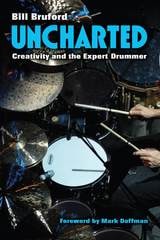
cover of Uncharted: Creativity and the Expert Drummer

Uncharted

Creativity and the Expert Drummer

Bill Bruford

University of Michigan Press, 2018
What do expert drummers do? Why do they do it? Is there anything creative about it? If so, how might that creativity inform their practice and that of others in related artistic spheres? Applying ideas from cultural psychology to findings from research into the creative behaviors of a specific subset of popular music instrumentalists, Bill Bruford demonstrates the ways in which expert drummers experience creativity in performance and offers fresh insights into in-the-moment interactional processes in music. An expert practitioner himself, Dr. Bruford draws on a cohort of internationally renowned, peak-career professionals and his own experience to guide the reader through the many dimensions of creativity in drummer performance.
[more]
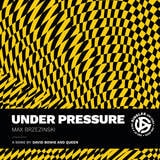
cover of Under Pressure: A Song by David Bowie and Queen

Under Pressure

A Song by David Bowie and Queen

Max Brzezinski

Duke University Press, 2025

In 1981, David Bowie and Queen both happened to be in Switzerland: They met and made “Under Pressure.” Recorded on a lark, the song broke the path for subsequent pop anthems. In Under Pressure, Max Brzezinski tells the classic track’s story, charting the relationship between pop music, collective politics, and dominant institutions of state, corporations, and civil society. Brzezinski shows that, like all great pop anthems, “Under Pressure” harnesses collective sentiments in order to model new ways of thinking and acting. As we continue to live under the sign of the global oppressive power the song names, analyzes, and attempts to move beyond, we remain, in Bowie and Freddie Mercury’s phrase, under pressure.
[more]
cover of Underground Symphony: The Plastic People

Underground Symphony

The Plastic People

František Stárek and Martin Valenta

Karolinum Press, 2026

First-hand insight into the Czechoslovak underground music scene and the numerous obstacles placed in its way by communist-era security services.

Underground Symphony: The Plastic People traces the history of the rock band The Plastic People of the Universe against the backdrop of political developments in communist Czechoslovakia. It begins with the band’s formation in the 1960s, when psychedelic rock was first introduced to Czechoslovakia, through the emergence of the first concepts of cultural opposition and politically oriented dissent, particularly Charter 77, ending with a detailed account of the band’s breakup in the second half of the 1980s.

The authors rely on primary sources, many of which have not been published; for example, the Plastic People’s chronicles, extensive interviews with band members and friends, and contemporary writings by individual participants (in samizdat publications, private correspondence, diaries, etc.). They also “mine” archival sources from the State Security (Archive of Security Services, National Archives, etc.). The result is an insightful study of the legendary underground band and its era.
[more]
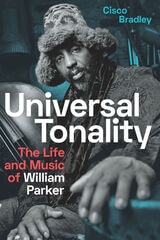
cover of Universal Tonality: The Life and Music of William Parker

Universal Tonality

The Life and Music of William Parker

Cisco Bradley

Duke University Press, 2021
Since ascending onto the world stage in the 1990s as one of the premier bassists and composers of his generation, William Parker has perpetually toured around the world and released over forty albums as a leader. He is one of the most influential jazz artists alive today. In Universal Tonality historian and critic Cisco Bradley tells the story of Parker’s life and music. Drawing on interviews with Parker and his collaborators, Bradley traces Parker’s ancestral roots in West Africa via the Carolinas to his childhood in the South Bronx, and illustrates his rise from the 1970s jazz lofts and extended work with pianist Cecil Taylor to the present day. He outlines how Parker’s early influences—Ornette Coleman, John Coltrane, Albert Ayler, and writers of the Black Arts Movement—grounded Parker’s aesthetic and musical practice in a commitment to community and the struggle for justice and freedom. Throughout, Bradley foregrounds Parker’s understanding of music, the role of the artist, and the relationship between art, politics, and social transformation. Intimate and capacious, Universal Tonality is the definitive work on Parker’s life and music.
[more]
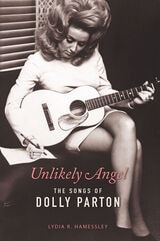
cover of Unlikely Angel: The Songs of Dolly Parton

Unlikely Angel

The Songs of Dolly Parton

Lydia R. Hamessley

University of Illinois Press, 2020

Dolly Parton's success as a performer and pop culture phenomenon has overshadowed her achievements as a songwriter. But she sees herself as a songwriter first, and with good reason. Parton's compositions like "I Will Always Love You" and "Jolene" have become American standards with an impact far beyond country music.

Lydia R. Hamessley's expert analysis and Parton’s characteristically straightforward input inform this comprehensive look at the process, influences, and themes that have shaped the superstar's songwriting artistry. Hamessley reveals how Parton’s loving, hardscrabble childhood in the Smoky Mountains provided the musical language, rhythms, and memories of old-time music that resonate in so many of her songs. Hamessley further provides an understanding of how Parton combines her cultural and musical heritage with an artisan’s sense of craft and design to compose eloquent, painfully honest, and gripping songs about women's lives, poverty, heartbreak, inspiration, and love.

Filled with insights on hit songs and less familiar gems, Unlikely Angel covers the full arc of Dolly Parton's career and offers an unprecedented look at the creative force behind the image.
[more]
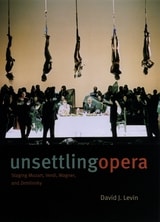
cover of Unsettling Opera: Staging Mozart, Verdi, Wagner, and Zemlinsky

Unsettling Opera

Staging Mozart, Verdi, Wagner, and Zemlinsky

David J. Levin

University of Chicago Press, 2007

What happens when operas that are comfortably ensconced in the canon are thoroughly rethought and radically recast on stage? What does a staging do to our understanding of an opera, and of opera generally? While a stage production can disrupt a work that was thought to be established, David J. Levin here argues that the genre of opera is itself unsettled, and that the performance of operas, at its best, clarifies this condition by bringing opera’s restlessness and volatility to life.

Unsettling Opera explores a variety of fields, considering questions of operatic textuality, dramaturgical practice, and performance theory. Levin opens with a brief history of opera production, opera studies, and dramatic composition, and goes on to consider in detail various productions of the works of Wagner, Mozart, Verdi, and Alexander Zemlinsky. Ultimately, the book seeks to initiate a dialogue between scholars of music, literature, and performance by addressing questions raised in each field in a manner that influences them all.
[more]
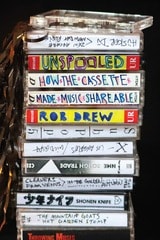
cover of Unspooled: How the Cassette Made Music Shareable

Unspooled

How the Cassette Made Music Shareable

Rob Drew

Duke University Press, 2024

Well into the new millennium, the analog cassette tape continues to claw its way back from obsolescence. New cassette labels emerge from hipster enclaves while the cassette’s likeness pops up on T-shirts, coffee mugs, belt buckles, and cell phone cases. In Unspooled, Rob Drew traces how a lowly, hissy format that began life in office dictation machines and cheap portable players came to be regarded as a token of intimate expression through music and a source of cultural capital. Drawing on sources ranging from obscure music zines to transcripts of Congressional hearings, Drew examines a moment in the early 1980s when music industry representatives argued that the cassette encouraged piracy. At the same time, 1980s indie rock culture used the cassette as a symbol to define itself as an outsider community. Indie’s love affair with the cassette culminated in the mixtape, which advanced indie’s image as a gift economy. By telling the cassette’s long and winding history, Drew demonstrates that sharing cassettes became an acceptable and meaningful mode of communication that initiated rituals of independent music recording, re-recording, and gifting.
[more]
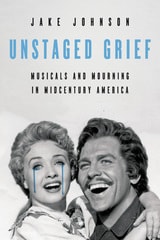
cover of Unstaged Grief: Musicals and Mourning in Midcentury America

Unstaged Grief

Musicals and Mourning in Midcentury America

Jake Johnson

University of Illinois Press, 2025

Often dismissed as escapism, screen musicals of the 1960s in fact tapped into unspoken sadness about an America that was slipping away. Jake Johnson delves into film and television musicals of the era to examine their place in networks of grieving in America, for America, and about America.

The Golden Age of musical theater ended just as Elisabeth Kübler-Ross’s On Death and Dying debuted, and Johnson uses Kübler-Ross’s five stages to frame the intertwining of musicals and grief. He analyzes films like Seven Brides for Seven Brothers and State Fair alongside paintings, poetry, and other images and texts to reveal how the musical theater engine built in the first half of the century broke down just as a new language emerged to describe the melancholy felt by people facing the end of the world they had known.

Nuanced and original, Unstaged Grief plumbs the grief, loss, and hope behind the Technicolor spectacle and rousing showstoppers.
[more]
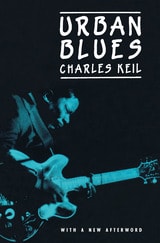
cover of Urban Blues

Urban Blues

Charles Keil

University of Chicago Press, 1968

Charles Keil examines the expressive role of blues bands and performers and stresses the intense interaction between performer and audience. Profiling bluesmen Bobby Bland and B. B. King, Keil argues that they are symbols for the black community, embodying important attitudes and roles—success, strong egos, and close ties to the community. While writing Urban Blues in the mid-1960s, Keil optimistically saw this cultural expression as contributing to the rising tide of raised political consciousness in Afro-America. His new Afterword examines black music in the context of capitalism and black culture in the context of worldwide trends toward diversification.

"Enlightening. . . . [Keil] has given a provocative indication of the role of the blues singer as a focal point of ghetto community expression."—John S. Wilson, New York Times Book Review
"A terribly valuable book and a powerful one. . . . Keil is an original thinker and . . . has offered us a major breakthrough."—Studs Terkel, Chicago Tribune

"[Urban Blues] expresses authentic concern for people who are coming to realize that their past was . . . the source of meaningful cultural values."—Atlantic

"An achievement of the first magnitude. . . . He opens our eyes and introduces a world of amazingly complex musical happening."—Robert Farris Thompson, Ethnomusicology 

"[Keil's] vigorous, aggressive scholarship, lucid style and sparkling analysis stimulate the challenge. Valuable insights come from treating urban blues as artistic communication."—James A. Bonar, Boston Herald
 
[more]