Results by title
73 books match the query 'German literature' and 4 start with u
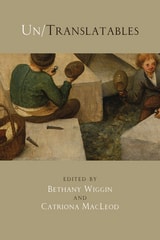
Un/Translatables
New Maps for Germanic LiteraturesEdited by Bethany Wiggin and Catriona MacLeod
Northwestern University Press, 2016
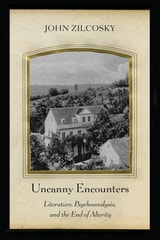
Uncanny Encounters
Literature, Psychoanalysis, and the End of AlterityJohn Zilcosky
Northwestern University Press, 2015
Winner of the Friedrich Wilhelm Bessel Research Award
Recipient, 2022 Guggenheim Fellowship
Around 1900, when the last blank spaces on their maps were filled, Europeans traveled to far-flung places hoping to find the spectacularly foreign. They discovered instead what Freud called, several years later, the uncannily familiar: disturbing reflections of themselves—either actual Europeans or Westernized natives. This experience was most extreme for German travelers, who arrived in the contact zones late, on the heels of other European colonialists, and it resulted not in understanding or tolerance but in an increased propensity for violence and destruction. The quest for a “virginal,” exotic existence proved to be ruined at its source, mirroring back to the travelers demonic parodies of their own worst aspects. In this strikingly original book, John Zilcosky demonstrates how these popular “uncanny” encounters influenced Freud’s—and the literary modernists’—use of the term, and how these encounters remain at the heart of our cross-cultural anxieties today.
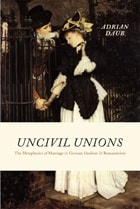
Uncivil Unions
The Metaphysics of Marriage in German Idealism and RomanticismAdrian Daub
University of Chicago Press, 2012
“What a strange invention marriage is!” wrote Kierkegaard. “Is it the expression of that inexplicable erotic sentiment, that concordant elective affinity of souls, or is it a duty or a partnership . . . or is it a little of all that?”
Like Kierkegaard a few decades later, many of Germany’s most influential thinkers at the turn of the eighteenth century wondered about the nature of marriage but rejected the easy answers provided by biology and theology. In Uncivil Unions, Adrian Daub presents a truly interdisciplinary look at the story of a generation of philosophers, poets, and intellectuals who turned away from theology, reason, common sense, and empirical observation to provide a purely metaphysical justification of marriage.
Through close readings of philosophers like Fichte and Schlegel, and novelists like Sophie Mereau and Jean Paul, Daub charts the development of this new concept of marriage with an insightful blend of philosophy, cultural studies, and theory. The author delves deeply into the lives and work of the romantic and idealist poets and thinkers whose beliefs about marriage continue to shape ideas about gender, marriage, and sex to the present day.
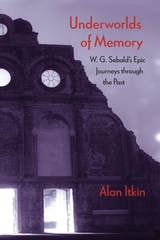
Underworlds of Memory
W. G. Sebald's Epic Journeys through the PastAlan Itkin
Northwestern University Press, 2017
Scholars often read Sebald’s work as a project of cultural memory that aims to reevaluate Europe's past in the wake of the traumatic and complex events of the twentieth century. Sebald’s characters seek out the traces of Europe’s destructive history in strange places. They linger in disused train stations, pause before works of art, and return to childhood homes that turn out to be more foreign than any place they have visited. Underworlds of Memory demonstrates that these strange encounters with the past are based on central tropes of classical epic: the journey to the underworld, the encounter with a work of art, and the return to the homeland.
Sebald thus follows in the footsteps of German Jewish authors, including Peter Weiss, Siegfried Kracauer, and Jean Améry, who use these same epic tropes to reconsider the cultural memory of the Holocaust. Underworlds of Memory reads Sebald's works together with the works of these German Jewish authors and the classical epics of Homer and Virgil in order to describe and trace the origins of the unique intervention into cultural memory they embody.