Results by title
67 books match the query 'Global Warming & Climate Change' and 4 start with u
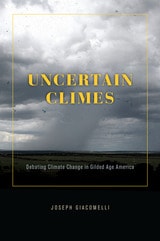
Uncertain Climes
Debating Climate Change in Gilded Age AmericaJoseph Giacomelli
University of Chicago Press, 2023
Uncertain Climes looks to the late nineteenth century to reveal how climate anxiety was a crucial element in the emergence of American modernity.
Even people who still refuse to accept the reality of human-induced climate change would have to agree that the topic has become inescapable in the United States in recent decades. But as Joseph Giacomelli shows in Uncertain Climes, this is actually nothing new: as far back as Gilded Age America, climate uncertainty has infused major debates on economic growth and national development.
In this ambitious examination of late-nineteenth-century understandings of climate, Giacomelli draws on the work of scientists, foresters, surveyors, and settlers to demonstrate how central the subject was to the emergence of American modernity. Amid constant concerns about volatile weather patterns and the use of natural resources, nineteenth-century Americans developed a multilayered discourse on climate and what it might mean for the nation’s future. Although climate science was still in its nascent stages during the Gilded Age, fears and hopes about climate change animated the overarching political struggles of the time, including expansion into the American West. Giacomelli makes clear that uncertainty was the common theme linking concerns about human-induced climate change with cultural worries about the sustainability of capitalist expansionism in an era remarkably similar to the United States’ unsettled present.
[more]
Uncertain Climes
Debating Climate Change in Gilded Age AmericaJoseph Giacomelli
University of Chicago Press, 2023
This is an auto-narrated audiobook edition of this book.
Uncertain Climes looks to the late nineteenth century to reveal how climate anxiety was a crucial element in the emergence of American modernity.
Even people who still refuse to accept the reality of human-induced climate change would have to agree that the topic has become inescapable in the United States in recent decades. But as Joseph Giacomelli shows in Uncertain Climes, this is actually nothing new: as far back as Gilded Age America, climate uncertainty has infused major debates on economic growth and national development.
In this ambitious examination of late-nineteenth-century understandings of climate, Giacomelli draws on the work of scientists, foresters, surveyors, and settlers to demonstrate how central the subject was to the emergence of American modernity. Amid constant concerns about volatile weather patterns and the use of natural resources, nineteenth-century Americans developed a multilayered discourse on climate and what it might mean for the nation’s future. Although climate science was still in its nascent stages during the Gilded Age, fears and hopes about climate change animated the overarching political struggles of the time, including expansion into the American West. Giacomelli makes clear that uncertainty was the common theme linking concerns about human-induced climate change with cultural worries about the sustainability of capitalist expansionism in an era remarkably similar to the United States’ unsettled present.
[more]
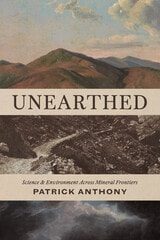
Unearthed
Science and Environment Across Mineral FrontiersPatrick Anthony
University of Chicago Press, 2026
How nineteenth-century environmental sciences laid the groundwork for global mineral extraction.
Unearthed depicts a pivotal moment during the nineteenth century: As European and settler schemes to govern ever larger territories intensified, the earth and atmospheric sciences were also becoming more global in scope, assembling models of the planet while making use of militarized or highly industrialized systems. These efforts were informed by the physique du monde, or global physics, of Alexander von Humboldt (1769–1859), a program of vast data collection that spanned four hemispheres that aimed to determine general, scientific laws about the planet and its environments.
Using Humboldt’s itineraries as a frame, Unearthed traces an information order that linked far-flung industrial sites and frontier stations, from Prussian provinces to the Spanish and Russian empires. Humboldt intersected with Saxon miners, Mexican cartographers, and Siberian surveyors, among other itinerant Germans who mobilized the labor and resources of widespread mining operations for global surveys of earth and air. Interweaving the histories of capital and climate, Patrick Anthony takes readers from mines to mountains to show how the sciences of Humboldt’s circuits both measured and made modern natures. These sciences of the mineral frontier, he argues, ultimately laid the groundwork for carbon-intensive economics and a logic of unending extraction. Wide-ranging and ambitious, Unearthed will interest scholars working in the history of science, global history, and the environmental humanities.
[more]
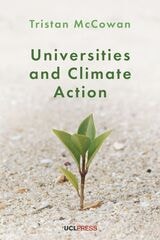
Universities and Climate Action
Tristan McCowan
University College London, 2025
The climate crisis demands more than innovation; it requires a radical rethinking of the role of universities.
As the climate crisis intensifies, universities stand at a crossroads—both as contributors to ecological challenges and as agents of change. Universities and Climate Action presents a novel framework for understanding how higher education institutions can engage meaningfully with climate issues across teaching, research, governance, and community outreach. Tristan McCowan investigates the tensions between academia’s historical complicity in environmental exploitation and its immense potential in driving sustainable transformation.
This work offers a holistic perspective on how universities influence climate change at local and global levels, underscoring both the barriers to action and the pathways to meaningful change. With examples from institutions worldwide, McCowan demonstrates how universities can embed climate responsibility into curricula, shift research priorities, and foster climate-conscious campus operations. By synthesizing diverse approaches and offering practical principles for reform, Universities and Climate Action is a vital blueprint for academics and university leaders seeking to reorient higher education toward a just and sustainable future.
[more]