Results by title
668 books match the query 'History & Surveys' and 5 start with u
Understanding Our Being
Introduction to Speculative Philosophy in the Perennial TraditionJohn W. Carlson
Catholic University of America Press, 2008
Unfinished System Of Nonknowledge
Georges Bataille
University of Minnesota Press, 2004
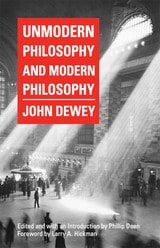
Unmodern Philosophy and Modern Philosophy
John Dewey, Edited by Phillip Deen, Foreword by Larry A. Hickman
Southern Illinois University Press, 2012
800x600Normal0falsefalsefalseEN-USX-NONEX-NONEMicrosoftInternetExplorer4
In 1947 America’s premier philosopher, educator, and public intellectual John Dewey purportedly lost his last manuscript on modern philosophy in the back of a taxicab. Now, sixty-five years later, Dewey’s fresh and unpretentious take on the history and theory of knowledge is finally available. Editor Phillip Deen has taken on the task of editing Dewey’s unfinished work, carefully compiling the fragments and multiple drafts of each chapter that he discovered in the folders of the Dewey Papers at the Special Collections Research Center at Southern Illinois University Carbondale. He has used Dewey’s last known outline for the manuscript, aiming to create a finished product that faithfully represents Dewey’s original intent. An introduction and editor’s notes by Deen and a foreword by Larry A. Hickman, director of the Center for Dewey Studies, frame this previously lost work.
In Unmodern Philosophy and Modern Philosophy, Dewey argues that modern philosophy is anything but; instead, it retains the baggage of outdated and misguided philosophical traditions and dualisms carried forward from Greek and medieval traditions. Drawing on cultural anthropology, Dewey moves past the philosophical themes of the past, instead proposing a functional model of humanity as emotional, inquiring, purposive organisms embedded in a natural and cultural environment.
Dewey begins by tracing the problematic history of philosophy, demonstrating how, from the time of the Greeks to the Empiricists and Rationalists, the subject has been mired in the search for immutable absolutes outside human experience and has relied on dualisms between mind and body, theory and practice, and the material and the ideal, ultimately dividing humanity from nature. The result, he posits, is the epistemological problem of how it is possible to have knowledge at all. In the second half of the volume, Dewey roots philosophy in the conflicting beliefs and cultural tensions of the human condition, maintaining that these issues are much more pertinent to philosophy and knowledge than the sharp dichotomies of the past and abstract questions of the body and mind. Ultimately, Dewey argues that the mind is not separate from the world, criticizes the denigration of practice in the name of theory, addresses the dualism between matter and ideals, and questions why the human and the natural were ever separated in philosophy. The result is a deeper understanding of the relationship among the scientific, the moral, and the aesthetic.
More than just historically significant in its rediscovery, Unmodern Philosophy and Modern Philosophy provides an intriguing critique of the history of modern thought and a positive account of John Dewey’s naturalized theory of knowing. This volume marks a significant contribution to the history of American thought and finally resolves one of the mysteries of pragmatic philosophy.

Unruly Women
200 Years of Philosophers, Romantics, and RevolutionariesKristin Gjesdal
University of Chicago Press, 0
A vivid account of the powerful ideas and remarkable lives of eleven women philosophers across two centuries.
When you think of modern philosophers, who comes to mind? Likely, they are popular figures such as Kant, Hegel, Marx, and Nietzsche. But what if the history of philosophy we know is missing some of its most vital voices?
As Kristin Gjesdal shows us in Unruly Women, there is an abundance of important thinkers who were famous in their time, helped shape philosophy as we know it, and yet have been pushed into oblivion. She introduces eleven iconic women philosophers, from Germaine de Staël in Paris during the French Revolution to Angela Davis during the Black freedom movement in the US, whose ideas challenged and revolutionized the intellectual orthodoxies of their time. Moving across centuries, traditions, and political contexts, Unruly Women illustrates how the work of these philosophers engaged with questions that remain urgent now: What does freedom imply? How are power and inequality produced and sustained? What roles do gender, race, and class play in shaping our lives? And who gets to define what counts as knowledge, reason, and philosophy?
More than just an act of historical recovery, this book places these forgotten thinkers in conversation with one another, revealing a new history of philosophy—one shaped not only by abstract systems and canonical texts, but also by struggles over justice, emancipation, and political change. The result is a vibrant and accessible account of philosophy as something lived, contested, and deeply connected to the world around us—with unruly ideas that still matter today.
Unsettling Obligations
Essays on Reason, Reality and the Ethics of BeliefAllen W. Wood
CSLI, 2002