Results by title
85 books match the query 'Housing' and 3 start with u
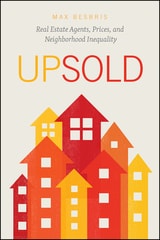
Upsold
Real Estate Agents, Prices, and Neighborhood InequalityMax Besbris
University of Chicago Press, 2020
What do you want for yourself in the next five, ten years? Do your plans involve marriage, kids, a new job? These are the questions a real estate agent might ask in an attempt to unearth information they can employ to complete a sale, which as Upsold shows, often results in upselling. In this book, sociologist Max Besbris shows how agents successfully upsell, inducing buyers to spend more than their initially stated price ceilings. His research reveals how face-to-face interactions influence buyers’ ideas about which neighborhoods are desirable and which are less-worthy investments and how these preferences ultimately contribute to neighborhood inequality.
Stratification defines cities in the contemporary United States. In an era marked by increasing income segregation, one of the main sources of this inequality is housing prices. A crucial part of wealth inequality, housing prices are also directly linked to the uneven distribution of resources across neighborhoods and to racial and ethnic segregation. Upsold shows how the interactions between real estate agents and buyers make or break neighborhood reputations and construct neighborhoods by price.
Employing revealing ethnographic and quantitative housing data, Besbris outlines precisely how social influences come together during the sales process. In Upsold, we get a deep dive into the role that the interactions with sales agents play in buyers’ decision-making and how neighborhoods are differentiated, valorized, and deemed to be worthy of a certain price.
[more]
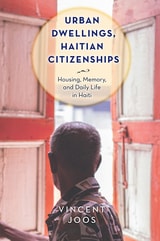
Urban Dwellings, Haitian Citizenships
Housing, Memory, and Daily Life in HaitiVincent Joos
Rutgers University Press, 2022
Urban Dwellings, Haitian Citizenships explores the failed international reconstruction of Port-au-Prince after the devastating 2010 earthquake. It describes the failures of international aid in Haiti while it analyzes examples of Haitian-based reconstruction and economic practices. By interrogating the relationship between indigenous uses of the cityscape and the urbanization of the countryside within a framework that centers on the violence of urban planning, the book shows that the forms of economic development promoted by international agencies institutionalize impermanence and instability. Conversely, it shows how everyday Haitians use and transform the city to create spaces of belonging and forms of citizenship anchored in a long history of resistance to extractive economies. Taking readers into the remnants of failed industrial projects in Haitian provinces and into the streets, rubble, and homes of Port-au-Prince, this book reflects on the possibilities and meanings of dwelling in post-disaster urban landscapes.
[more]
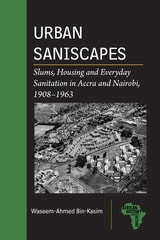
Urban Saniscapes
Slums, Housing and Everyday Sanitation in Accra and Nairobi, 1908–1963Waseem-Ahmed Bin-Kasim
Michigan State University Press, 2025
In this comparative study, Bin-Kasim examines environmental sanitation in the historical development of Accra and Nairobi, the capitals of the Gold Coast (Ghana) and Kenya. This book traces the approaches to sanitation during colonial rule and urban growth throughout the first half of the twentieth century and beyond. From the consolidation of the colonial regimes to the Great Depression, urbanization waves, and postwar development, sanitation was both a cause and a consequence of the built environment. Bin-Kasim characterizes this complex relationship between sanitation and urban growth over time as the 'saniscape.' The saniscape is the confluence of public health, planning interventions, and various urban constituencies, and includes an array of influences like colonial expertise and African industry, which shaped the two cities regardless of their power dynamics and land tenure. Attention to the saniscape validates how Africans called out colonial discrimination and inefficiencies to intervene and shape cities. This volume highlights the shared histories of Accra and Nairobi and upends conventional narratives that attach too much difference to non-settler and settler colonialism.
[more]