Results by title
517 books match the query 'In literature' and 8 start with u
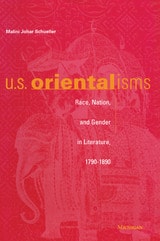
U.S. Orientalisms
Race, Nation, and Gender in Literature, 1790-1890Malini Johar Schueller
University of Michigan Press, 2001
This book begins with an examination of the literature of the "Barbary" Orient generated by the U.S. Algerian conflict in the late eighteenth century in the works of such writers as Royall Tyler, Susanna Rowson, and Washington Irving. It then moves on to the Near East Orientalist literature of the nineteenth century in light of Egyptology, theories of race, and the growth of missionary fervor in writers such as John DeForest, Maria Susanna Cummins, Herman Melville, Edgar Allan Poe, and Harriet Prescott Spofford. Finally, Schueller considers the Indic Orientalism of the period in the context of Indology, British colonialism, and the push for Asian trade in the United States, focusing particularly on Emerson and Whitman. U.S. Orientalisms demonstrates how these writers strove to create an Orientalism premised on the idea of civilization and empire moving West, from Asia, through Europe, and culminating in the New World.
Schueller draws on the work of Michel Foucault, Edward Said, Homi Bhabha, Rey Chow, and Judith Butler and compellingly demonstrates how a raced, compensatory "Orientalist" discourse of empire was both contested and evoked in the literary works of a wide variety of writers. The book will be of interest to readers in American history, postcolonial studies, gender studies, and literary theory.
Malini Johar Schueller is Associate Professor, Department of English, University of Florida. She is the author of The Politics of Voice: Liberalism and Social Criticism from Franklin to Kingston.
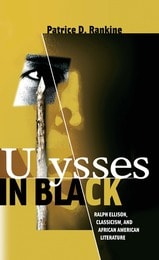
Ulysses in Black
Ralph Ellison, Classicism, and African American LiteraturePatrice D. Rankine
University of Wisconsin Press, 2008
In this groundbreaking work, Patrice D. Rankine asserts that the classics need not be a mark of Eurocentrism, as they have long been considered. Instead, the classical tradition can be part of a self-conscious, prideful approach to African American culture, esthetics, and identity. Ulysses in Black demonstrates that, similar to their white counterparts, African American authors have been students of classical languages, literature, and mythologies by such writers as Homer, Euripides, and Seneca.
Ulysses in Black closely analyzes classical themes (the nature of love and its relationship to the social, Dionysus in myth as a parallel to the black protagonist in the American scene, misplaced Ulyssean manhood) as seen in the works of such African American writers as Ralph Ellison, Toni Morrison, and Countee Cullen. Rankine finds that the merging of a black esthetic with the classics—contrary to expectations throughout American culture—has often been a radical addressing of concerns including violence against blacks, racism, and oppression. Ultimately, this unique study of black classicism becomes an exploration of America’s broader cultural integrity, one that is inclusive and historic.
Outstanding Academic Title, Choice Magazine
Unattainable Bride Russia
Gendering Nation, State, and Intelligentsia in Russian Intellectual CultureEllen Rutten
Northwestern University Press, 2010
Throughout the twentieth century and continuing today, personifications of Russia as a bride occur in a wide range of Russian texts and visual representations, from literature and political and philosophical treatises to cartoons and tattoos. Invariably, this metaphor functions in the context of a political gender allegory, which represents the relationships between Russia, the intelligentsia, and the Russian state, as a competition of two male suitors for the former’s love.
In Unattainable Bride Russia, Ellen Rutten focuses on the metaphorical role the intelligentsia plays as Russia’s rejected or ineffectual suitor. Rutten finds that this metaphor, which she covers from its prehistory in folklore to present-day pop culture references to Vladimir Putin, is still powerful, but has generated scarce scholarly consideration. Unattainable Bride Russia locates the cultural thread and places the political metaphor in a broad contemporary and social context, thus paying it the attention to which it is entitled as one of Russia’s modern cultural myths.
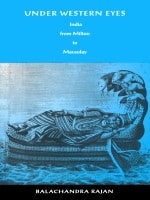
Under Western Eyes
India from Milton to MacaulayBalachandra Rajan
Duke University Press, 1999
Rajan begins with the Portuguese poet Camões, whose poem celebrating Vasco da Gama’s passage to India becomes, according to its eighteenth-century English translator, the epic of those who would possess India. He closely examines Milton’s treatment of the Orient and Dryden’s Aureng-Zebe, the first English literary work on an Indian subject. Texts by Shelley, Southey, Mill, and Macaulay, among others, come under careful scrutiny, as does Hegel’s significant impact on English imperial discourse. Comparing the initial English representation of its actions in India (as a matter of commerce, not conquest) and its contemporaneous treatment of Ireland, Rajan exposes contradictions that shed new light on the English construction of a subaltern India.
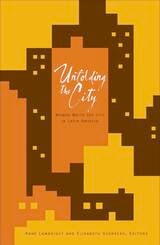
Unfolding the City
Women Write the City in Latin AmericaAnne Lambright
University of Minnesota Press, 2007
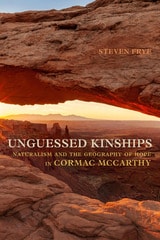
Unguessed Kinships
Naturalism and the Geography of Hope in Cormac McCarthySteven Frye
University of Alabama Press, 2023
Literary naturalism at play in one of America’s most visionary novelists: Cormac McCarthy
It took six novels and nearly thirty years for Cormac McCarthy to find commercial success with the National Book Award–winning All the Pretty Horses, followed by major prizes, more best sellers, and Hollywood adaptations of his work. Those successes, though, have obscured McCarthy’s commitment to an older form of literary expression: naturalism.
It is hardly a secret that McCarthy’s work tends to darker themes: violence, brutality, the cruel indifference of nature, themes which would not be out of place in the writing of Jack London or Stephen Crane. But literary naturalism is more than the oversimplified Darwinism that many think of. Nature may be red in tooth and claw, and humans are part of nature, but the humanity depicted in naturalist literature is capable of love, selflessness, and spirituality, as well.
In Unguessed Kinships, Steven Frye illuminates all these dimensions of McCarthy’s work. In his novels and plays, McCarthy engages both explicitly and obliquely with the project of manifest destiny, in the western drama Blood Meridian, the Tennessee Valley Authority-era Tennessee novels, and the atomic frontier of Alamogordo in Cities of the Plain. McCarthy’s concerns are deeply religious and philosophical, drawing on ancient Greek philosophy, Gnosticism, and Nietzsche, among other sources. Frye argues for McCarthy not merely as a naturalist writer but as a naturalist in the most expansive sense. Unguessed Kinships includes biographical and historical context in each chapter, widening the appeal of the text to not just naturalists or McCarthy scholars but anyone studying the literature of the South or the West.
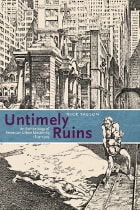
Untimely Ruins
An Archaeology of American Urban Modernity, 1819-1919Nick Yablon
University of Chicago Press, 2009
American ruins have become increasingly prominent, whether in discussions of “urban blight” and home foreclosures, in commemorations of 9/11, or in postapocalyptic movies. In this highly original book, Nick Yablon argues that the association between American cities and ruins dates back to a much earlier period in the nation’s history. Recovering numerous scenes of urban desolation—from failed banks, abandoned towns, and dilapidated tenements to the crumbling skyscrapers and bridges envisioned in science fiction and cartoons—Untimely Ruins challenges the myth that ruins were absent or insignificant objects in nineteenth-century America.
The first book to document an American cult of the ruin, Untimely Ruins traces its deviations as well as derivations from European conventions. Unlike classical and Gothic ruins, which decayed gracefully over centuries and inspired philosophical meditations about the fate of civilizations, America’s ruins were often “untimely,” appearing unpredictably and disappearing before they could accrue an aura of age. As modern ruins of steel and iron, they stimulated critical reflections about contemporary cities, and the unfamiliar kinds of experience they enabled. Unearthing evocative sources everywhere from the archives of amateur photographers to the contents of time-capsules, Untimely Ruins exposes crucial debates about the economic, technological, and cultural transformations known as urban modernity. The result is a fascinating cultural history that uncovers fresh perspectives on the American city.
Urban Chroniclers in Modern Latin America
The Shared Intimacy of Everyday LifeBy Viviane Mahieux
University of Texas Press, 2011
An unstructured genre that blends high aesthetic standards with nonfiction commentary, the journalistic crónica, or chronicle, has played a vital role in Latin American urban life since the nineteenth century. Drawing on extensive archival research, Viviane Mahieux delivers new testimony on how chroniclers engaged with modernity in Mexico City, Buenos Aires, and São Paulo during the 1920s and 1930s, a time when avant-garde movements transformed writers' and readers' conceptions of literature. Urban Chroniclers in Modern Latin America: The Shared Intimacy of Everyday Life examines the work of extraordinary raconteurs Salvador Novo, Cube Bonifant, Roberto Arlt, Alfonsina Storni, and Mário de Andrade, restoring the original newspaper contexts in which their articles first emerged.
Each of these writers guided their readers through a constantly changing cityscape and advised them on matters of cultural taste, using their ties to journalism and their participation in urban practice to share accessible wisdom and establish their role as intellectual arbiters. The intimate ties they developed with their audience fostered a permeable concept of literature that would pave the way for overtly politically engaged chroniclers of the 1960s and 1970s. Providing comparative analysis as well as reflection on the evolution of this important genre, Urban Chroniclers in Modern Latin America is the first systematic study of the Latin American writers who forged a new reading public in the early twentieth century.