Results by title
456 books match the query 'India' and 10 start with u

Under Western Eyes
India from Milton to MacaulayBalachandra Rajan
Duke University Press, 1999
Rajan begins with the Portuguese poet Camões, whose poem celebrating Vasco da Gama’s passage to India becomes, according to its eighteenth-century English translator, the epic of those who would possess India. He closely examines Milton’s treatment of the Orient and Dryden’s Aureng-Zebe, the first English literary work on an Indian subject. Texts by Shelley, Southey, Mill, and Macaulay, among others, come under careful scrutiny, as does Hegel’s significant impact on English imperial discourse. Comparing the initial English representation of its actions in India (as a matter of commerce, not conquest) and its contemporaneous treatment of Ireland, Rajan exposes contradictions that shed new light on the English construction of a subaltern India.
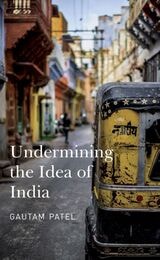
Undermining the Idea of India
Gautam Patel
Seagull Books, 2022
“India is improbable. By any measure of logic or reason, it should not be. Not in this form. And yet it is.”
With this provocation, Justice Gautam Patel of the Bombay High Court sketches the exoskeleton of this improbability—the “Constitutional” idea of India. Justice Patel argues that the devolution of power is necessary for the survival of any liberal democracy, maintaining the idea that “the right to choose one’s own government is the right to dissent.” Decrying the portrayal of politics as sport, Patel elucidates the strategies and tactics used by “nimble” governments to enforce a culture of “broad-spectrum illiberalism.” A champion of transparency in the judiciary, Patel argues that the Internet and the judiciary must serve as beacons in this age of precarity. A timely text that comes at a juncture where liberal democracies across the world are facing existential threats, Undermining the Idea of India is a searing manifesto for our troubled times.
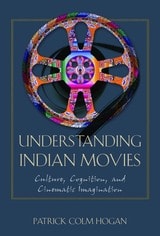
Understanding Indian Movies
Culture, Cognition, and Cinematic ImaginationBy Patrick Colm Hogan
University of Texas Press, 2008
Indian movies are among the most popular in the world. However, despite increased availability and study, these films remain misunderstood and underappreciated in much of the English-speaking world, in part for cultural reasons.
In this book, Patrick Colm Hogan sets out through close analysis and explication of culturally particular information about Indian history, Hindu metaphysics, Islamic spirituality, Sanskrit aesthetics, and other Indian traditions to provide necessary cultural contexts for understanding Indian films. Hogan analyzes eleven important films, using them as the focus to explore the topics of plot, theme, emotion, sound, and visual style in Indian cinema. These films draw on a wide range of South Asian cultural traditions and are representative of the greater whole of Indian cinema. By learning to interpret these examples with the tools Hogan provides, the reader will be able to take these skills and apply them to other Indian films.
But this study is not simply culturalist. Hogan also takes up key principles from cognitive neuroscience to illustrate that all cultures share perceptual, cognitive, and emotional elements that, when properly interpreted, can help to bridge gaps between seemingly disparate societies. Hogan locates the specificity of Indian culture in relation to human universals, and illustrates this cultural-cognitive synthesis through his detailed interpretations of these films. This book will help both scholars and general readers to better understand and appreciate Indian cinema.

Understanding Peasant Agriculture
An Integrated Land-Use Model for the PunjabJoseph H. Astroth Jr.
University of Chicago Press, 1989
Undoing the Revolution
Comparing Elite Subversion of Peasant RebellionsVasabjit Banerjee
Temple University Press, 2019
Undoing the Revolution looks at the way rural underclasses ally with out-of-power elites to overthrow their governments—only to be shut out of power when the new regime assumes control. Vasabjit Banerjee first examines why peasants need to ally with dissenting elites in order to rebel. He then shows how conflict resolution and subsequent bargains to form new state institutions re-empower allied elites and re-marginalize peasants.
Banerjee evaluates three different agrarian societies during distinct time periods spanning the twentieth century: revolutionary Mexico from 1910 to 1930; late-colonial India from 1920 until 1947; and White-dominated Zimbabwe (Rhodesia) from the mid-1960s to 1980. This comparative approach also allows examination of both the underclass need for elite participation and the variety of causes that elites use to incentivize peasant classes to participate, extending from religious-ethnic identity and common political targets to the peasants’ and elites’ own economic grievances.
Undoing the Revolution demonstrates that both international and domestic investors in cash crops, natural resources, and finance can ally with peasant rebels; and, after threatened or actual state collapse, they can bargain with each other to select new state institutions.
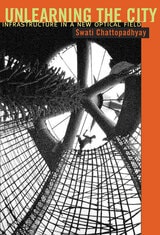
Unlearning the City
Infrastructure in a New Optical FieldSwati Chattopadhyay
University of Minnesota Press, 2012
Cities are more than concrete and steel infrastructure. But modern urban theory does not have the language to describe and debate the vital component of urban life that is lived on the streets of cities and towns. Swati Chattopadhyay has written a nuanced argument for a new vocabulary of the city in Unlearning the City, proposing a way of analyzing the materiality of the urban that captures the ever-changing element of human experience.
Urban life is intrinsically messy and usually refuses to conform to the rigid views laid down in much of urban studies theory. Chattopadhyay looks at urban life in India with a fresh perspective that incorporates the everyday and the unstructured. As the first to apply the theories of subalternity for an understanding of urban history, Chattopadhyay provides an in-depth study of vehicular art, street cricket, political wall writing, and religious festivities that link the visual and spatial attributes of these popular cultural forms with the imagination and practices of urban life. She contends that these practices have a direct impact on the configuration and knowledge of public space, and the political potential of the people inhabiting cities.
Unlearning the City uses the popular culture of Indian cities to question the dominant conception of urban infrastructure and encourage a conceptual realignment in how the city is seen, discussed, and even experienced.

Unlove Story
Sudipto Pal
Seagull Books, 2024
Mallar, a shy and introspective sixteen-year-old, finds himself drawn to Srijan, his classmate’s enigmatic elder cousin, during a fateful summer in a small-town family home. At first, Mallar’s fantasies take shape in secret sketches of Srijan. But soon, their connection becomes a complex play of mutual desire and dominance, which leads to the forging of a unique pact—a promise never to fall in love with each other.
As their lives take them from the serene landscapes of Bengal to the vibrant beaches of Chennai, the mysterious alleys of Paris, and the buzzing streets of Bangalore, the two men’s unconventional companionship deepens. With each meeting comes a new revelation, a fresh twist to their agreement, and a surprising facet of their identities. Mallar, reviving his childhood passion, embarks on a journey to establish himself as an artist. Collaborating on an art project, Mallar transforms Srijan’s body into a living canvas. But what begins as a creative endeavor quickly becomes a voyage into uncharted depths, as the canvas asks questions, challenges their resolve, and unravels hidden truths, culminating in new beginnings.
Delving into the intricate layers of two men’s lives, their fears, insecurities, hopes, and the mosaic of experiences that shape them, this novel is a testament to the complexities of human connection. One of the first openly gay novels written in Bengali, and the first to be translated into English, Sudipto Pal’s Unlove Story is a groundbreaking addition to the canon of queer literature from around the world.
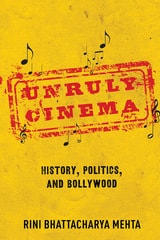
Unruly Cinema
History, Politics, and BollywoodRini Bhattacharya Mehta
University of Illinois Press, 2020
Rini Bhattacharya Mehta considers four aspects of Indian cinema's complicated history. She begins with the industry's surprising, market-driven triumph over imports from Hollywood and elsewhere in the 1930s. From there she explores how the nationalist social melodrama outwitted the government with its 1950s cinematic lyrical manifestoes. In the 1970s, an action cinema centered on the angry young male co-opted the voice of the oppressed. Finally, Mehta examines Indian film's discovery of the global neoliberal aesthetic that encouraged the emergence of Bollywood.
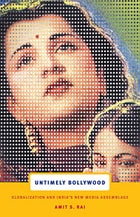
Untimely Bollywood
Globalization and India's New Media AssemblageAmit S. Rai
Duke University Press, 2009
Rai recounts his experience of attending the first showing of a Bollywood film in a single-screen theater in Bhopal: the sensory experience of the exhibition space, the sound system, the visual style of the film, the crush of the crowd. From that event, he elicits an understanding of cinema as a historically contingent experience of pleasure, a place where the boundaries of identity and social spaces are dissolved and redrawn. He considers media as a form of contagion, endlessly mutating and spreading, connecting human bodies, organizational structures, and energies, thus creating an inextricable bond between affect and capital. Expanding on the notion of media contagion, Rai traces the emerging correlation between the postcolonial media assemblage and capitalist practices, such as viral marketing and the development of multiplexes and malls in India.
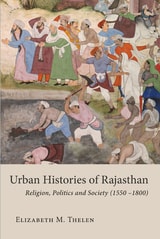
Urban Histories of Rajasthan
Religion, Politics and Society (1550–1800)Elizabeth M. Thelen
Gingko, 2022
Diverse peoples intermingled in the streets and markets of premodern Indian cities. This book considers how these diverse residents lived together and negotiated their differences. Which differences mattered, when and to whom? How did state actions and policies affect urban society and the lives of various communities? How and why did conflict occur in urban spaces? Through these questions, this book explores the histories of urban communities in the three cities of Ajmer, Nagaur, and Pushkar in Rajasthan, between the sixteenth and eighteenth centuries. The focus of this study is on everyday life, contextualizing religious practices and conflicts by considering patterns of patronage and broader conflict patterns within society. The book examines various archival documents, from family and institutional records to state registers, and uses these documents to demonstrate the complex and sometimes contradictory ways religion intersected with politics, economics, and society. The author shows how many patronage patterns and processes persisted in altered forms, and how the robustness of these structures contributed to the resilience of urban spaces and society in precolonial Rajasthan.