Results by title
54 books match the query 'Indians in literature' and 2 start with u
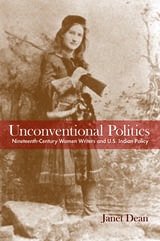
Unconventional Politics
Nineteenth-Century Women Writers and U.S. Indian PolicyJanet Dean
University of Massachusetts Press, 2016
Dean argues that in protesting U.S. Indian policy through popular genres, Wakefield, Sigourney, Callahan, and Eddleman also critiqued cultural protocols and stretched the contours of accepted modes of feminine discourse. Their acts of improvisation and reinvention tell a new story about the development of American women's writing and political expression.
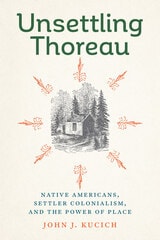
Unsettling Thoreau
Native Americans, Settler Colonialism, and the Power of PlaceJohn J. Kucich
University of Massachusetts Press, 2024
A CHOICE 2025 Outstanding Academic Title
Finalist for the 2025 New England Society Book Awards
Henry David Thoreau’s life-long fascination with Native Americans is widely known and a recurring topic of interest, and it is also a source of modern debate. This is a figure who both had a deep interest in Native American history and culture and was seen by many of his contemporaries, including Ralph Waldo Emerson and Nathaniel Hawthorne, as “more like an Indian” than his white neighbors. At the same time, Thoreau did little to protest the systematic dispossession of Indigenous people across the country in his lifetime. John J. Kucich charges into this contradiction, considering how Thoreau could demonstrate deep respect for Native American beliefs on one hand and remain largely silent about their genocide, actively happening throughout his life, on the other. Thoreau’s long study of Native peoples, as reflected in so much of his writing, allowed him to glimpse an Indigenous worldview, but it never fully freed him from the blind spots of settler colonialism.
Drawing on Indigenous studies and critiques of settler colonialism, as well as new materialist approaches that illustrate Thoreau’s radical reimagining of the relationship between humans and the natural world, Unsettling Thoreau explores the stakes of Thoreau’s effort to live mindfully and ethically in place when living alongside, or replacing marginalized peoples. By examining the whole scope of his writings, including the unpublished Indian Notebooks, and placing them alongside Native writers and communities in and beyond New England, this book gauges Thoreau’s effort to use Indigenous knowledge to reimagine a settler colonial world, without removing him from its trappings.