Results by title
468 books match the query 'Industries' and 3 start with u

Unavoidable Industrial Restructuring in Latin America
Fernando Fajnzylber
Duke University Press, 1990
In the recent economic history of Latin America no country has yet found the means to combine effectively economic growth with equity. Unavoidable Industrial Restructuring in Latin America compares the development path of Latin America with that of the East Asian newly industrialized countries (NICs), the United States, and Europe in the 1970s and 1980s to show the national policies and international cooperation necessary to set Latin American countries on the road to healthy economies.
Fernando Fajnzylber argues that technological and industrial progress is the driving force of a positive relationship among dynamism, competitiveness, austerity, and equity. Latin America’s failure to master this technological progress underlies its economic difficulties. To overcome the inheritance of past mistakes, the author maintains, Latin America must undergo not only macroeconomic stabilization and a reduction of the debt burden, but also a complete transformation of the production structure. The role of the state and the institutional setup need to be modified and new social and sectoral policies devised. Fajnzylber sees this radical restructuring as an unavoidable step if Latin America is ever to achieve a workable balance between growth and equity.
Fernando Fajnzylber argues that technological and industrial progress is the driving force of a positive relationship among dynamism, competitiveness, austerity, and equity. Latin America’s failure to master this technological progress underlies its economic difficulties. To overcome the inheritance of past mistakes, the author maintains, Latin America must undergo not only macroeconomic stabilization and a reduction of the debt burden, but also a complete transformation of the production structure. The role of the state and the institutional setup need to be modified and new social and sectoral policies devised. Fajnzylber sees this radical restructuring as an unavoidable step if Latin America is ever to achieve a workable balance between growth and equity.
[more]
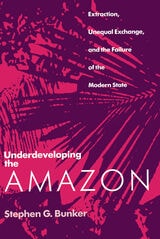
Underdeveloping the Amazon
Extraction, Unequal Exchange, and the Failure of the Modern StateStephen G. Bunker
University of Chicago Press, 1988
Underdeveloping the Amazon shows how different extractive economies have periodically enriched various dominant classes but progressively impoverished the entire region by disrupting both the Amazon Basin's ecology and human communities. Contending that traditional models of development based almost exclusively on the European and American experience of industrial production cannot apply to a regional economy founded on extraction, Stephen G. Bunker proposes a new model based on the use and depletion of energy values in natural resources as the key to understanding the disruptive forces at work in the Basin.
[more]
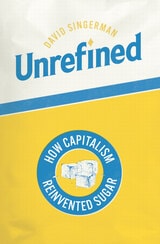
Unrefined
How Capitalism Reinvented SugarDavid Singerman
University of Chicago Press, 2025
A surprising look at how modern capitalism changed sugar from a natural food to a scientific commodity.
Sugar is everywhere in the western diet, blamed for epidemics of obesity, diabetes, and other modern maladies. Our addiction to sweetness has a long and unsavory history. Over the past five hundred years, sugar has shaped empires, made fortunes for a few, and brought misery for millions of workers both enslaved and free. How did sugar become a defining modern food and an essential global commodity?
In Unrefined, David Singerman recasts our thinking about this crucial substance in the history of capitalism. Before the nineteenth century, sugar’s value depended on natural qualities: its color, its taste, where it was grown, and who had made it. But beginning around 1850, a combination of plantation owners, industrialists, and scientists set out to redefine sugar itself. Deploying the tools and rhetoric of science, they transformed not just how sugar was produced or traded but even how people thought about it. By changing sugar into a pure chemical object, these forces stripped power from workers and enabled—and obscured—new kinds of fraud, corruption, and monopoly.
Taking us to unexplored spaces in the world of sugar, from laboratories and docks to refineries and the halls of Congress, Singerman illuminates dark intersections of the histories of corruption, science, and capitalism.
[more]