Results by title
1031 books match the query 'Intellectual life' and 9 start with u
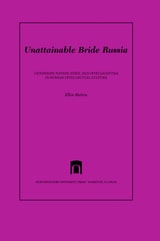
Unattainable Bride Russia
Gendering Nation, State, and Intelligentsia in Russian Intellectual CultureEllen Rutten
Northwestern University Press, 2010
Throughout the twentieth century and continuing today, personifications of Russia as a bride occur in a wide range of Russian texts and visual representations, from literature and political and philosophical treatises to cartoons and tattoos. Invariably, this metaphor functions in the context of a political gender allegory, which represents the relationships between Russia, the intelligentsia, and the Russian state, as a competition of two male suitors for the former’s love.
In Unattainable Bride Russia, Ellen Rutten focuses on the metaphorical role the intelligentsia plays as Russia’s rejected or ineffectual suitor. Rutten finds that this metaphor, which she covers from its prehistory in folklore to present-day pop culture references to Vladimir Putin, is still powerful, but has generated scarce scholarly consideration. Unattainable Bride Russia locates the cultural thread and places the political metaphor in a broad contemporary and social context, thus paying it the attention to which it is entitled as one of Russia’s modern cultural myths.
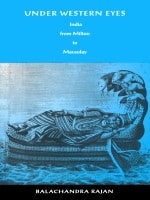
Under Western Eyes
India from Milton to MacaulayBalachandra Rajan
Duke University Press, 1999
Rajan begins with the Portuguese poet Camões, whose poem celebrating Vasco da Gama’s passage to India becomes, according to its eighteenth-century English translator, the epic of those who would possess India. He closely examines Milton’s treatment of the Orient and Dryden’s Aureng-Zebe, the first English literary work on an Indian subject. Texts by Shelley, Southey, Mill, and Macaulay, among others, come under careful scrutiny, as does Hegel’s significant impact on English imperial discourse. Comparing the initial English representation of its actions in India (as a matter of commerce, not conquest) and its contemporaneous treatment of Ireland, Rajan exposes contradictions that shed new light on the English construction of a subaltern India.

Unfastened
Globality and Asian North American NarrativesEleanor Ty
University of Minnesota Press, 2010
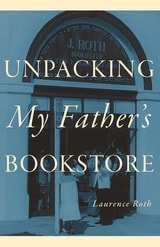
Unpacking My Father's Bookstore
Laurence Roth
Rutgers University Press, 2025
2026 Independent Publisher Book Awards (IPPY) Silver Medal in the West – Pacific Non-Fiction category
Unpacking My Father’s Bookstore brings to life the history of J. Roth / Bookseller of Fine & Scholarly Judaica, which was a microcosm of the Los Angeles Jewish community from 1966 to 1994 and one of the premier Jewish bookstores in the United States. Blending critical analysis with a personal account of growing up in his father’s bookstore, and connecting both to larger forces that helped shape Jewish and American book retailing in the twentieth-century, Laurence Roth crafts a richly felt narrative about his family’s Jewish experience in America. It is a reminder, too, that while most independent bookstores like J. Roth Bookseller disappear from history, these retailers often had outsized effects on their communities. Breaking with conventional modes of scholarship, Unpacking My Father’s Bookstore tells a unique and troubled story that rarely gets told, one that is both personal and analytical, theoretical but rooted in the everyday.
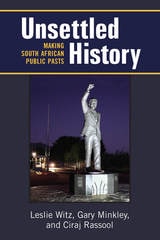
Unsettled History
Making South African Public PastsLeslie Witz, Gary Minkley, and Ciraj Rassool
University of Michigan Press, 2017
Leslie Witz, Gary Minkley, and Ciraj Rassool take the reader to sites of historical production in which complex ideas about pasts are invoked, and navigate a path toward understanding the agencies of image-making and memory production. This volume is the outcome of the authors’ intensive collaborative research and engagement over twenty-five years on questions including the production and performance of apartheid history; the cultural politics of social history; South Africa’s Truth and Reconciliation Commission and practices of orality; tourism as an arena of image-making and historical construction; museums as sites of heritage production for a new South Africa; photographs, archival meanings, and the construction of the social documentary; and the centenary commemorations of the South African War and the making of race. The authors not only witnessed many of these instances of history-making but were also participants in their constitution.
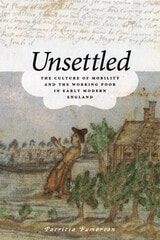
Unsettled
The Culture of Mobility and the Working Poor in Early Modern EnglandPatricia Fumerton
University of Chicago Press, 2006
Migrants made up a growing class of workers in late sixteenth- and seventeenth- century England. In fact, by 1650, half of England’s rural population consisted of homeless and itinerant laborers. Unsettled is an ambitious attempt to reconstruct the everyday lives of these dispossessed people. Patricia Fumerton offers an expansive portrait of unsettledness in early modern England that includes the homeless and housed alike.
Fumerton begins by building on recent studies of vagrancy, poverty, and servants, placing all in the light of a new domestic economy of mobility. She then looks at representations of the vagrant in a variety of pamphlets and literature of the period. Since seamen were a particularly large and prominent class of mobile wage-laborers in the seventeenth century, Fumerton turns to seamen generally and to an individual poor seaman as a case study of the unsettled subject: Edward Barlow (b. 1642) provides a rare opportunity to see how the laboring poor fashioned themselves, for he authored a journal of over 225,000 words and 147 pages of drawings. Barlow’s journal, studied extensively here for the first time, vividly charts what he himself termed his “unsettled mind” and the perpetual anxieties of England’s working and wayfaring poor. Ultimately, Fumerton explores representations of seamen as unsettled in the broadside ballads of Barlow’s time.
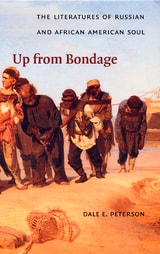
Up from Bondage
The Literatures of Russian and African American SoulDale E. Peterson
Duke University Press, 2000
Illuminating a remarkably widespread cross-pollination between the two cultural and intellectual traditions, Dale E. Peterson frames much of his argument around W. E. B. DuBois’s concept of “double-consciousness,” wherein members of an oppressed section of society view themselves simultaneously through their own self-awareness and through the internalized standards of the dominant culture. He shows how the writings of Dostoevsky, Hurston, Chesnutt, Turgenev, Ellison, Wright, Gorky, and Naylor—texts that enacted and described this sense of double awareness—were used both to perform and to contest the established genres of Western literacy. Woven through Peterson’s textual analyses is his consideration of cultural hybridism and its effects: The writers he examines find multiple ways to testify to and challenge the symptoms of postcolonial trauma. After discussing the strong and significant affinity expressed by contemporary African American cultural theorists for the dialogic thought of Russian linguist Mikhail Bakhtin, Peterson argues that a fuller appreciation of the historic connection between the two cultures will enrich the complicated meanings of being black or Russian in a world that has traditionally avoided acknowledging pluralistic standards of civilization and cultural excellence.
This investigation of comparable moments in the development of Russian and African American ethnic self-consciousness will be valuable to students and scholars of comparative literature, philosophy, cultural theory, ethnicity, linguistics, and postcolonialism, in addition to Slavic and African American studies.
Urban Chroniclers in Modern Latin America
The Shared Intimacy of Everyday LifeBy Viviane Mahieux
University of Texas Press, 2011
An unstructured genre that blends high aesthetic standards with nonfiction commentary, the journalistic crónica, or chronicle, has played a vital role in Latin American urban life since the nineteenth century. Drawing on extensive archival research, Viviane Mahieux delivers new testimony on how chroniclers engaged with modernity in Mexico City, Buenos Aires, and São Paulo during the 1920s and 1930s, a time when avant-garde movements transformed writers' and readers' conceptions of literature. Urban Chroniclers in Modern Latin America: The Shared Intimacy of Everyday Life examines the work of extraordinary raconteurs Salvador Novo, Cube Bonifant, Roberto Arlt, Alfonsina Storni, and Mário de Andrade, restoring the original newspaper contexts in which their articles first emerged.
Each of these writers guided their readers through a constantly changing cityscape and advised them on matters of cultural taste, using their ties to journalism and their participation in urban practice to share accessible wisdom and establish their role as intellectual arbiters. The intimate ties they developed with their audience fostered a permeable concept of literature that would pave the way for overtly politically engaged chroniclers of the 1960s and 1970s. Providing comparative analysis as well as reflection on the evolution of this important genre, Urban Chroniclers in Modern Latin America is the first systematic study of the Latin American writers who forged a new reading public in the early twentieth century.
Useful Knowledge
The Victorians, Morality, and the March of IntellectAlan Rauch
Duke University Press, 2001
Rauch discusses both the influence and the ideology of knowledge in terms of how it affected nineteenth-century anxieties about moral responsibility and religious beliefs. Drawing on a wide array of literary, scientific, and popular works of the period, the book focusses on the growing importance of scientific knowledge and its impact on Victorian culture. From discussions of Jane Webb Loudon’s The Mummy! and Mary Shelley’s Frankenstein, to Charlotte Brontë’s The Professor, Charles Kingsley’s Alton Locke, and George Eliot’s Mill on the Floss, Rauch paints a fascinating picture of nineteenth-century culture and addresses issues related to the proliferation of knowledge and the moral issues of this time period. Useful Knowledge touches on social and cultural anxieties that offer both historical and contemporary insights on our ongoing preoccupation with knowledge.
Useful Knowledge will appeal to readers interested in nineteenth century history, literature, culture, the mediation of knowledge, and the history of science.