Results by title
751 books match the query 'International Relations' and 11 start with u
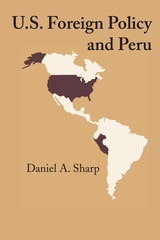
U.S. Foreign Policy and Peru
By Daniel A. Sharp
University of Texas Press, 1972
This book presents the first authoritative and comprehensive account of the development of the Peruvian revolution of 1968. The study resulted from a team experiment in applied political science, economics, and sociology that maintained effective communications between Peru and the United States at many levels during the difficult years following the revolution. Each chapter is the result of continuous interaction between a leading authority and the major sectors of both societies. History is here presented in its diplomatic, social, economic, and cultural context.
The Peruvian and U.S. governments helped to define the subjects of greatest interest to their respective countries, and a systematic effort was made to find the leading authorities on each issue. Since one purpose of this volume is to affect policy by identifying new alternative policies, the papers included here were prepared specifically to be of value to policy makers.
This book was produced by a citizens’ constituency on U.S. foreign policy under the auspices of the Adlai Stevenson Institute of International Affairs, the Chicago Council on Foreign Relations, and the Johnson Foundation.

U.S. Foreign Policy in the Middle East
The Role of Lobbies and Special Interest GroupsJanice J. Terry
Pluto Press, 2005
Israel is America's key ally in the Middle East, and helps maintain U.S. dominance in the region. This book shows how pro-Israeli lobbyists and domestic interest groups have been hugely successful in creating government and financial support for Israel. By contrast, Arab-American groups and Arab governments have had less success putting forward their agencies.
Janice J. Terry shows how special interest groups work, and why certain lobbying techniques are more effective than others. She sets this within the wider cultural context, showing how the U.S. media -- and the general public -- view the Middle East.
To explain how lobbies work, Terry draws on case studies including the Sinai accords and Camp David under Presidents Ford and Carter, the Conflict between Green and Turkish lobbies over Cyprus, and the major campaign against the Arab boycott.
Making use of primary sources, and unpublished material from various presidential libraries, this is a fascinating exposé of the role that lobby groups really play in determining U.S. foreign policy in the Middle East. It will be of interest to students of American politics and Middle East studies.
Ukraine in the Crosshairs of Geopolitical Power Play
Edited by Peter W. Schulze and Winfried Veit
Campus Verlag, 2020
Peace in Ukraine seemed possible following Volodymyr Zelensky’s 2019 election. The new president reopened conversations with both the European Union and separatist authorities, bringing an end to the Donbass conflict in sight. Such an achievement promised revitalized talks between Europe and Russia, and so the nearly forgotten conflict returned to global prominence. Ukraine in the Crosshairs of Geopolitical Power Play analyzes why European and Russian objectives in Ukraine place daunting limits of any potential compromise.
Unholy Wars
Afghanistan, America and International TerrorismJohn Cooley
Pluto Press, 2002
Cooley marshals a wealth of evidence - from the assassination of Sadat, the destabilisation of Algeria and Chechnya and the emergence of the Taliban, to the bombings of the World Trade Center and the US embassies in Africa. He examines the crucial role of Pakistan’s military intelligence organisation; uncovers China’s involvement and its aftermath; the extent of Saudi financial support; the role of 'America's most wanted man' Osama bin Laden; the BCCI connection; the CIA's cynical promotion of drug traffic in the Golden Crescent; the events in Pakistan since the military coup of October 1999; and, finally, the events of September 11th 2001 and their continuing impact on world affairs.

United States-Latin American Relations, 1800-1850
The Formative GenerationsT. Ray Shurbutt
University of Alabama Press, 1991
Relations between the United States and the countries of Latin America have been characterized by misunderstandings based on language and culture, a lack of sustained commitment on the part of the United States, and, in some cases, incompetent diplomats. During the era when many of the Latin American countries discarded the yoke of colonial status, the young United States attempted to define itself culturally, economically, constitutionally, geographically, and diplomatically. As Latin American emerged from the crucible of revolution and international power politics, it was affected by—and in varying degrees affected—the United States and its desired position of leadership in the Western Hemisphere.
To make sense of these relationships, this volume concentrates on Central America, Peru, Colombia, Argentina, Brazil, Chile, and Mexico. Describing the particular paths taken by each of the formation of relations with the United States, Shurbutt and his colleagues focus on the American diplomatic community and its effectiveness in tense political situations.
Contributors in addition to the editor include Lawrence A. Clayton, Paul B. Goodwin, Eugene R. Huck, Phil Brian Johnson, Edward H. Moseley, Wesley P. Newton, Charles S. Stansifer, and Robert Kim Stevens.
United States–Latin American Relations, 1850–1903
Establishing a RelationshipEdited by Thomas M. Leonard
University of Alabama Press, 1999
United States–Latin American Relations, 1850–1903 is a collection of essays that provide an in-depth analysis of the developing relationship between the Americas during the critical period from the Mexican War to the Panama Canal treaty of 1903.
During the second half of the 19th century several forces in the United States, Latin America, and Europe converged to set the stage for the establishment of a more permanent relationship between the United States and Latin America. The key factors--security, economics, and modernization--created both commonalities and conflicts between and among regions. In this volume, scholars examine not only the domestic but also the geopolitical forces that encouraged and guided development of diplomatic relations in this rapidly changing period.
As the contributors note, by the end of the century, economic interests dominated the relationship that eventually developed. This period saw the building of a string of U.S. naval bases in Latin America and the Caribbean, the rapid industrialization of the United States and the development of a substantial export market, the entrance of many U.S. entrepreneurs into Latin American countries, and the first two inter-American conferences. By the century's end, the United States appeared as the dominant partner in the relationship, a perception that earned it the "imperialist" label.
This volume untangles this complex relationship by examining U.S. relations with Mexico, Cuba, Colombia, Central America, Peru, Argentina, Chile, Brazil, Uruguay, and Paraguay from the perspective of both the United States and the individual Latin American countries.
A companion volume to United States-Latin American Relations, 1800-1850: The Formative Generations, edited by T. Ray Shurbutt, this book establishes a historical perspective crucial to understanding contemporary diplomatic relations.

Unsilencing Gaza
Reflections on ResistanceSara Roy
Pluto Press, 2021
Gaza, the centre of Palestinian nationalism and resistance to the occupation, is the linchpin of the Israeli-Palestinian conflict and the key to its resolution. Since 2005, Israel has deepened the isolation of the territory, severing it almost completely from its most vital connections to the West Bank, Israel and beyond, and has deliberately shattered its economy, transforming Palestinians from a people with political rights into a humanitarian problem.
Sara Roy unpacks this process, looking at US foreign policy towards the Palestinians, as well as analysing the trajectory of Israeli policy toward Gaza, which became a series of punitive approaches meant not only to contain the Hamas regime but weaken Gazan society.
Roy also reflects on Gaza's ruination from a Jewish perspective and discusses the connections between Gaza's history and her own as a child of Holocaust survivors. This book, a follow up from the renowned Failing Peace, comes from one of the world's most acclaimed writers on the region.

Untying the Knot of War
A Bargaining Theory of International CrisesT. Clifton Morgan
University of Michigan Press, 1994
Uses Of The Other
“The East” in European Identity FormationIver B. Neumann
University of Minnesota Press, 1998
Examines identity politics in the context of international relations.
The field of international relations has recently witnessed a tremendous growth of interest in the theme of identity and its formation, construction, and deconstruction. In Uses of the Other, Iver B. Neumann demonstrates how thinking about identity in terms of the self and other may prove highly useful in the study of world politics.
Neumann begins by tracing the four different paths along which this thinking has developed during this century-ethnographic, psychological, Continental philosophical, and “Eastern excursion”-and he shows how these blended at the margins of the discipline of international relations at the end of the 1980s. There follow several incisive readings of European identity formations on the all-European, regional, and national levels. The theme that draws these readings together is how “the East” is used as a sign of otherness at all three levels. Whereas previous studies framed this process as part of colonial and postcolonial developments, this book suggests that “Easternness” is also present as a marker in contemporary discourses about Russia, Turkey, Central Europe, and Bashkortostan, among others. Situating his work in contemporary critical debates, Neumann argues that, while the self/other perspective is always of relevance, it is now more in need of being used as a perspective on specific sequences of identity formation than of further embellishment.ISBN: 0-8166-3082-8 Cloth $49.95xxISBN: 0-8166-3083-6 Paper $19.95x248 Pages 5-7/8x9 NovemberBorderlines Series, Volume 9Translation inquiries:
Utopia and Modernity in China
Contradictions in TransitionDavid Margolies
Pluto Press, 2022
Utopia and Modernity in China examines the conflicts inherent in China's attempt to achieve a 'utopia' by advancing production and technology. Through the lenses of literature, arts, law, the press and the environment, the contributors interrogate the contradictions of modernization in Chinese society and its fundamental challenges.
By unpicking both China's vision of utopia and its realities and the increasing tension between traditional Chinese values and those of the West, this book offers a unique insight into the cultural forces that are part of reshaping today's China.