Results by title
104 books match the query 'Japanese' and 2 start with u
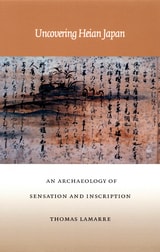
Uncovering Heian Japan
An Archaeology of Sensation and InscriptionThomas LaMarre
Duke University Press, 2000
The poetry of the Heian court of Japan has typically been linked with the emergence of a distinct Japanese language and culture. This concept of a linguistically homogeneous and ethnically pure “Japaneseness” has been integral to the construction of a modern Japanese nation, especially during periods of western colonial expansion and cultural encroachment. But Thomas LaMarre argues in Uncovering Heian Japan that this need for a cultural unity—a singular Japanese identity—has resulted in an overemphasis of a relatively minor aspect of Heian poetry, obscuring not only its other significant elements but also the porousness of Heian society and the politics of poetic expression.
Combining a pathbreaking visual analysis of the calligraphy with which this poetry was transcribed, a more traditional textual analysis, and a review of the politics of the period, LaMarre presents a dramatically new view of Heian poetry and culture. He challenges the assumption of a cohesive “national imagination,” seeing instead an early Japan that is ethnically diverse, territorially porous, and indifferent to linguistic boundaries. Working through the problems posed by institutionalized notions of nationalism, nativism, and modernism, LaMarre rethinks the theories of scholars such as Suzuki Hideo, Yoshimoto Takaaki, and Komatsu Shigemi, in conjunction with theorists such as Derrida, Karatani, Foucault, and Deleuze. Contesting the notion that speech is central to the formation of community, Uncovering Heian Japan focuses instead on the potential centrality of the more figural operations of poetic practice.
Specialists in Japanese history and culture as well as scholars working in other areas of cultural criticism will find that this book enriches their understanding of an early Japan that has exerted so much influence on later concepts of what it means to be Japanese.
[more]
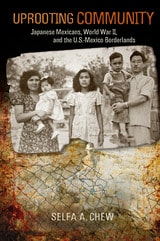
Uprooting Community
Japanese Mexicans, World War II, and the U.S.-Mexico BorderlandsSelfa A. Chew
University of Arizona Press, 2015
Joining the U.S.’ war effort in 1942, Mexican President Manuel Ávila Camacho ordered the dislocation of Japanese Mexican communities and approved the creation of internment camps and zones of confinement. Under this relocation program, a new pro-American nationalism developed in Mexico that scripted Japanese Mexicans as an internal racial enemy. In spite of the broad resistance presented by the communities wherein they were valued members, Japanese Mexicans lost their freedom, property, and lives.
In Uprooting Community, Selfa A. Chew examines the lived experience of Japanese Mexicans in the U.S.-Mexico borderlands during World War II. Studying the collaboration of Latin American nation-states with the U.S. government, Chew illuminates the efforts to detain, deport, and confine Japanese residents and Japanese-descent citizens of Latin American countries during World War II. These narratives challenge the notion that Japanese Mexicans enjoyed the protection of the Mexican government during the war and refute the mistaken idea that Japanese immigrants and their descendants were not subjected to internment in Mexico during this period. Through her research, Chew provides evidence that, despite the principles of racial democracy espoused by the Mexican elite, Japanese Mexicans were in fact victims of racial prejudice bolstered by the political alliances between the United States and Mexico.
The treatment of the ethnic Japanese in Mexico was even harsher than what Japanese immigrants and their children in the United States endured during the war, according to Chew. She argues that the number of persons affected during World War II extended beyond the first-generation Japanese immigrants “handled” by the Mexican government during this period, noting instead that the entire multiethnic social fabric of the borderlands was reconfigured by the absence of Japanese Mexicans.
[more]