102 books match the query 'Limits' and 3 start with u
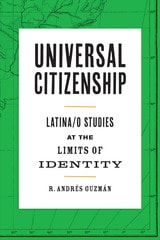
cover of Universal Citizenship: Latina/o Studies at the Limits of Identity

Universal Citizenship

Latina/o Studies at the Limits of Identity

By R. Andrés Guzmán

University of Texas Press, 2019

Recently, many critics have questioned the idea of universal citizenship by pointing to the racial, class, and gendered exclusions on which the notion of universality rests. Rather than jettison the idea of universal citizenship, however, R. Andrés Guzmán builds on these critiques to reaffirm it especially within the fields of Latina/o and ethnic studies. Beyond conceptualizing citizenship as an outcome of recognition and admittance by the nation-state—in a negotiation for the right to have rights—he asserts that, insofar as universal citizenship entails a forceful entrance into the political from the latter’s foundational exclusions, it emerges at the limits of legality and illegality via a process that exceeds identitarian capture.

Drawing on Lacanian psychoanalysis and philosopher Alain Badiou’s notion of “generic politics,” Guzmán advances his argument through close analyses of various literary, cultural, and legal texts that foreground contention over the limits of political belonging. These include the French Revolution, responses to Arizona’s H.B. 2281, the 2006 immigrant rights protests in the United States, the writings of Oscar “Zeta” Acosta, Frantz Fanon’s account of Algeria’s anticolonial struggle, and more. In each case, Guzmán traces the advent of the “citizen” as a collective subject made up of anyone who seeks to radically transform the organizational coordinates of the place in which she or he lives.
[more]
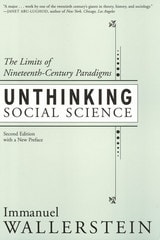
cover of Unthinking Social Science: Limits Of 19Th Century Paradigms

Unthinking Social Science

Limits Of 19Th Century Paradigms

Immanuel Wallerstein

Temple University Press, 2001
In this new edition of a classic work -- now with a new preface -- on the roots of social scientific thinking, Immanuel Wallerstein develops a thorough-going critique of the legacy of nineteenth-century social science for social thought in the new millennium. We have to "unthink" -- radically revise and discard -- many of the presumptions that still remain the foundation of dominant perspectives today. Once considered liberating, these notions are now barriers to a clear understanding of the social world. They include, for example, ideas built into the concept of "development." In place of such a notion, Wallerstein stresses transformations in time and space. Geography and chronology should not be regarded as external influences upon social transformations but crucial to what such transformation actually is. Unthinking Social Science applies the ideas thus elaborated to a variety of theoretical areas and historical problems. Wallerstein also offers a critical discussion of the key figures whose ideas influenced the position he formulates -- including Karl Marx and Fernand Braudel, among others. In the concluding sections of the book, Wallerstein demonstrates how these new insights lead to a revision of world-systems analysis.
[more]
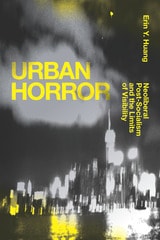
cover of Urban Horror: Neoliberal Post-Socialism and the Limits of Visibility

Urban Horror

Neoliberal Post-Socialism and the Limits of Visibility

Erin Y. Huang

Duke University Press, 2020

In Urban Horror Erin Y. Huang theorizes the economic, cultural, and political conditions of neoliberal post-socialist China. Drawing on Marxist phenomenology, geography, and aesthetics from Engels and Merleau-Ponty to Lefebvre and Rancière, Huang traces the emergence and mediation of what she calls urban horror—a sociopolitical public affect that exceeds comprehension and provides the grounds for possible future revolutionary dissent. She shows how documentaries, blockbuster feature films, and video art from China, Hong Kong, and Taiwan made between the 1990s and the present rehearse and communicate urban horror. In these films urban horror circulates through myriad urban spaces characterized by the creation of speculative crises, shifting temporalities, and dystopic environments inhospitable to the human body. The cinematic image and the aesthetics of urban horror in neoliberal post-socialist China lay the groundwork for the future to such an extent, Huang contends, that the seeds of dissent at the heart of urban horror make it possible to imagine new forms of resistance.
[more]